Author: Noah Kim

  • Everyday AI · Part 4-1 — Self-Driving

    Everyday AI · Part 4-1 — Self-Driving

    “Sir, we’ve arrived at the company parking lot. It’s time to wake up.”

    You open your eyes.

    During the hour-long commute, you never touched the steering wheel. You slept, checked your messages, read the news, and prepared for the day ahead. The car handled the driving.

    This is the change autonomous driving is beginning to create. The significance goes far beyond the convenience of taking your hands off the wheel. Time once consumed by driving is beginning to return to people, along with relief from the constant attention that driving demands.

    AI Began by Assisting Human Drivers

    Autonomous driving did not begin by removing the driver. It began by helping the driver.

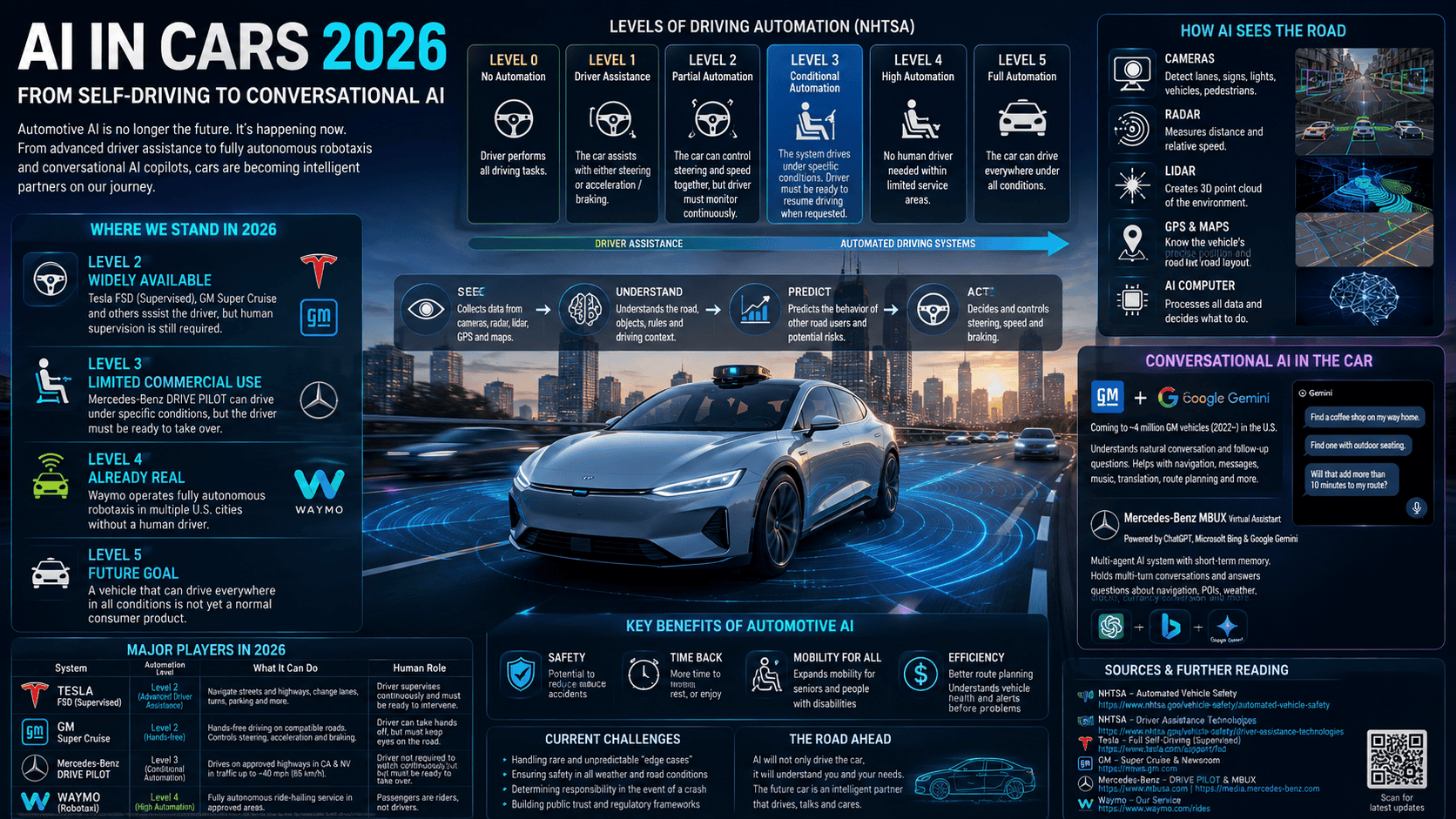
    Today’s vehicles already use AI to maintain lanes, adjust speed, follow navigation routes, change lanes, respond to surrounding traffic, and avoid vehicles and obstacles.

    Tesla’s FSD (Supervised), for example, can perform many parts of the driving task, but Tesla explicitly states that the system requires active driver supervision and does not make the vehicle fully autonomous.

    GM’s Super Cruise also provides hands-free driving on compatible roads. In April 2026, GM said customers had accumulated 1 billion hands-free miles using the system across nearly 750,000 enabled vehicles and 23 models in North America.

    Mercedes-Benz DRIVE PILOT represents another step forward. As a Level 3 conditional automated-driving system, it can perform the driving task under approved conditions, although the human driver must still be able to take over when requested.

    The next stage changes the relationship more fundamentally. Instead of merely assisting the driver, AI begins to take over the driving task itself.

    Waymo already operates Level 4 fully autonomous passenger services within designated operating areas. On September 1, 2026, Waymo began welcoming public riders in Denver, San Diego, and Tampa, bringing the number of cities where it provides fully autonomous trips to 14.

    The direction is clear: AI is advancing from helping humans drive to driving on their behalf.

    At Level 4, the Human Becomes a Passenger

    The difference between Level 2, Level 3, and Level 4 is not simply a matter of better technology. It changes the role of the person inside the vehicle.

    LevelDriver’s RoleAI’s Role
    Level 2Continuous supervisionDriving assistance
    Level 3Takes over when requestedConditional automated driving
    Level 4Driving not requiredAutonomous driving within designated areas

    At Level 2, the human remains responsible for supervising the system. At Level 3, the system can drive under specific conditions, but the human must be ready to take control when requested. At Level 4, within the system’s approved operating environment, the person no longer needs to perform the driving task.

    The driver becomes a passenger.

    Level 5 — a vehicle capable of operating broadly without relying on a human across essentially all roads and environmental conditions — is not yet a mainstream reality. But Level 4 is no longer confined to laboratories or demonstrations. Driverless passenger services are already operating on public roads.

    Driving Time Is Beginning to Return to People

    This change goes far beyond the convenience of not having to hold the steering wheel.

    For decades, driving has required continuous human attention. Commuting, long-distance travel, traffic congestion, and repetitive daily trips consume time that cannot easily be used for anything else.

    Autonomous driving changes that equation.

    An hour-long commute can become an hour of rest. A passenger can read, work, communicate, watch something, or simply sleep while the vehicle handles the road.

    Fully autonomous driving does not eliminate travel time. It transforms time that was once locked into the task of driving into time that people can use for themselves.

    Real-World Crash Data Is Changing the Standard for Autonomous Driving

    The future of autonomous driving will not ultimately be decided by how futuristic the technology looks. The most important test is safety.

    In July 2026, the nonprofit Insurance Institute for Highway Safety (IIHS) published research comparing Waymo Level 4 driverless vehicles with human drivers operating in the same cities and during the same years. The Waymo vehicles accumulated about 50 million miles of driverless operation during the study period.

    Waymo Level 4 vs. Human Drivers

    Crash TypeWaymo ResultCompared With Humans
    Police-reportable crashesLow68% reduction
    Rear-end crashesLow91% reduction
    Injury crashesLow81% reduction

    The IIHS comparison applies specifically to the Waymo Level 4 vehicles and operating conditions included in the study. It does not prove that every autonomous vehicle is safer than every human driver in every situation. That distinction matters.

    But an important threshold is already being crossed: independent research has found that, in some real-world Level 4 operating environments, driverless vehicles have recorded lower crash rates than comparable human drivers.

    More Than 220 Million Autonomous Miles Show a Similar Pattern

    Waymo’s larger dataset points in the same direction.

    In June 2026, Waymo reported safety results covering more than 220 million fully autonomous miles. Compared with human drivers in the same areas and during the same periods, Waymo reported 94% fewer crashes resulting in serious or fatal injuries, 82% fewer airbag-deployment crashes, and 82% fewer crashes involving any reported injury.

    It also reported 93% fewer injury-causing crashes involving pedestrians and 84% fewer involving cyclists and motorcyclists.

    These figures come from Waymo’s own analysis and therefore need to be distinguished from the independent IIHS study. Even so, the independent research and Waymo’s much larger operating dataset point in the same general direction.

    Autonomous-driving AI is entering a stage where its safety record is being compared directly with that of human drivers.

    Safety and Trust Are Separate Problems

    A vehicle can be statistically safer and still feel uncomfortable to the person sitting inside it.

    Experienced drivers develop their own sense of braking distance, cornering speed, lane position, and timing. When a vehicle turns the steering wheel by itself through a curve, a person may understand intellectually that the system is operating normally and still instinctively want to grab the wheel.

    People do not judge autonomous driving only by whether it avoids a crash. They also judge whether the vehicle behaves in a predictable and comfortable way.

    A 2026 on-road Human Factors study followed 30 people during their first ride in a commercially operating fully driverless robotaxi. Researchers measured trust every two minutes.

    Trust generally increased during the ride and then stabilized. Driving style, perceived safety and comfort, interface design, and individual differences all influenced how that trust developed.

    People do not learn to trust autonomous AI simply by hearing explanations. They build trust through experience.

    Robotaxis Are Moving From Experiments to Everyday Transportation

    A separate 2026 study published in Transportation Research Part F followed 64 adults in Shanghai who had never previously used a robotaxi.

    Participants completed baseline measurements, took a commercial Level 4 robotaxi ride, completed a post-ride survey, and were then followed for four weeks using verified app booking records.

    After their first ride, their concerns shifted away from rare technical risks and toward ordinary service factors such as comfort, travel time, and reliability.

    The study reported that 81% of participants shifted toward evaluating the robotaxi more as a transportation service rather than primarily as a source of risk. Their stated intention to use the service again was also associated with verified repeat use four weeks later.

    Driverless vehicles are beginning to move from experimental technology to a form of transportation that people actually use and then decide whether they want to use again.

    If AI Has Fewer Crashes, the Standard for Safety Changes

    For decades, automotive safety technology was primarily designed to compensate for human limitations.

    ABS helped drivers brake more effectively. Lane-keeping systems assisted steering. Automatic emergency braking intervened when a driver failed to react quickly enough. The human remained the final driver.

    That relationship changes if autonomous AI consistently demonstrates lower crash rates than human drivers across more cities, weather conditions, and complex road environments. At that point, AI is no longer simply a safety feature assisting a human driver. AI itself becomes the safer driver.

    Human driving carries familiar risks: fatigue, drowsiness, alcohol impairment, phone distraction, speeding, and momentary errors in judgment. Autonomous systems introduce different risks, including sensor failures, software faults, and unusual road situations that the system may fail to interpret correctly.

    For that reason, it would be inaccurate to claim that AI is already safer everywhere and under every condition.

    But if the safety advantage now appearing in Level 4 operations continues across broader real-world conditions, the standard begins to change.

    Until now, autonomous technology has had to prove that AI can drive as safely as a human. Once it consistently exceeds that threshold, society may increasingly have to ask a very different question: Is keeping a human behind the wheel actually the safer choice?

    People Who Cannot Drive Can Still Move Freely

    For more than a century, using a car independently has generally required the ability to drive one.

    Fully autonomous driving begins to change that relationship.

    Older adults, people with certain disabilities, and people without a driver’s license could travel by car without personally operating the vehicle.

    The ability to use a car and the ability to drive a car no longer have to be the same thing.

    This does not mean driver’s licenses will suddenly disappear. The more important change is that a long-standing requirement begins to weaken: people may no longer need to know how to drive in order to benefit from personal automobile transportation.

    Autonomous driving is therefore more than a new automotive technology. It can expand the number of people who are able to travel independently.

    When the Driver Disappears, Responsibility for Accidents Changes Too

    Removing the human driver creates another major question: Who is responsible when something goes wrong?

    Traditional traffic law and insurance systems were largely built around the assumption that a human driver controls the vehicle. With autonomous driving, responsibility becomes more complicated.

    The vehicle manufacturer, autonomous-driving software developer, sensor and hardware systems, fleet operator, maintenance provider, and other parties can all become relevant when determining why an accident occurred and who bears responsibility.

    AI taking over the driving task therefore changes more than the act of driving itself. It also changes the structure of responsibility surrounding that act.

    Cars Without Human Drivers Change the Meaning of Travel

    When people no longer have to concentrate on operating the vehicle, their role inside the car changes. They become passengers who can use their travel time freely.

    That can also change how automobiles themselves are designed and used.

    The center of transportation shifts from a person driving a vehicle to a destination toward a vehicle carrying a person to that destination.

    This may eventually influence seating layouts, interior design, entertainment systems, work environments, accessibility features, parking patterns, and even the way cities allocate space to vehicles.

    The car begins to change from a machine that a person operates into a mobility space that carries a person.

    FAQ

    1. Are fully autonomous cars already available everywhere?

    No. Level 4 autonomous-driving services currently operate only in designated areas and under defined operating conditions. Most vehicles on the road still require a human driver.

    2. Does Level 4 mean a person never has to drive?

    Within the approved operating conditions of a Level 4 system, a human driver is not required to perform the driving task. Outside those conditions, the vehicle may not be able to operate autonomously.

    3. Are autonomous vehicles already safer than human drivers?

    Some real-world Level 4 data shows lower crash rates than comparable human drivers. However, this does not establish that every autonomous system is safer under every road, weather, and operating condition.

    4. Will driver’s licenses disappear?

    Not in the immediate future. Human-driven vehicles will remain on the road for a long time. But as fully autonomous transportation expands, the ability to use a car may increasingly become separate from the qualification to drive one.

    5. Why is public trust still important if autonomous vehicles are safer?

    People judge more than statistical safety. Comfort, predictability, driving behavior, system transparency, and personal experience all influence whether passengers are willing to trust autonomous vehicles.

    Conclusion — Autonomous Driving Gives Human Time Back

    The moment people no longer have to hold the steering wheel, time once consumed by driving begins to return to them.

    But autonomous driving represents an even larger change.

    For more than a century, the automobile was a machine that moved only when a human drove it. Now we are beginning to move from an era in which humans move cars to one in which cars move humans.

    The real significance of autonomous driving is not simply that AI can turn a steering wheel, follow a lane, or stop at an intersection.

    It is that people can hand the task of driving over to the vehicle and reclaim the time and freedom of movement that were once tied to driving.

    The age of the human driver is not over. But for the first time, we can clearly see what may come after it.

  • Best Foldable Phones in 2026: Galaxy Z Fold8 vs OPPO Find N6 vs HONOR Magic V6

    Best Foldable Phones in 2026: Galaxy Z Fold8 vs OPPO Find N6 vs HONOR Magic V6

    Do people really choose a new smartphone by comparing every processor, AI feature, and technical specification?

    Some do. But for many ordinary buyers, the decision is much simpler.

    “My phone is getting old. Maybe it’s time for a new one.” Then they see something different. “That looks nice. Maybe I should try a foldable.”

    And after using one, they begin discovering the advantages one by one. Open the phone to watch YouTube, and suddenly the video feels much bigger. A message comes in while you are watching, and instead of closing the video and switching back and forth between apps, you can keep the video open and chat beside it.

    “Oh, this is actually convenient.”

    That may be a better way to understand foldable phones in 2026 than studying dozens of specifications. So instead of asking which phone has the longest feature list, let’s compare the Samsung Galaxy Z Fold8, OPPO Find N6, and HONOR Magic V6 from a simpler perspective: What actually makes each one useful in everyday life?

    Samsung Galaxy Z Fold8

    “First of all, it just looks good.”

    The first thing that attracts someone to the Galaxy Z Fold8 may not be the processor. It may simply be the design.

    You are already thinking about replacing your phone. Then you see a foldable in a store or online. “That looks good.” Sometimes that is where the buying decision begins.

    But after using it, the more interesting part is what happens when you open it. Folded, it works like a regular smartphone. Open it, and the screen suddenly becomes much larger. YouTube videos, movies, photos, websites, and documents all have more room.

    Samsung lists a large main display and a cover display for everyday use, while also emphasizing the unfolded screen for video, reading, browsing, and multitasking in its official Galaxy Z Fold8 information.

    Watching a video while chatting is surprisingly useful

    Imagine watching a video when a friend sends you a message. On a conventional smartphone, you might switch to the messaging app and then return to the video.

    On a foldable, you can use the larger screen to keep multiple apps visible. You do not have to be a business user or a multitasking expert to appreciate that.

    Watching a video while chatting, browsing the web while messaging someone, or looking at photos on a larger screen may be enough to make the foldable format feel useful.

    It is lighter than you might expect

    The Galaxy Z Fold8 weighs 201 grams and uses a 4,800mAh battery. Those numbers matter because a smartphone is something you carry every day. You can confirm the current specifications on Samsung’s official product page.

    You do not have to use every feature

    The Galaxy Z Fold8 offers AI features and multitasking tools, but most people will probably never use every one of them. And that is fine.

    If you enjoy watching videos on a larger screen, using two apps at once, browsing websites more comfortably, and looking at photos on a bigger display, you are already using some of the biggest advantages of a foldable phone.

    What is the downside?

    Price is an obvious consideration. Foldable phones also have more complex hinges and flexible inner displays than conventional smartphones, so repairs can be expensive if those parts are damaged.

    But that does not mean you need to treat the phone like a museum piece. It is an expensive smartphone, so use reasonable care. Try not to drop it, keep sharp objects away from the inner display, and follow the manufacturer’s care instructions.

    Who is it for?

    The Galaxy Z Fold8 makes sense for someone thinking: “My phone is getting old, I like the design, and I want to try that larger screen.”

    If you already use Galaxy Watches, Buds, tablets, or other Samsung products, it is also an easy way to enter the foldable market without leaving a familiar ecosystem.

    OPPO Find N6

    “It does many of the same things as the Samsung — so why would I choose OPPO?”

    The basic foldable experience of the OPPO Find N6 is similar. Use it folded like a smartphone. Open it when you want more screen space. Watch videos on the larger display and use multiple apps when needed.

    So the interesting question is not whether it folds. The question is: Why choose the OPPO instead of the Samsung?

    That is where the battery, camera, and crease design become important.

    A bigger battery and a serious camera

    The OPPO Find N6 has a 6,000mAh silicon-carbon battery, compared with the Galaxy Z Fold8’s 4,800mAh battery. It also features a 200MP main camera system developed with Hasselblad.

    For someone who takes a lot of photos and videos, that gives the Find N6 a clearer reason to exist beyond simply being another foldable. OPPO details the battery and camera system in its official Find N6 launch information.

    OPPO also focused heavily on the crease

    Every book-style foldable has to deal with the area where the screen folds. OPPO calls its approach “Zero-Feel Crease.”

    The company says its hinge and display structure are designed to create a flatter-looking fold. That does not mean the physical fold magically disappears. But if the visible or tactile crease has always bothered you about foldable phones, the Find N6 is worth comparing in person. The design is described in OPPO’s official launch announcement.

    It is built to handle everyday use

    OPPO lists IP56, IP58, and IP59 water and dust resistance ratings for the Find N6. The phone weighs 225 grams, which makes it heavier than the 201-gram Galaxy Z Fold8. Buyers who care strongly about weight should compare the two in their hands before deciding.

    Who is it for?

    The Find N6 makes sense for someone thinking: “I want a foldable, but I don’t want to compromise as much on battery or camera.”

    Or: “If I’m spending this much money anyway, I want a big battery and a powerful camera too.”

    The important catch is availability. OPPO availability, carrier compatibility, accessories, warranties, and repair support can vary considerably by country. Check your local market before buying, especially if you are considering an imported model.

    HONOR Magic V6

    “I want a foldable that is easy to carry every day.”

    The appeal of the HONOR Magic V6 is relatively easy to understand. It is thin. It is relatively light. And it still has a very large battery.

    The white version measures approximately 8.75mm when folded and 4.0mm when unfolded, while weighing around 219 grams. For a foldable phone that you carry every day, those numbers are not just specifications. You can actually feel them in your pocket, bag, and hand.

    HONOR lists the dimensions and weight in its official Magic V6 launch information.

    And the battery is actually the largest of the three

    The Magic V6 has a 6,660mAh silicon-carbon battery. That is larger than the 6,000mAh battery in the OPPO Find N6 and the 4,800mAh battery in the Galaxy Z Fold8.

    The large battery inside a thin foldable body is one of the Magic V6’s clearest advantages, and HONOR highlights the battery technology in its official product announcement.

    Thin does not mean low performance

    The Magic V6 uses the Snapdragon 8 Elite Gen 5 platform. So this is not simply a thin phone that sacrifices flagship-level performance to reduce its size.

    For everyday browsing, video, messaging, photography, gaming, and multitasking, it remains a high-end foldable.

    Price needs a little more thought

    It would be misleading to describe the Magic V6 as simply a “cheap foldable.” Pricing varies significantly by country, retailer, and launch promotion.

    Its value becomes much more attractive when strong discounts or launch offers are available. The sensible approach is simple: compare the actual price available to you with the Galaxy Z Fold8 and OPPO Find N6 before buying.

    If the Magic V6 is available at a good price, its combination of performance, battery capacity, thin design, and portability becomes very compelling.

    Who is it for?

    The Magic V6 makes sense for someone thinking: “I want a foldable, but I don’t want to carry a thick and heavy phone every day.”

    Or: “I want something thin and easy to carry, but I still want good performance and a big battery.”

    For those buyers, the Magic V6 has a very clear appeal.

    The Three Phones in Simple Terms

    Phone What You Will Actually Notice Best Fit
    Samsung Galaxy Z Fold8 Attractive design, light 201g body, familiar Galaxy ecosystem, large unfolded screen “I liked the design, and then I discovered how convenient the big screen is.”
    OPPO Find N6 6,000mAh battery, 200MP camera, reduced-crease design “I want a foldable, but I also care a lot about camera and battery.”
    HONOR Magic V6 Thin design, around 219g, 6,660mAh battery, flagship performance “I want a foldable that is easy to carry every day.”

    Why Foldables Are Useful Is Actually Pretty Simple

    You do not need to use every feature on a foldable phone. Most people do not use every feature on a conventional smartphone either.

    They make calls. They send messages. They watch YouTube. They browse the web. They take photos.

    A foldable does the same things. The difference appears when you open it.

    YouTube gets bigger. You can watch a video while chatting with someone. You can browse a website while keeping another app open. Photos are easier to show to friends or family on the larger display.

    These are small conveniences. But when you use your phone every day, small conveniences add up. That may be the real reason foldable phones are becoming more practical.

    What About Expensive Repairs?

    Foldable phones contain hinges and flexible displays that conventional smartphones do not. That makes their construction more complicated, and repairs can be expensive if those parts are damaged.

    But that alone is not a reason to avoid a foldable. If you spend flagship-phone money on any smartphone, you probably already try not to drop it.

    A foldable simply deserves the same common-sense care, with a little extra attention to the inner display. Keep sharp objects away from the flexible screen, do not remove a factory-installed inner-screen protector unless the manufacturer instructs you to, and check the warranty and accidental-damage options available in your country.

    So Which Foldable Should You Buy?

    You do not have to make this complicated.

    Choose the Galaxy Z Fold8 if you like its design, already feel comfortable with Samsung products, and want a light foldable with a large screen that makes everyday activities more convenient.

    Choose the OPPO Find N6 if you want the foldable experience but care strongly about battery capacity, camera performance, and reducing the feel and appearance of the screen crease.

    Choose the HONOR Magic V6 if you want a thin, relatively light foldable that is easy to carry every day while still giving you a very large battery and flagship-level performance.

    The best foldable phone is not necessarily the one with the highest number in every specification.

    It is the one that feels easiest and most enjoyable to use every day.

  • Climate Change · Part 4 — Bering Sea Snow Crabs

    Climate Change · Part 4 — Bering Sea Snow Crabs

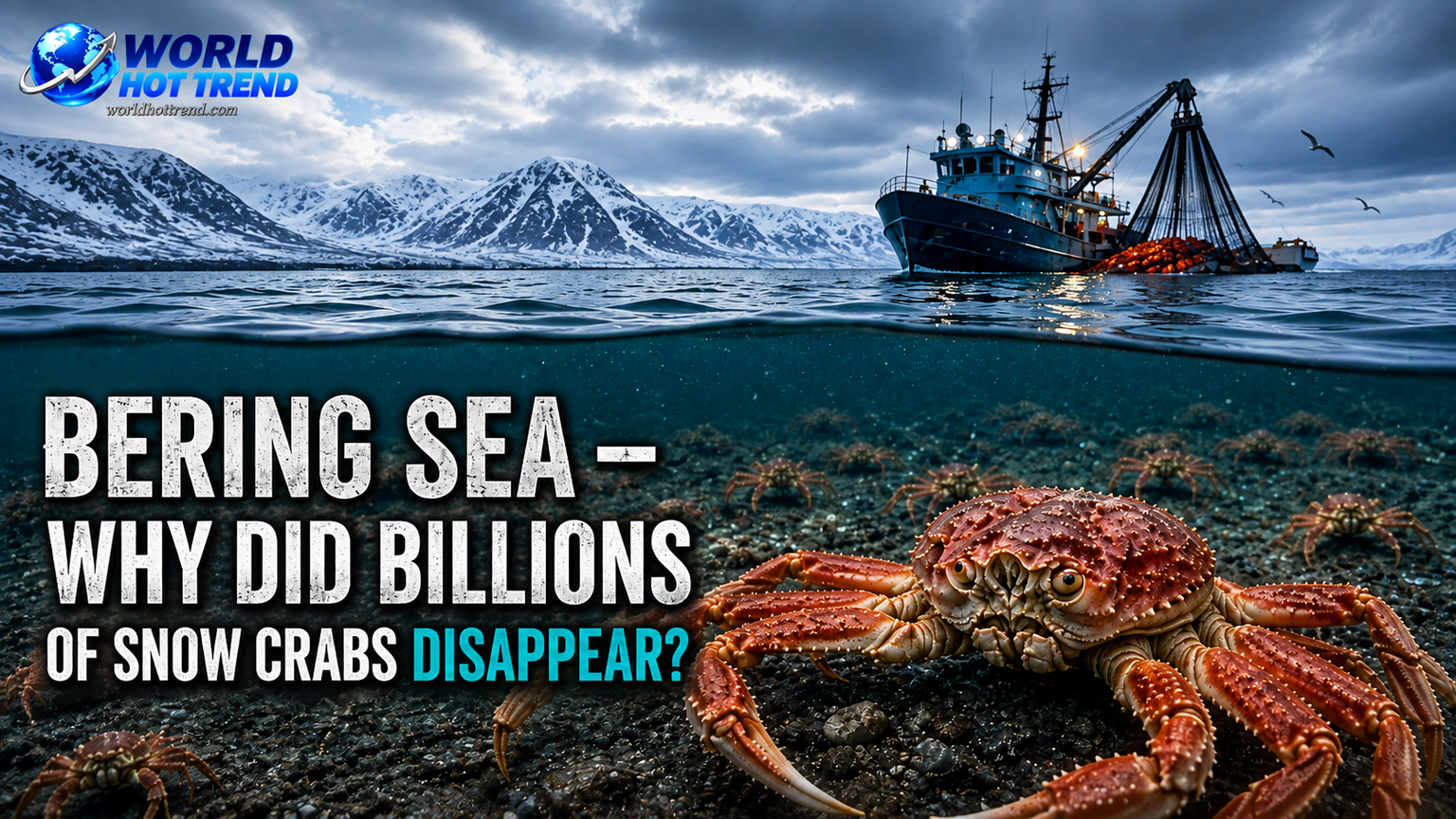
    In 2018, the Bering Sea between Alaska and Russia was home to an enormous population of snow crabs. That year, surveys recorded exceptionally high numbers of the species. Then, within just a few years, the situation reversed.

    More Than 10 Billion Snow Crabs Vanished

    Between 2018 and 2021, more than 10 billion snow crabs disappeared from the eastern Bering Sea. By 2021, survey estimates had fallen to the lowest level recorded since the survey began in 1975.

    At first, there was no simple explanation. Had fishing removed too many crabs? Had predators such as Pacific cod eaten them? Had the crabs migrated somewhere else? Was disease responsible?

    According to NOAA Fisheries, scientists investigated these possibilities one by one. What they eventually found was much bigger than the disappearance of a single species. The sea itself was changing.

    What Happened in the Bering Sea?

    Snow crabs are adapted to cold water. In the Bering Sea, an important part of their habitat has historically been associated with the “cold pool,” a layer of cold bottom water shaped by winter sea ice. This cold environment supports snow crabs and other Arctic species.

    But in 2018 and 2019, the Bering Sea experienced exceptionally warm conditions and a major marine heatwave. Sea ice declined, bottom-water temperatures increased, and the cold Arctic conditions that snow crabs had long depended on weakened.

    According to NOAA Fisheries, the problem was not simply that the water became a little warmer. The conditions that made the Bering Sea suitable for snow crabs were changing.

    The Crabs Did Not Simply Die From Heat

    The evidence does not show that billions of snow crabs simply reached a lethal temperature and died from direct heat exposure. Something more complicated happened.

    Warmer water increased their metabolism. As water temperature rises, snow crabs require more energy to maintain basic biological functions. Laboratory research cited by NOAA found that the caloric requirements of snow crabs nearly doubled as water temperatures increased from 0°C to 3°C.

    According to NOAA Fisheries, a crab living in warmer water needed substantially more food just to survive. At the same time, the cold-water habitat available to the crabs was shrinking.

    They Needed More Food — But Had Less Room to Find It

    As the Bering Sea warmed, suitable cold-water habitat contracted. Large numbers of snow crabs became concentrated into a smaller area. Their energy requirements were rising while competition for food was becoming more intense.

    Researchers also found evidence of declining body condition. Young crabs of similar size were lighter during the heatwave period than they had been before it.

    Scientists investigated other possible explanations, including migration, fishing bycatch and predation. None was large enough to account for the disappearance of billions of crabs. The evidence increasingly pointed toward an energy crisis: the crabs needed more food in warmer water while shrinking habitat increased competition for what was available.

    Starvation emerged as the most likely explanation for the extraordinary mortality. The warmer ocean did not simply cook the crabs. It disrupted the energy balance they needed to survive.

    Then Billions of Snow Crabs Were Gone

    In 2018, scientists had observed historically high numbers of snow crabs. By 2021, roughly 10 billion had disappeared. The commercial fishery collapsed with them.

    According to NOAA, the fishery had been worth roughly $227 million before the collapse. Within two years, that value had fallen to zero.

    Then came a decision without precedent. In October 2022, the Bering Sea snow crab season was canceled for the first time in U.S. history. The following season was canceled again.

    This Was No Longer Just a Problem for Alaska’s Crab Fishermen

    When the fishery stopped, the economic damage did not end with the boats. Fishermen lost income. Processors lost the crab they depended on. Distributors and seafood businesses were affected. Ports and fishing-dependent communities lost revenue.

    A biological collapse beneath the surface of the Bering Sea had become an economic crisis. And soon, the state of Alaska turned to the federal government.

    Alaska Asked Washington to Declare a Disaster

    In 2022, Alaska requested a federal fishery disaster determination for crab fisheries affected by the collapse. In December 2022, the U.S. Department of Commerce approved fishery disaster determinations covering affected Alaska crab fisheries.

    According to NOAA Fisheries, the collapse that began beneath the surface of the Bering Sea had now become an officially recognized federal fishery disaster.

    The Federal Government Stepped In

    Federal recognition was followed by financial assistance. For the 2021–2022 Alaska crab fishery disasters, the federal government allocated approximately $94.6 million. For the 2022–2023 Bering Sea snow crab and Bristol Bay red king crab disasters, approximately $96.7 million was allocated.

    According to NOAA Fisheries, the crisis did not end there. The 2023–2024 Bering Sea snow crab fishery was also approved for federal fishery disaster assistance, with another $39.5 million allocated.

    The Economic Shock of the Snow Crab Collapse

    EventScaleWhy It Matters
    Snow crabs lostMore than 10 billionDecline occurred between 2018 and 2021
    Population declineMore than 90%Abrupt collapse during the marine heatwave period
    Fishery valueAbout $227 million → $0Collapse occurred within roughly two years
    2022 snow crab seasonCanceledFirst cancellation in U.S. history
    Following seasonCanceled againTwo consecutive closures
    2021–22 Alaska crab disaster fundingAbout $94.6 millionFederal disaster assistance
    2022–23 crab disaster fundingAbout $96.7 millionFederal disaster assistance
    2023–24 snow crab disaster funding$39.5 millionAdditional federal assistance

    The numbers tell a larger story. A major American fishery was shut down for the first time in its history. The state asked the federal government for help. The U.S. Department of Commerce formally recognized fishery disasters. Tens of millions of dollars in federal assistance were allocated repeatedly.

    But What Happened to the Sea After the Crabs Disappeared?

    Snow crabs are not simply seafood for humans. They are part of the Bering Sea food web. They consume organisms living on and near the seafloor, while young snow crabs are prey for fish including Pacific cod.

    But it would be too simplistic to say that the disappearance of snow crabs caused the entire Bering Sea ecosystem to change. The evidence points to something larger. The ecosystem itself was already changing. The snow crab collapse was one of the most dramatic consequences of that transformation.

    The Bering Sea Is Becoming a Different Sea

    For decades, the Bering Sea has been strongly influenced by winter sea ice and cold Arctic conditions. But as sea ice declines and bottom temperatures rise, the structure of the ecosystem is changing.

    Scientists call this process “borealization.” In simple terms, an ecosystem dominated by Arctic conditions is shifting toward a warmer, more sub-Arctic state.

    NOAA researchers found evidence of a broad ecological transition involving sea ice, bottom temperatures, plankton and fish communities. Cold-adapted species are losing some of the environmental conditions that historically supported them, while species better suited to warmer waters gain opportunities to expand.

    Climate Change Is Changing Who Can Live in the Sea

    A 2024 study published in Nature Climate Change found that the strongly boreal conditions associated with the snow crab collapse are now roughly 200 times more likely than under the preindustrial climate. The researchers concluded that the rapid borealization of the Bering Sea was more than 98% likely to have been human-induced.

    Climate change does more than raise the temperature of the ocean. It changes which species are best equipped to survive there. In that sense, climate change is changing who gets to live in the Bering Sea.

    What Happens in the Ocean Does Not Stay in the Ocean

    The collapse of Bering Sea snow crabs is not simply the story of one species. It shows how tightly the natural world and the human economy are connected.

    The ocean warmed. The crabs needed more energy. Their cold-water habitat contracted. More than 10 billion snow crabs disappeared. A fishery worth hundreds of millions of dollars collapsed. For the first time in U.S. history, the Bering Sea snow crab season was canceled. Alaska requested federal disaster assistance. The U.S. government officially recognized fishery disasters.

    The deepest scar left in the Bering Sea is not simply the empty space left by billions of missing crabs. It is the possibility that the Bering Sea itself is becoming something fundamentally different from the sea we once knew.

    FAQ

    Did more than 10 billion snow crabs really disappear?

    Yes. NOAA researchers estimate that more than 10 billion snow crabs disappeared from the eastern Bering Sea between 2018 and 2021.

    Did the crabs simply die because the water became too hot?

    No. Warmer water increased their energy requirements while suitable cold-water habitat contracted. Researchers concluded that increased metabolic demand, shrinking habitat and insufficient food likely created severe energetic stress, with starvation playing a major role.

    Could the missing crabs simply have migrated somewhere else?

    Scientists investigated that possibility. Surveys did not find enough crabs farther north or elsewhere to account for the enormous decline. Movement, fishing bycatch and predation were insufficient to explain the disappearance of billions of crabs.

    Did the U.S. government really declare it a disaster?

    Yes. The U.S. Department of Commerce approved federal fishery disaster determinations covering affected Alaska crab fisheries in December 2022, and federal funding was subsequently allocated.

    Was the snow crab season really canceled for the first time in U.S. history?

    Yes. The 2022–2023 Bering Sea snow crab season was canceled for the first time in the history of the fishery. The following season was also canceled.

    How strong is the connection to climate change?

    A 2024 Nature Climate Change study found that the rapid borealization associated with the collapse was more than 98% likely to have been human-induced, and that strongly boreal conditions like those associated with the collapse are now roughly 200 times more likely than under preindustrial climate conditions.

    Are the snow crabs coming back?

    There have been signs of improvement, and the fishery eventually reopened after two consecutive closures. The latest survey provides much clearer evidence of recovery. According to NOAA Fisheries’ 2025 Bering Sea survey, estimated snow crab biomass on the eastern Bering Sea shelf increased by 52% from 2024 to 2025, while the population was estimated at 7.2 billion individuals. NOAA’s 2026 technical memorandum also reports that the recovery signs that began in 2023 continued in 2025 as large juvenile cohorts started reaching maturity. Even so, the recovery is not complete: recruitment into the smallest juvenile size classes remained limited, and the broader long-term shift toward warmer, more boreal conditions remains a major concern.

    What is the most important lesson from the Bering Sea snow crab collapse?

    Climate change should not be understood only as a change in average temperature. A few degrees of warming can change how much energy an animal needs, where it can live, food webs, fisheries and eventually human economies and disaster policy.

  • India Is Getting Rich. But Who Is Getting the Money?

    India Is Getting Rich. But Who Is Getting the Money?

    भारत अमीर हो रहा है। लेकिन पैसा किसे मिल रहा है?

    India is growing at a speed that most major economies can only envy.

    In the April–June quarter of 2026, India’s real GDP expanded 7.8% year on year. Investment jumped 11.9%, household consumption grew 7.1%, and exports increased 12.0%. Official Government of India data show an economy expanding strongly across several major components.

    On paper, the message looks simple: India is booming.

    But there is another question — and it may be more important than the headline GDP number.

    If India is getting richer so quickly, who is actually getting the money?

    India’s Growth Is Real

    It would be misleading to dismiss India’s economic expansion as nothing more than a statistical illusion. There is real money moving through the economy.

    Private-sector capital investment rose sharply in the April–June quarter, while gross fixed capital formation reached about 34.3% of GDP. Corporate spending, factory activity and bank credit also point to genuine economic momentum, according to Reuters.

    Companies are investing. Banks are lending. Factories are producing. Consumers are spending.

    Chart 1 — India’s Growth Engine

    Economic IndicatorYear-on-Year GrowthWhat It Shows
    Exports+12.0%Strong external demand
    Investment+11.9%Rapid capital expansion
    Real GDP+7.8%Fast overall growth
    Household Consumption+7.1%Consumers are still spending
    April–June 2026. Source: Government of India.

    At first glance, this looks like exactly what a rapidly developing economy should look like. But follow the money one step further and the picture becomes more complicated.

    Follow the Money

    Economic growth is supposed to create a chain reaction: Investment → Business Growth → Jobs → Higher Wages → Higher Household Income → More Consumption.

    India is doing very well at the beginning of that chain. Investment is rising, credit is expanding, and manufacturing and services are growing. But the connection between economic growth and large-scale, high-quality employment is weaker.

    The debate became especially visible after the latest growth figures. Former Reserve Bank of India Governor Raghuram Rajan and other economists questioned why such powerful headline growth was not being matched by equally convincing improvements in areas such as job creation and investment. At the same time, other indicators — including automobile sales and bank credit — support the case that the economy is genuinely strong. Reuters’ analysis captures this tension.

    The 15% vs. 15% Problem

    This may be the most revealing comparison in the Indian economy.

    Agriculture produces about 15% of India’s GDP, yet it employs nearly half of the country’s workforce. At the other end of the economy, modern high-value services — including information technology, finance and business services — generate roughly 15% of GDP while directly employing only around 3% of workers, according to an IMF India analysis.

    Chart 2 — Same Share of GDP, Completely Different Share of Jobs

    SectorShare of GDPShare of Workforce
    Agriculture~15%Nearly 50%
    IT, Finance & Modern Business Services~15%~3%
    Source: IMF Finance & Development.

    This comparison explains a great deal about India’s economic paradox. The industries producing enormous economic value employ relatively few people, while one of the industries employing the most people produces far less value per worker.

    India has built globally competitive technology companies, financial services and business-service centers. But many of these sectors are capital-intensive or skill-intensive. They can create enormous economic value without creating employment on the scale that India’s population requires.

    So Who Benefits First?

    When an economy has this structure, growth does not reach everyone at the same speed.

    Large corporations connected to infrastructure, manufacturing, finance and expanding private investment can benefit relatively quickly. Highly skilled workers in technology, finance and professional services are positioned inside some of the economy’s most productive sectors. People who own businesses, stocks, property or other financial assets also have additional channels through which expansion can increase wealth.

    But hundreds of millions of people working in agriculture, informal employment and lower-productivity sectors experience a different economy. The same IMF analysis notes that more than 85% of India’s workforce remains in informal employment.

    That does not mean these workers receive no benefit from growth. It means the benefits travel through the economy at very different speeds.

    A 7.8% Economy Does Not Mean a 7.8% Pay Raise

    When a country’s GDP rises 7.8%, it does not mean the income of every household rises 7.8%. GDP measures economic production across the entire economy. A household experiences the economy through wages, job security, food prices, housing costs and the money left after necessities are paid.

    Food prices are an especially important part of that experience. Official Government of India inflation data reported consumer inflation of 4.45% in July 2026 and food inflation of 5.52%. Rural inflation was higher than urban inflation, at 4.84% versus 3.96%.

    For a wealthy household, higher food prices may be irritating. For a lower-income household, they can fundamentally change the monthly budget. That is one reason headline GDP growth and economic sentiment can move in different directions.

    Chart 3 — Where the Money Flows

    StageWhat Is Happening?Who Feels It First?
    Government & Infrastructure InvestmentStrongConstruction and infrastructure companies
    Private InvestmentRising stronglyCorporations, manufacturers and investors
    Banking & CreditExpandingBusinesses and borrowers
    High-Value ServicesHighly productiveSkilled urban workers
    Large-Scale Quality JobsNot keeping pace with outputThe broader workforce waits longer
    Household IncomeUnevenDepends heavily on sector and job
    Food & Living CostsRisingLower-income households feel it most
    Based on Government of India, IMF and Reuters reporting.

    This Does Not Mean Ordinary Indians Are Getting Poorer

    The evidence does not support the simplistic claim that India’s rich are taking everything while everyone else is becoming poorer. Household consumption grew strongly in the April–June quarter, while automobile sales, bank lending and other indicators point to genuine economic activity. Reuters’ GDP report reflects that broader strength.

    The issue is not whether prosperity exists. The issue is how broadly and how quickly that prosperity spreads.

    India has successfully created world-class technology and services businesses and is investing heavily in infrastructure and manufacturing. But transforming that success into higher productivity and better incomes for hundreds of millions of workers requires moving people from low-productivity activities into more productive jobs.

    The Job Question May Matter More Than the GDP Question

    India’s young population can be an enormous economic advantage, but a young population becomes an economic dividend only when young people can move into productive employment. Otherwise, millions of new workers enter the labor market competing for too few high-quality jobs.

    The IMF’s examination of India’s rise identifies job creation and productivity as central structural challenges. That changes the question from simply “Can India keep growing at 7%?” to “How many productive jobs can India create while doing it?”

    Can We Trust the 7.8% Number?

    There is also a legitimate debate about measurement. India recently introduced a new GDP series with a new base year, additional data sources and more detailed price measures. Critics have questioned whether the revised methodology makes real growth appear stronger than underlying economic conditions suggest, as detailed by Reuters.

    India’s Statistics Secretary Saurabh Garg rejected the suggestion that the revisions were designed to inflate growth. He said the changes reflect improved data and methodology, including more detailed price deflators, and noted that revisions have moved in both directions, according to Reuters.

    But even if the 7.8% figure is completely accurate, the fundamental question remains: How does that growth eventually reach the lives of more than a billion people?

    What Could India Do?

    India does not need less growth. It needs growth that reaches more people through productive jobs, stronger wages and broader opportunity.

    1. Create More Labor-Intensive Manufacturing Jobs

    India needs industries capable of absorbing workers leaving low-productivity agriculture at scale. Expanding labor-intensive manufacturing can create a bridge between rural work and higher-productivity employment while spreading the benefits of investment beyond capital-intensive sectors.

    2. Help Small and Mid-Sized Businesses Grow

    Large corporations and high-value technology companies cannot create enough jobs on their own. Easier access to finance, simpler regulation and stronger local business ecosystems can help smaller firms expand and hire more workers across India.

    3. Connect Skills Training to Real Jobs

    India’s young population becomes an economic advantage only when education and vocational training lead to productive employment. Training programs need to match the skills actually demanded by manufacturing, logistics, construction, technology and modern services.

    4. Measure Success Beyond GDP

    Headline GDP growth remains important, but it should be read alongside job creation, real wage growth, household purchasing power and movement from low-productivity work into higher-productivity employment. Those indicators show whether national growth is reaching ordinary families.

    India does not need less growth. It needs growth that creates more jobs, raises more wages, and reaches more families.

    India Is Getting Richer

    India’s rise should not be underestimated. Its companies are investing. Its infrastructure is expanding. Its manufacturing ambitions are growing. Its services sector is globally competitive. Its consumers are spending more.

    But a country becoming richer and every citizen becoming richer at the same pace are two very different things.

    Corporate profits are not wages. GDP is not household income. A booming stock market is not a better job. And national economic growth does not automatically put more food on every family’s table.

    That is why the next phase of India’s economic story will not be decided by GDP alone. Watch the number of productive jobs being created. Watch wages. Watch whether workers move out of low-productivity agriculture. Watch household purchasing power. And watch whether India’s extraordinary economic growth produces a much larger middle class.

    Because ultimately, the most important question facing one of the world’s fastest-growing major economies is no longer simply: How fast is India getting richer?

    Who Is Getting the Money?

    पैसा किसे मिल रहा है?

    FAQ

    1. Is India’s economy really growing as fast as the headline numbers suggest?

    Yes. Investment, consumption, exports, manufacturing activity and credit data all show genuine economic momentum. However, strong GDP growth does not mean that every worker or household experiences the same rate of income growth.

    2. Why can people feel financially pressured when India’s GDP is growing strongly?

    GDP measures total economic output, not an individual household’s purchasing power. Wages, job quality, food prices, housing costs and employment security determine how growth feels in everyday life. When living costs rise faster than a household’s income, strong national growth can still feel distant.

    3. Which parts of India’s economy benefit most directly from current growth?

    Large companies, infrastructure and manufacturing businesses, financial markets, investors and highly skilled workers in technology and professional services are positioned close to some of India’s fastest-growing and most productive sectors. Workers in agriculture and informal employment may experience the benefits more slowly.

    4. What will determine whether India’s growth reaches more ordinary households?

    The key test is productive job creation. India needs more workers to move from low-productivity activities into higher-productivity manufacturing and services, accompanied by stronger wages and household purchasing power. The long-term success of India’s growth story will depend not only on how fast GDP rises, but on how widely the resulting prosperity spreads.

  • AI Is Hitting the Power and Water Wall — Can the Next Generation of Chips Break Through?

    AI Is Hitting the Power and Water Wall — Can the Next Generation of Chips Break Through?

    AI is invisible to most of us. We type a question into a phone or computer and receive an answer seconds later. But behind that short response, thousands of AI chips are working inside enormous physical facilities.

    Those chips need electricity. Electricity produces heat, and removing that heat requires more power, cooling equipment and, in some data centers, water.

    That has pushed a surprisingly simple question into the center of America’s AI debate: How much water does one ChatGPT query use?

    OpenAI CEO Sam Altman has estimated that an average ChatGPT query uses about ChatGPT water-use estimate. That is a tiny amount on an individual basis. If a person drinks about two liters of water a day, 0.32 milliliters is roughly one-six-thousandth of that amount.

    But the tiny number triggered a much bigger question. What happens when hundreds of millions of people use AI repeatedly, while giant data centers keep expanding across the United States?

    A Tiny Drop Sparked a Much Bigger Debate

    The controversy is not really about a few drops of water behind a single prompt. It is about scale, location and infrastructure.

    In July 2026, Reuters data-center protests over the rapid expansion of AI-driven data centers. Residents raised concerns about water use, environmental impacts, pressure on local resources and whether communities were receiving enough benefits in return.

    That does not mean Americans have simply turned against AI. Much of the dispute is about how data centers are built: how much water and electricity they use, how transparent developers are, where facilities are located and how local communities share the costs and benefits.

    The real question is becoming less about whether AI should exist and more about whether the infrastructure supporting it can grow sustainably.

    Electricity May Be an Even Bigger Constraint

    Water is only part of the story. AI data centers also require extraordinary amounts of electricity.

    In September 2026, Reuters U.S. data-center power, more than ten times the estimated current electricity use of all U.S. data centers. Not all of those projects will be built. Some developers apply for grid connections in multiple places or submit requests before financing is secure, creating what utilities call “ghost demand.”

    Texas responded by halting new data-center grid connections while auditing projects. Other states are also tightening requirements.

    Even after speculative requests are removed, the underlying problem remains: AI requires more than GPUs. It needs power plants, transmission lines, transformers, cooling systems and, depending on the cooling design, water.

    AI is becoming a physical infrastructure industry as much as a software industry.

    So Should We Slow Down AI?

    That is not where the industry is heading.

    AI is already spreading beyond chatbots into smartphones, business software, medicine, scientific research, manufacturing, cars and robotics. The more realistic question is no longer, “Should we use AI?”

    It is: “How can we run the same AI with less electricity and less water?”

    The AI Chip Race Is Changing

    For years, AI chip competition was dominated by raw computing performance: faster processors, more transistors and larger models.

    Now energy efficiency is becoming just as important. In May 2026, TSMC AI chip-design report. The company highlighted advanced packaging, chip stacking and photonics as important paths forward. Its A14 generation, expected in 2028, is projected to use up to 30% less power at the same speed than its N2 technology.

    The key metric is shifting from simply “How fast is the chip?” toward “How much performance can it deliver for each watt of electricity?”

    AI Uses Energy to Move Data, Not Just to Calculate

    There is another major energy problem inside modern computing systems: moving data.

    Memory and processors are traditionally separated. AI systems repeatedly fetch data from memory, process it and write results back. As models grow, this constant movement becomes increasingly expensive in both energy and time.

    That is why researchers are developing in-memory computing: bringing memory and computation closer together so less data has to travel.

    Then Comes Light

    Photonics takes the idea further by using light for some data transmission and computation instead of relying entirely on electrical signals.

    AI data centers move enormous amounts of information between GPUs, memory and servers. As those systems scale, conventional electrical interconnects face growing bandwidth and energy limits. Silicon photonics and optical interconnects can move large amounts of data using light.

    This is no longer only a laboratory concept. In July 2026, GlobalFoundries CHIPS R&D to advance next-generation silicon photonics, optical materials, wafer technologies and advanced packaging, including near-packaged and co-packaged optics.

    What About “Optical Memory”?

    Researchers are also exploring ways to combine photonic computing with memory located close to the computing unit.

    A 2026 Nature photonic-computing study demonstrated a design that reduces repeated long-distance data movement. The researchers’ analysis found more than 26× power savings compared with conventional SRAM-DAC architectures for that specific architecture.

    That does not mean an entire data center would suddenly use one twenty-sixth of the electricity. It is an architecture-specific research result, not a whole-data-center power reduction.

    Nor does it mean today’s GPUs are about to be replaced by optical-memory chips. Much of this technology remains at the research and development stage. What matters is the direction: future AI hardware is increasingly being designed to reduce data movement and deliver more computation per unit of energy.

    Lower-Power Chips Can Also Ease the Cooling Burden

    Energy efficiency matters for another reason. Electricity consumed by computing equipment ultimately contributes to heat that cooling systems must remove.

    If the same AI workload can be processed with less power, the heat load can also be reduced. That can ease the burden on cooling infrastructure.

    But chip efficiency is only half of the solution. Cooling technology itself is changing.

    Instead of Evaporating Water, Keep It Circulating

    Microsoft is one example. Its Microsoft data-center cooling that avoids water evaporation for cooling. Microsoft says the design can avoid more than 125 million liters of water per year per data center compared with designs that depend on evaporative cooling.

    This changes the water debate. The fact that some data centers consume substantial amounts of water today does not mean future data centers must use the same cooling architecture.

    There is still a trade-off. Mechanical or water-saving cooling approaches can require more electricity in some conditions. The real goal therefore is not simply “zero water.” It is to optimize water and electricity together, taking local climate, water availability and grid conditions into account.

    AI’s Problems Are Creating New Industries

    There is an interesting paradox here.

    AI consumes too much electricity, so the market needs more efficient chips. AI produces enormous heat, so the market needs advanced liquid cooling. Data movement becomes a bottleneck, so silicon photonics becomes more valuable. Power supply becomes constrained, so utilities need more generation, transmission equipment and transformers.

    In other words, AI’s bottlenecks are creating new technology markets.

    What America’s Water Debate Really Means

    Return to the number that helped focus public attention: roughly 0.32 milliliters of water for an average ChatGPT query, according to Altman’s estimate.

    On its own, it sounds almost trivial. But at global scale, the debate changes. The important question is not whether one prompt uses a few drops. It is whether the infrastructure behind billions of AI interactions can expand without overwhelming local water supplies, electricity grids and communities.

    The answer does not have to be “stop AI.”

    The industry is already trying to use less power per computation, reduce data movement, shift some connections from electricity to light, develop new memory architectures, circulate cooling water instead of evaporating it and build new power infrastructure around AI data centers.

    The Next AI Race Is About Efficiency

    The first AI race was about bigger models. The next was about securing more GPUs.

    Now another race is emerging: Who can deliver the same intelligence with fewer resources?

    Less electricity for the same computation. Less energy spent moving data. Less water required to remove heat.

    Water and power constraints are real, especially for communities located near large data-center projects. Transparency, careful site selection, responsible infrastructure planning and local accountability remain necessary.

    But those constraints may reshape AI more than stop it.

    The next breakthrough in AI may not be only about making AI more powerful. It may be about making intelligence dramatically more efficient.

    FAQ

    1. How much water does one ChatGPT query actually use?

    Sam Altman has estimated that an average ChatGPT query uses about ChatGPT water-use estimate. The figure is an average estimate and was not published with a detailed methodology, so it should not be treated as a precise measurement for every model, prompt or data center. The larger concern is aggregate use at massive scale.

    2. Are U.S. data-center protests simply anti-AI protests?

    No. The concerns documented by Reuters include water use, environmental impacts, pressure on local resources, accountability and whether communities receive meaningful benefits. The debate is as much about infrastructure and local governance as it is about AI.

    3. Can photonic chips and optical memory solve AI’s power problem?

    They are promising technologies, but they are not immediate replacements for today’s GPUs. A Nature Communications study reported more than 26× power savings for a specific neuromorphic photonic architecture with co-located analog memory compared with conventional SRAM-DAC architectures. That result applies to the studied architecture, not to the electricity consumption of an entire data center.

    4. Will water and electricity shortages stop AI growth?

    They are major constraints, but the current industry response is largely to make AI infrastructure more efficient, according to TSMC energy-efficient chips, while companies and researchers are investing in photonics, new memory architectures, advanced cooling and power infrastructure. These constraints are increasingly becoming drivers of the next wave of AI engineering.

  • BTS · Part 2 — Global ARMY

    BTS · Part 2 — Global ARMY

    Editor’s focus: This story is about ARMY — why fans travel long distances, wait through years of separation and experience a BTS concert as both a performance and a reunion. For the story of how BTS became a global phenomenon, see our previous article.

    On the night of September 1, 2026, SoFi Stadium in Inglewood, near Los Angeles, once again became a BTS stage.

    This concert is difficult to treat as just another stop on a world tour.

    It is part of BTS’s first full-group tour after the members completed their military service, and it marks their return to a major Los Angeles stadium stage after nearly five years. The Los Angeles Times concert review described the SoFi opener as the beginning of a four-night stand on BTS’s first tour since the members completed their mandatory South Korean military service.

    But the most interesting question surrounding this return is not whether BTS is still famous.

    Yet tens of thousands of people still scream for them. Fans travel from other cities and countries to see them. Some prepare a member’s birthday as if it were their own celebration. Others waited years simply to see all seven members standing together again.

    The question is no longer how BTS became successful, but why people are still so powerfully drawn to them.

    The Los Angeles performances offered a surprisingly clear answer.

    Fans Came for a Reunion, Not Just a Concert

    If this tour is treated like an ordinary world tour, an important part of the story disappears: waiting.

    For a long period, BTS could not perform as a full group while the members completed their military service. Fans interviewed by CBS Los Angeles made it clear that the return itself carried enormous emotional meaning.

    Some were not simply coming to hear new songs. They had been waiting to see all seven members standing together again.

    One fan traveled roughly 20 hours from the Philippines with her 80-year-old father to attend the Los Angeles event. CBS Los Angeles also reported that the four SoFi Stadium shows were sold out and featured fans celebrating Jung Kook’s birthday before the first concert, according to CBS Los Angeles.

    For many people in the stadium, this was more than a tour supporting a new album. It was the experience of meeting people again after a long separation.

    “It Feels Like a Big Family”

    One fan interviewed by CBS Los Angeles compared the atmosphere surrounding BTS to a big family. The fan described people who may arrive as strangers but feel like relatives reconnecting around the same shared interest.

    This helps explain something important about BTS fandom. At a concert with a powerful fan community, people do not come only to see the artist. They also come to meet other fans.

    They coordinate clothing, prepare fan items, organize birthday events, exchange information and begin conversations with strangers. The concert experience can begin while fans are traveling to the venue.

    Fans are not only spectators. They participate in creating the event.

    Why Travel Thousands of Miles for BTS?

    Long-distance concert travel makes little sense if a ticket is viewed only as two hours of entertainment. For committed ARMY, the trip can carry several meanings at once: seeing all seven members together, marking the end of a long wait, meeting other fans and taking part in a shared moment that may not happen again in the same form.

    That helps explain why the journey itself becomes part of the memory. Flights, hotels, queues, fan projects and conversations outside the stadium are not merely costs surrounding the concert. They become part of the experience fans believe they are sharing with BTS and with one another.

    Seven Members Create More Than Seven Individual Fandoms

    A new listener may first become interested because of one member. But many long-term fans eventually begin paying attention to the relationships among all seven.

    They notice who teases whom, who supports another member and how the members react to each other after so many years together. BTS therefore offers both individual personalities and another identity created by the relationship among all seven.

    Fans do not only follow music releases. They can also follow the continuity of the relationship itself.

    Perfect Superstars and Familiar People at the Same Time

    The Los Angeles Times described a stadium-scale production built on precise choreography, video, lighting and pyrotechnics. But the review also highlighted the freer later moments when the members joked, laughed and reacted to the crowd.

    September 1 was Jung Kook’s 29th birthday. Fans arrived wearing birthday hats, the members placed a crown on him and tens of thousands joined the celebration.

    That contrast is central to the fan relationship. People can admire polished global stars while also becoming attached to moments when the seven members appear spontaneous and familiar.

    People admire perfect stars. They often stay longer with stars who still feel human.

    Why a Stadium of 70,000 People Can Still Feel Personal

    SoFi Stadium seats approximately 70,000 people and can expand to 100,000 for special events, according to SoFi Stadium.

    At that scale, the physical distance between artist and audience is huge. Yet repeated interaction can make the audience feel less anonymous. The members ask questions, listen to the roar, react, laugh and turn back to the crowd.

    The audience itself becomes part of the performance. A BTS concert can feel less like “We perform. You watch.” and more like “We make this space together tonight.”

    Emotion Arrives Before Translation

    Fans do not need to understand every Korean sentence to recognize laughter, teasing, affection, reunion or a birthday celebration. Dance, facial expression, tone of voice and relationships communicate before every word is translated.

    This is one reason the bond can cross language barriers without requiring BTS to erase its Korean identity.

    ARMY Loyalty Is Built From Participation, Memory and Belonging

    The strongest explanation for long-term fandom is not a single song, performance or social-media campaign. It is the accumulation of shared experiences.

    Fans remember eras of music, concerts, member interactions, periods of separation and the full-group return. They also build friendships and rituals with other fans. Over time, following BTS can become connected to personal memories and a sense of belonging.

    That does not mean every fan experiences BTS in the same way. It explains why the fandom can remain durable even when the group is temporarily absent from the stage.

    What the Los Angeles Shows Reveal About ARMY

    Fan experience What appeared in Los Angeles Why it matters
    Long-distance travel Fans arrived from other cities and countries The concert becomes a destination and milestone
    Waiting and reunion All seven members together after military service Years of waiting add emotional weight
    Community Fans described the atmosphere as a big family Belonging extends beyond the artist
    Participation Birthday events, fan items and crowd interaction Fans help create the event
    Seven-member chemistry Teasing, laughter and spontaneous interaction Fans follow relationships as well as music
    Shared memory A major full-group return The event becomes part of a longer personal story

    Not Every Local Reaction Is Positive

    A global fan event also creates costs for the surrounding city. CBS Los Angeles reported concerns from residents near SoFi Stadium about serious traffic congestion during the BTS concert dates. For fans, the concert is a celebration; for nearby residents, it can mean road closures and delays.

    This does not explain ARMY loyalty, but it shows the physical scale created when a highly mobile international fandom gathers in one place.

    This article focuses on a different question: why BTS fans keep waiting, traveling and returning long after the group became a global phenomenon.

    FAQ

    Why do BTS fans travel so far for concerts?

    For many fans, a BTS concert combines a live performance with reunion, community and a shared milestone. The 2026 Los Angeles shows carried additional meaning because all seven members were together again after military service.

    Did fans really travel internationally to the Los Angeles shows?

    Yes. CBS Los Angeles reported, among other examples, a fan who traveled roughly 20 hours from the Philippines with her 80-year-old father.

    Why is the relationship among the seven members important to fans?

    Fans can enter through an individual member but remain interested in the chemistry, support, humor and history shared by all seven. That gives the fandom an ongoing story beyond individual songs.

    Is ARMY only about BTS?

    No. Fan-to-fan relationships are an important part of the experience. Fans exchange information, organize events and projects, meet at concerts and describe the community itself as a source of belonging.

    Conclusion

    The most revealing fact about the Los Angeles shows is not simply that BTS can still fill a stadium.

    It is that people are willing to cross borders, spend days traveling and wait through years of separation to be there when seven members stand together again.

    ARMY loyalty is sustained by more than music. Performance attracts attention, but participation turns a show into a shared event. The members’ chemistry gives fans an ongoing human story. Waiting creates anticipation. Reunion gives that waiting meaning. And the fan community allows people to belong to something larger than a single concert.

    That is why thousands of miles can feel worth traveling: for many fans, they are not simply going to see BTS. They are going back to a community, a shared history and a moment they have been waiting to experience together.

  • BTS · Part 1 — Global Phenomenon

    BTS · Part 1 — Global Phenomenon

    In September 2026, Los Angeles is turning into BTS territory.

    Global superstars perform in Los Angeles all the time. But this time, the city itself has joined the celebration. Los Angeles officially designated September 1 through 8 as BTS Week as the group brings its ARIRANG World Tour to SoFi Stadium. City Hall is also being illuminated in red, the key color associated with the ARIRANG album. Mayor Karen Bass said the proclamation reflects a belief in the power of art and culture to connect communities and recognized BTS for its contributions to global culture, according to KBS World

    BTS is scheduled for four Los Angeles shows on September 1, 2, 5 and 6, all beginning at 8 p.m. local time, according to SoFi Stadium

    That raises a bigger question: Why would one of the world’s entertainment capitals dedicate an entire week to seven artists who began their career in South Korea? To understand why Los Angeles is celebrating BTS today, it helps to go back to how the group reached the world in the first place.

    From Seven Young Korean Artists to Global Superstars

    BTS debuted on June 13, 2013. Their rise was not an overnight leap from Korea to global stadiums. It was a series of breakthroughs built over years through music, performance, direct communication and an increasingly international fan network. By 2015, BTS had entered the Billboard 200. In 2016, Wings climbed to No. 26, then the highest position for a K-pop album at the time. In 2017, the group’s global breakthrough accelerated dramatically.

    That year BTS became the first K-pop group to win Top Social Artist at the Billboard Music Awards. Love Yourself: Her reached No. 7 on the Billboard 200, while “DNA” became BTS’s first song to enter the Billboard Hot 100. The group then performed at the American Music Awards, putting seven Korean artists before one of American pop culture’s largest television audiences, according to Yonhap News Agency

    In 2018, another barrier fell. Love Yourself: Tear became the first album by a Korean act to reach No. 1 on the Billboard 200, and “Fake Love” became the first K-pop group song to enter the Billboard Hot 100 Top 10. By 2020, “Dynamite” had taken BTS to No. 1 on the Hot 100, followed by more chart-topping singles and Grammy nominations. The progression matters because it shows that BTS did not simply become famous through one viral song. Their international audience expanded step by step until the group moved from K-pop success to mainstream global pop culture, according to Yonhap News Agency

    The Music Came First: Stories Fans Could Recognize

    Technology helped BTS travel farther, but technology alone does not explain why people stayed. Their songs repeatedly explored anxiety, failure, dreams, loneliness, pressure, youth and self-acceptance. Those themes gave international listeners an emotional entry point even when they did not speak Korean.

    In a 2018 interview, BTS leader RM pushed back against the idea that social media alone explained the group’s success. He emphasized the quality of the music and performance, the sincerity of the group’s messages and frequent communication with fans. Suga similarly argued that reducing BTS’s rise to social-media skill missed the substance of what the group was trying to say through its music, according to Yonhap News Agency

    The language was different. The emotions connected.

    The Internet Changed the Way BTS Reached the World

    For decades, becoming a truly global music star usually depended heavily on major record labels, radio networks and television in the United States and Europe. YouTube, social media and streaming changed that structure.

    BTS and Big Hit were unusually active online from the group’s early years. Videos, behind-the-scenes material and direct messages allowed fans outside Korea to encounter the members without waiting for traditional Western media to introduce them. A video released in Seoul could be watched almost immediately in New York, London, São Paulo or Tokyo.

    The importance of that digital relationship became impossible to ignore in 2017. BTS won Billboard’s Top Social Artist award against established global stars, a moment that demonstrated how large and organized its international audience had already become. Social media did not create the music, but it removed many of the old geographic barriers between BTS and potential listeners.

    ARMY Turned Attention Into a Global Network

    It is difficult to explain BTS’s global rise without ARMY. Fans became more than consumers of albums and concert tickets. Across languages and borders, they translated interviews and lyrics, shared performances, organized online activity and introduced BTS to new audiences.

    That created a powerful feedback loop. BTS communicated directly with fans; fans translated and distributed that content; new listeners discovered the group; and a larger international community formed around the music. Academic research has since examined ARMY as a transnational social-media network, while studies of BTS’s success have highlighted the interaction among the group, Big Hit and the fandom, according to ScienceDirect study

    By the time American television, awards shows and mainstream media were paying close attention, BTS had already built something unusually valuable: a global audience that did not depend entirely on traditional gatekeepers. The music created identification, digital platforms created access, and ARMY accelerated distribution. Together, those forces help explain how seven Korean artists crossed from a domestic debut into global pop culture.

    If the Beatles Moved Stadiums, BTS Moves Cities

    Once BTS became a global phenomenon, the scale of that fandom began to appear not only on charts but in the physical world. That naturally invites comparison with another group that transformed popular music fandom: The Beatles.

    On August 15, 1965, the Beatles performed at New York’s Shea Stadium before a then-record crowd of about 55,600 people. Tickets cost between $4.50 and $5.65, and the show grossed about $304,000, with the Beatles receiving $150,000. MLB’s history of the event describes it as a watershed moment that established a new sense of scale for live popular music, according to MLB

    It would be misleading to compare the Beatles and BTS simply by converting ticket revenue into today’s dollars. The two groups belong to different eras, with different touring industries, travel patterns, media systems and data collection methods. The more revealing comparison is how far the economic influence of fandom now extends beyond the stadium.

    Sixty Years Later, the Concert Economy Extends Beyond the Venue

    Today, fans cross cities and national borders for major concerts. They buy airline tickets, book hotels, eat at restaurants, shop and visit local attractions. That means the economic impact of a concert can spread far beyond ticket sales.

    BTS’s 2026 concerts in Busan provide unusually clear evidence. South Korea’s Ministry of SMEs and Startups analyzed local business sales around the June 12 and 13 ARIRANG concerts. Across the four-week period spanning two weeks before and after the shows, Busan small-business sales increased 3.6% year over year. On the concert days, sales were 11.1% higher than a year earlier.

    The strongest signal came from international visitors. Foreign spending in Busan increased 71.7%. Accommodation spending by foreign visitors rose 148.1%, restaurant spending rose 72.3%, and convenience-store spending rose 71.0%. The ministry said the analysis demonstrated with data the economic ripple effect that large-scale cultural content such as K-pop concerts can have on small businesses and neighborhood commercial districts, according to Ministry of SMEs and Startups

    ComparisonThe BeatlesBTS
    Representative era1960s2020s
    Fandom phenomenonBeatlemaniaARMY
    Landmark example1965 Shea StadiumARIRANG World Tour
    Common economic measuresAttendance and ticket revenueConcerts, hotels, food, shopping and tourism
    Media environmentTV, radio and newspapersYouTube, social media and streaming
    Measured impactPrimarily venue-centered historical dataVenue, local commerce and tourism data

    If the Beatles helped demonstrate the new scale of the stadium concert, BTS shows how a global fandom can extend the concert economy into the city around it.

    How Is the World Evaluating BTS?

    Instead of simply saying that BTS is influential, it is more useful to look at what host cities and public officials are actually doing and saying as the tour arrives.

    Los Angeles: A Full BTS Week

    Los Angeles designated September 1 through 8 as BTS Week. Mayor Karen Bass said the proclamation reflects the belief that art and culture can foster mutual understanding and unite communities, while recognizing BTS’s contribution to global culture and its special connection with Los Angeles. The Los Angeles City Council also described BTS as one of the most influential artists of this generation and highlighted the group’s role in opening doors for Korean and Asian artists in the global music industry, according to SBS News

    Toronto: BTS Boulevard and BTS Weekend

    Toronto went even further with a visible citywide welcome. The city temporarily designated a section of Yonge Street from North York Boulevard to Finch Avenue as BTS Boulevard, with the designation remaining through September 23. Toronto also proclaimed August 22 and 23 as BTS Weekend and illuminated the Toronto Sign in purple. The city noted that the two sold-out concerts were drawing thousands of fans from across Canada and around the world, according to City of Toronto

    Why Do Cities Welcome BTS?

    Viewed separately, BTS Week, BTS Boulevard and a spike in Busan business sales can look like unrelated news stories. Put them together and a pattern appears.

    When fans travel, transportation moves. When they arrive, hotels fill. When they walk through a city, restaurants and shops gain customers. When tens of thousands gather for a concert, tourism and global media attention follow.

    For a host city, a major global concert is no longer just a music event. It can also be tourism, consumer spending, cultural diplomacy and international city promotion at the same time.

    From Seven Korean Artists to a Global Phenomenon

    The path from BTS’s 2013 debut to BTS Week in Los Angeles did not come from a single breakthrough. Music and performance created the foundation. Personal themes helped listeners identify with the group. Digital platforms gave BTS direct access to people outside Korea. ARMY translated that connection across languages and borders. Billboard breakthroughs and major American stages then made an already-growing global audience impossible for the mainstream music industry to ignore.

    That is why the story now extends beyond charts. Fans cross borders, stay in hotels, visit restaurants and shops, and turn concerts into citywide events. Cities proclaim BTS Week. Streets become BTS Boulevard. Public agencies can now measure the spending effects of fandom in real time.

    BTS has become a vivid example of what happens when music, message, digital platforms and a global fan network converge.

    Perhaps one of the most revealing measures of BTS’s influence is no longer only a chart position or album sales figure. It is how many people, businesses and cities begin to move when BTS arrives.

    FAQ

    Is BTS Week in Los Angeles official?

    Yes. Los Angeles designated September 1 through 8, 2026 as BTS Week in connection with the group’s ARIRANG World Tour concerts, according to KBS World

    When are the BTS concerts in Los Angeles?

    SoFi Stadium lists four shows on September 1, 2, 5 and 6, 2026, with each event scheduled to begin at 8 p.m. local time, according to SoFi Stadium

    Is there evidence that BTS concerts affect local economies?

    Yes. The South Korean government’s analysis of the 2026 Busan concerts found a 3.6% year-over-year increase in small-business sales across the study period and a 71.7% increase in foreign spending. Foreign accommodation spending increased 148.1%, according to Ministry of SMEs and Startups

    Can the economic impact of BTS and the Beatles be directly compared?

    Not on an equal basis. Their peak touring eras are separated by roughly six decades, and modern data can track hotel, restaurant, retail and foreign visitor spending in ways that were not available in the 1960s. The comparison in this article focuses on how the scope of measurable fandom economics has changed rather than claiming one group generated more economic value.

    Why compare BTS with the Beatles?

    The comparison is not about musical similarity or declaring a winner. Beatlemania became a defining example of 20th-century mass music fandom, while BTS and ARMY demonstrate how global fandom operates in a digital, connected and highly mobile era.

    Is BTS Boulevard in Toronto real?

    Yes, but it is an honorary temporary designation rather than a permanent street renaming. Toronto designated part of Yonge Street as BTS Boulevard and proclaimed August 22 and 23 BTS Weekend, according to City of Toronto

    Why call BTS a global phenomenon?

    Because the group’s influence extends beyond music sales and concert attendance. BTS connects music, digital fandom, international travel, tourism, local spending and cultural visibility across multiple countries and cities.

    Next: The Los Angeles Concert Reviews

    This article looked at how BTS became a global phenomenon and how that influence now reaches cities and local economies. The next story will return to the stage itself.

    Next: BTS in Los Angeles — What Did the Critics Say?

    We will examine reviews from U.S. and international media after the Los Angeles performances, including assessments of the show, the seven members’ performances, the atmosphere created by ARMY and what critics thought of BTS on stage. Positive and critical assessments will be linked directly to the original reviews.

  • Climate Change · Part 3 — Wildfires

    Climate Change · Part 3 — Wildfires

    In recent years, massive wildfires have repeatedly swept across different parts of the world.

    Vast forests have burned in Canada. In the United States, flames have reached residential communities. Southern Europe and Australia have experienced repeated large-scale fires, while forests and wetlands in South America have also been consumed by enormous blazes.

    Wildfire is a natural part of some ecosystems.

    But the megafires we are seeing today cannot be understood simply as “forest fires.”

    When a major wildfire passes through an ecosystem, trees are not the only things that disappear. Animals die and habitats are destroyed. Survivors lose food and shelter. Soil and water conditions change, while forests lose part of their ability to absorb and store carbon.

    And although a wildfire may burn for days or months, an ecosystem does not recover nearly as quickly.

    A severely damaged forest needs decades to recover its ecological functions.

    Why Does a Small Spark Become a Megafire?

    Wildfires begin from both natural and human causes. Lightning is one of the major natural ignition sources. Human-caused fires can begin with campfires, cigarettes, agricultural burning, electrical infrastructure, sparks from vehicles and machinery, or arson.

    It is inaccurate to say that climate change directly causes every wildfire. What started the fire and what allowed that fire to become a megafire are two different questions.

    As temperatures rise, moisture evaporates more quickly from soil and vegetation. When heat waves persist and rainfall remains low, grass, fallen leaves, branches, and trees become increasingly dry. A living forest begins to behave like an enormous reservoir of fuel.

    Higher temperatures → faster moisture loss → drought → drier forests → ignition → strong winds → megafire

    Canada’s 2023 wildfire season provides a powerful example. According to Nature, Canada experienced its hottest and driest fire season since at least 1980.

    How Much Damage Can Wildfires Do to an Ecosystem?

    Australia’s 2019–2020 Black Summer bushfires provide one of the clearest examples. Up to approximately 19 million hectares burned across Australia, including around 12.6 million hectares of forest and bushland.

    Researchers estimated that nearly 3 billion animals were affected by the fires: approximately 143 million mammals, 180 million birds, 2.46 billion reptiles, and 51 million frogs. More than 60,000 koalas were also affected.

    This does not mean that all 3 billion animals were killed by the flames. The estimate includes animals that died or were injured, displaced, exposed to smoke and extreme heat, deprived of food and water, or forced to survive after losing their habitat.

    According to WWF, a megafire does not simply kill wildlife. It destroys the environment wildlife needs to survive.

    Surviving the Flames Does Not Mean Surviving the Disaster

    For animals that escape the fire itself, the crisis continues. Vegetation that once provided food disappears. Tree hollows, shrubs, and ground cover that provided shelter are destroyed. Animals become more exposed to predators.

    Surviving wildlife is forced into smaller patches of unburned habitat, increasing competition for food, water, and territory. An ecosystem is a connected network of plants, insects, herbivores, predators, soil microorganisms, water, and nutrients.

    According to WWF, wildfire damage cannot be measured only by how many animals died. We must also measure how many animals lost the ecosystem they depended on.

    Canada Lost Forest Ecosystems on an Enormous Scale

    Approximately 15 million hectares of Canadian forest burned in 2023, more than seven times the annual average over the previous four decades.

    High-resolution satellite analysis estimated approximately 12.74 million hectares of land directly affected by wildfire, including around 9.51 million hectares of treed land. Another study focusing on stand-replacing tree-cover loss estimated nearly 7.8 million hectares of Canadian forest experienced wildfire-driven tree-cover loss, representing more than one-quarter of global tree-cover loss that year.

    One extreme fire season damaged Canadian forest ecosystems on an enormous scale.

    Green Trees Returning Does Not Mean the Ecosystem Has Recovered

    A few years after a wildfire, grass may return and young trees may begin growing across the burned landscape. But vegetation returning and an ecosystem recovering are not the same thing.

    A functioning forest needs more than trees. Its canopy structure must recover. Soil and water cycles must stabilize. Wildlife populations must return. Food webs must rebuild. The forest must also regain its ability to store and absorb carbon.

    Most Large-Fire Forests Do Not Recover Within Seven Years

    A 2025 study published in Nature Ecology & Evolution analyzed 3,281 large wildfires covering more than 10 square kilometers that occurred around the world between 2001 and 2021.

    Fewer than one-third of forests successfully recovered to their pre-fire levels within seven years. The stronger the fire severity, the longer the recovery took. Recovery stagnation was particularly evident in boreal forests.

    Ecosystem Recovery Requires Decades

    A Scientific Reports forest study demonstrates just how long forest recovery takes. Field observations indicate that net primary productivity requires approximately 20 to 30 years to stabilize following wildfire. Even after relatively low-severity fires, productivity recovery requires more than 25 years.

    Forest productivity commonly reaches its highest levels around 50 to 75 years after fire, while earlier research has reported recovery trajectories extending to 80 to 100 years.

    Restoring the ecological functions of a severely burned forest requires decades.

    The Greatest Danger Comes When the Forest Burns Again Before It Recovers

    If another major wildfire strikes before young trees mature and soil and ecosystem processes stabilize, the recovery process is interrupted again. Repeated fires make it harder for the original tree and plant communities to regenerate.

    A Scientific Reports study documented cases in which repeated wildfire contributes to shifts from conifer-dominated forests toward deciduous vegetation, shrubland, or other ecosystem states. The original ecosystem itself can be replaced by a different one.

    Wildfires Hit Carbon Twice

    Forests are enormous carbon stores and carbon sinks. A major wildfire creates two problems at the same time: burning trees and organic matter release stored carbon, while destruction of the forest removes part of the system that would have absorbed carbon in the future.

    According to Nature, between May and September 2023, Canadian wildfires released an estimated 647 million tonnes of carbon — 647 TgC. Researchers found that this five-month wildfire carbon release was comparable to India’s annual fossil-fuel carbon emissions.

    Wildfires release carbon stored in the past while damaging the forest that must absorb carbon in the future.

    A Smaller Burned Area Does Not Mean Less Damage

    According to Earth System Science Data, during the 2024–2025 global fire season, approximately 3.7 million square kilometers burned, about 9% below the average burned area of previous seasons. Yet wildfire carbon emissions reached approximately 2.2 billion tonnes of carbon, about 9% above average.

    Less land burned, but more carbon was released. Wildfire damage therefore cannot be understood through burned area alone.

    Wildfire Smoke Can Reach the Stratosphere

    Australia’s Black Summer revealed that the effects of extreme wildfire extend far beyond the forest. Some smoke reached the stratosphere.

    According to MIT, researchers found that chemical reactions involving wildfire smoke contributed to an estimated 3–5% reduction in total ozone across Southern Hemisphere mid-latitudes. Modeling also indicated that wildfire smoke contributed to the 2020 Antarctic ozone hole becoming approximately 2.5 million square kilometers larger, around 10% larger than the previous year.

    Wildfire → massive smoke plume → stratosphere → altered atmospheric chemistry → ozone loss

    Wildfires Have No Borders

    According to Nature, smoke from Canada’s 2023 wildfires traveled into the United States, and some smoke crossed the North Atlantic and reached Europe and Asia. Wildfire smoke contains PM2.5 and numerous other air pollutants.

    Wildfires have no borders. The destruction of one ecosystem can spread through the atmosphere and affect people and environments far beyond the fire zone.

    Climate Change and Wildfire Create a Dangerous Cycle

    Climate change → rising temperatures and heat waves → drought and forest drying → ignition → megafire → wildlife and habitat destruction → massive carbon emissions → loss of carbon sinks → decades of ecosystem recovery → greater danger if fire returns before recovery → ecosystem change

    As temperatures continue to rise, conditions that dry forests intensify. Wildfire and climate change reinforce one another through this cycle.

    A Water Crisis Becomes a Fire Crisis

    Water and wildfire are connected within the same climate system. Changing rainfall patterns, longer droughts, and declining soil moisture dry vegetation and forests.

    Some places receive too much water. Other places lose it. And where water disappears from the forest, the fire crisis begins.

    The Real Problem Is Not a Single Spark

    Wildfires will continue to occur. We cannot eliminate lightning, and we cannot prevent every human mistake. Fire is also a natural ecological process in some ecosystems.

    The more important question is: “Why is a small spark increasingly able to become an ecological disaster?”

    The true cost of a megafire is not simply the number of hectares burned. We must ask how many living creatures were affected, how much habitat disappeared, how much carbon entered the atmosphere, how much carbon-absorbing forest was lost, and how many decades the ecosystem needs to function again.

    FAQ

    Are Wildfires Always Bad for Ecosystems?

    No. Fire is a natural part of some ecosystems and plays an important ecological role. The danger increases when fires become unusually severe, extensive, or frequent and exceed the ecosystem’s ability to recover.

    Does Climate Change Directly Cause Every Wildfire?

    No. Lightning and human activities provide the direct ignition for many wildfires. Climate change matters because rising temperatures, drought, and drying vegetation strengthen the conditions that allow a small ignition to develop into a much larger fire.

    Can We Simply Plant Trees After a Wildfire?

    Planting trees addresses only one part of ecosystem recovery. A forest ecosystem also requires functioning soil, water cycles, plant diversity, wildlife habitat, food webs, and carbon storage. Replanting trees and restoring an ecosystem are not the same thing.

    Why Can’t We Judge Wildfire Damage Only by Burned Area?

    Because the same burned area can produce very different ecological consequences depending on what burned and how intensely it burned. Fire severity, ecosystem type, carbon loss, and biodiversity damage all matter.

    Conclusion — The Flames Disappear, but the Ecological Damage Remains

    Megafires do not simply burn trees. Animals die and habitats disappear. Surviving wildlife loses food and shelter. Soil, water systems, and food webs are disrupted. Carbon stored in forests is released into the atmosphere, while the forest’s future ability to absorb carbon is weakened.

    During Australia’s 2019–2020 Black Summer, nearly 3 billion animals were affected. In Canada in 2023, approximately 15 million hectares of forest burned, while an estimated 647 million tonnes of carbon were released between May and September.

    Global research on thousands of large wildfires found that fewer than one-third of affected forests recovered to pre-fire levels within seven years. Recovery of productivity and ecological functions in boreal forests takes decades.

    Fire can destroy in days what an ecosystem took decades or centuries to build.

    Restoring the ecological functions of that forest requires decades.

    The deeper danger is that some of Earth’s forests are becoming easier to burn while damaged ecosystems are losing the time they need to recover.

    Next in the Climate Change Series

    Fire is not the only ecosystem being transformed by a warming planet.

    The oceans absorb enormous amounts of the excess heat accumulating in Earth’s climate system. As ocean temperatures rise, marine heatwaves intensify, coral reefs face repeated bleaching, and marine ecosystems are being pushed into a new environment.

    The next article will follow climate change from burning forests into a warming ocean.

    Next — Climate Change Series Part 4: The Ocean Is Getting Hotter, and Marine Ecosystems Are Breaking Down


  • Climate Change · Part 2 — Nepal Bedrock

    Climate Change · Part 2 — Nepal Bedrock

    Climate Change Series

    Series connection: Glacial change → Nepal’s bedrock and permafrost → Next: Wildfires → Water, oceans and ecosystems → Human consequences

    The Mountain Beneath the Glacier Collapsed — A New Climate Risk Revealed by the Nepal Disaster

    When we talk about climate change, one of the first images that comes to mind is melting glaciers. Shrinking glaciers, rising sea levels, and disappearing ice across the Arctic and high mountain regions are no longer unfamiliar sights.

    But the massive disaster that struck the Nepal–Tibet border region on August 26, 2026, raises a deeper question: What if it is not only the glaciers that are changing, but also the stability of the mountains beneath them?

    Recent satellite analysis suggests that this was not simply a case of part of a glacier breaking away. At an elevation of roughly 5,200 meters on the Langtang Lirung massif in Nepal, a huge mass of glacier ice appears to have detached together with the underlying bedrock. Researchers cited by the University of Reading estimated that the detached section may have been approximately 1 to 1.3 kilometers wide.

    The falling ice, rock, and debris rushed down the valley. The U.S. Geological Survey reported that the initial collapse generated seismic energy equivalent to approximately a magnitude 5.2 earthquake. This was not simply a glacier collapse. It was a cascading disaster that began when part of a mountain came down together with the ice above it.

    The Rock Inside Mountains Is Warming Too

    Rock may appear permanent and unchanging. But the temperature inside mountain bedrock is not completely isolated from changes in the atmosphere.

    A 2024 study published in Nature Communications analyzed subsurface temperature measurements from 64 boreholes across European mountain regions. Between 2013 and 2022, sites containing mountain permafrost experienced an average warming rate of about 0.41°C per decade at a depth of 10 meters. At some sites, the rate exceeded 1°C per decade, reaching as high as 1.77°C. Even at 20 meters, an average warming rate of approximately 0.24°C per decade was observed.

    Warming is not confined to the air surrounding a mountain. Heat is penetrating into the mountain itself.

    There Is Ice Hidden Inside Fractured Bedrock

    Bedrock contains countless cracks and fractures. At high elevations, water can enter those fractures, freeze, and remain frozen for long periods. Permafrost does not exist only in frozen soil; ice can also persist inside cracks in mountain bedrock.

    As bedrock temperatures rise and ice inside fractures begins to thaw, the mechanical relationship between ice and rock changes. Meltwater can move through fractures, and slopes that remained stable for long periods may become less stable. The IPCC has concluded with high confidence that glacier retreat and permafrost thaw can reduce mountain-slope stability.

    Meltwater Can Penetrate Deep Into the Rock

    A 2025 permafrost bedrock study found sudden rock-temperature changes of approximately 0.2°C to 0.7°C at depths of 2, 3, and 5 meters during periods of active water flow. Researchers also measured water pressure corresponding to a water head of as much as 11.8 meters within the fractured rock system.

    The process can be summarized as: Rising temperatures → melting snow and ice → water entering fractures → changes in subsurface heat → permafrost degradation → changes in water pressure → reduced rock-slope stability.

    When Glaciers Retreat, the Conditions Around the Mountain Change

    A huge glacier is not simply a block of ice sitting on top of a mountain. Where glaciers have remained in contact with rock slopes for long periods, their mass, pressure, and thermal conditions interact with the surrounding mountain environment.

    When a glacier retreats, rock that was once in contact with ice becomes exposed, while long-established loading and support conditions can change. The IPCC has concluded with high confidence that glacier retreat has destabilized adjacent rock and sediment slopes in many high mountain regions.

    Rising temperatures → Glacier retreat → Bedrock warming → Thawing of permafrost and fracture ice → Increased movement of water → Changes in slope conditions → Greater potential for rock and ice instability.

    Was the Nepal Disaster Caused by Climate Change?

    Scientists have not established that climate change directly caused the 2026 Langtang Lirung collapse. The Himalayas are geologically active, and earthquakes, landslides, and rock-slope failures are natural hazards in the region. It would go beyond the available evidence to simply claim that global warming caused the mountain to collapse.

    But a separate body of scientific evidence is becoming increasingly clear: climate change is altering the background conditions under which high-mountain hazards occur.

    A better question may be: “In a warming world, how are the conditions that determine whether a mountain remains stable changing?”

    One Collapse Became a Cascading Disaster

    Rock and ice fell from high on the mountain. As the mass accelerated down the valley, it entrained additional rock, sediment, and debris. One mountain collapse developed into a chain of hazards: Bedrock failure → Glacier collapse → Rock-and-ice avalanche → Debris flow → River blockage → Flash flooding.

    And Below the Mountain, There Were People

    The changes began high in the mountains, but they did not remain there. The Nepal–Tibet disaster caused major loss of life and widespread damage to communities and infrastructure. Roads and bridges were destroyed or damaged, power-generation facilities and important cross-border transport routes were disrupted, and search and rescue operations became extremely difficult.

    Behind every statistic is a human life. When a road disappears, rescuers may not be able to reach survivors. When a power facility fails, communities and local economies are affected. When a school or village is destroyed, what disappears is not simply a building. It is part of someone’s everyday life.

    In the End, the Consequences Reach Humans

    Glaciers melt high in the mountains. Permafrost thaws inside rock where we cannot see it. Changes in bedrock temperature are largely invisible to us.

    But when a mountain collapses, there are people below it. When a river is blocked and then surges downstream, there are villages, schools, roads, power plants, and families in its path.

    Climate change is not simply a question of how many degrees the global average temperature rises. Changes in the atmosphere affect ice. Changes in ice can affect mountain stability. Changes in mountains can alter rivers. And changes in rivers can reach human lives.

    What happens to a mountain after the glacier above it disappears?

    Until now, we have watched the ice melt. Perhaps we must also begin watching what is happening beneath it. And at the very end of this chain of changes, the ones who may pay the greatest price are human beings.

    FAQ

    What caused the 2026 Nepal glacier collapse and flood?

    Current evidence indicates that a large rock-and-ice avalanche detached from the Langtang Lirung massif and developed into a cascading debris flow and flood. Scientists are still investigating the exact trigger.

    Did climate change directly cause the Nepal disaster?

    No direct attribution has been established. However, glacier retreat, warmer mountain conditions and permafrost degradation can reduce slope stability and may have contributed to the background conditions that made the collapse possible.

    What is permafrost, and can it exist inside bedrock?

    Permafrost is ground or rock that remains at or below freezing for at least two consecutive years. In high mountains, ice can persist inside cracks and fractures in bedrock, helping influence the mechanical and thermal conditions of a slope.

    Why can thawing ice make a mountain slope less stable?

    When ice inside fractures thaws, the relationship between rock, ice and water changes. Meltwater can penetrate fractures, transfer heat and alter water pressure, while the loss of frozen conditions can weaken already fractured slopes.

    Can glacier retreat affect the rock beneath and beside a glacier?

    Yes. As glaciers thin and retreat, surrounding rock can become exposed and long-established support, loading and temperature conditions can change. The effect varies by location, but glacier retreat is a recognized factor in high-mountain slope instability.

    Could similar cascading disasters happen elsewhere in the Himalayas?

    They can. High mountain regions can experience linked hazards in which rock or ice collapse leads to avalanches, debris flows, temporary river blockages and flash floods. Warming does not guarantee such an event, but it is changing the conditions in which these hazards occur.

    Next in the Climate Change Series — Wildfires

    The next article turns from frozen mountains to forests. As temperatures rise and prolonged dry conditions reduce moisture in soils and vegetation, trees, leaves, grasses, and dead wood can become more combustible fuel.

    Climate change does not cause every wildfire ignition. Fires can begin through lightning, human activity, electrical infrastructure, and many other sources. But hotter and drier conditions can create an environment in which a small ignition is more likely to grow into a large and destructive wildfire.

    Next question: Why can a small spark become a massive disaster in a hotter, drier world?


  • Everyday AI · Part 5 — Follow-Me AI

    Everyday AI · Part 5 — Follow-Me AI

    Imagine waking up in a home that already knows you are awake.

    The curtains open. The lights adjust. The temperature is already where you like it.

    You leave home, and the AI does not stay behind. It moves with you to your smartphone. You get into your car, and the conversation you started at home continues. Your destination, schedule and preferences are already part of the context.

    Later, your smartwatch notices changes in your body. Your AI glasses understand what you are looking at. When you return home, the house becomes part of the same digital environment again.

    The devices keep changing. The AI keeps following the same person.

    That idea has a name worth paying attention to: Follow-Me AI.

    What Is Follow-Me AI?

    Follow-Me AI is more than having the same chatbot installed on several devices. The deeper idea is that a personal AI can maintain context as a user moves between different places, devices and digital environments.

    The term is not just a futuristic phrase. In 2024, researchers published a Follow-Me AI study describing the concept.

    The researchers described AI agents that could accompany users through smart environments, interact with available systems, respond to user preferences, manage data according to consent and predict behavior to adjust an environment proactively.

    The research focused on smart environments rather than the complete consumer ecosystem we imagine today. But the central idea is powerful: What if the intelligence belonged to the person rather than to the device?

    The First Layer: Your Home Starts Understanding You

    For years, the smart home meant controlling appliances with a smartphone: turn on a light, adjust the thermostat, check a security camera or lock a door. That was useful, but it was still mostly remote control.

    AI changes the relationship. A truly intelligent home can combine information from lighting, climate systems, motion sensors, security devices, appliances and other connected systems to respond to what is happening inside the home.

    A home can adjust lighting according to time, occupancy and routines. Heating and cooling can respond to whether people are actually home. Leak sensors can detect water where it should not be, while connected shutoff systems can stop the water supply in compatible installations. Security cameras increasingly use AI-based recognition to distinguish between people, vehicles, animals and packages.

    The home is becoming more than a collection of connected appliances. It is becoming an environment that can sense what is happening around the user.

    The Second Layer: AI Moves From the Home to the Human Body

    A smart home can understand the environment. Wearable AI can go much closer. It can observe the person.

    Smartwatches already measure signals such as heart rate, movement and sleep. Smart rings add another form factor for continuous monitoring. Earbuds place microphones and AI assistance directly beside the user throughout the day. And intelligent glasses are beginning to put AI directly into the user’s field of view.

    At Google I/O 2026, Google presented its Android XR eyewear direction.

    The smartphone waits in your pocket until you take it out. AI glasses can potentially see part of the world you are seeing while you are seeing it. That gives AI something smartphones have never fully had: a continuous position inside the user’s physical experience.

    Wearable AI Is Moving From Recording to Detecting Risk

    For years, wearable health technology was largely about recording: how many steps you walked, what your heart rate was and how long you slept.

    Now researchers are working on a more consequential question: Can wearable devices detect danger before the user can react?

    Apple’s Fall Detection is one example of a wearable safety feature designed to respond when a hard fall is detected.

    Researchers have also studied whether physiological signals collected by smartwatches can help identify patterns associated with serious medical events. This does not mean today’s consumer smartwatch can reliably diagnose every emergency. It cannot. But the direction is clear: wearables are moving from “Here is what happened to your body” toward “Something unusual may be happening to your body right now.”

    Wearable Health Technology Is Becoming More Serious

    In August 2026, according to the FDA, Libre Duo became the first wearable device in the United States to continuously monitor ketone levels and the first device worldwide to continuously monitor both ketones and glucose in a single device.

    Wearables are no longer simply accessories for counting steps. They are increasingly becoming sensors that remain close to the human body for long periods and continuously produce information about the person wearing them. That information becomes extremely important when it is connected to AI.

    Now Connect the Home and the Body

    This is where Smart Home AI and Wearable AI stop being separate stories.

    The home knows when you wake up. The thermostat knows your preferred temperature. The security system knows when you leave. Your smartphone knows your location and schedule. Your car knows where you are traveling. Your smartwatch observes signals from your body. Your glasses can understand parts of what you are seeing. Your digital services may contain your emails, photographs, searches and personal history.

    Individually, these are different systems. But if one AI begins connecting them around one person, the relationship changes completely.

    The AI no longer belongs to one device. The devices become different windows through which the same personal AI interacts with you. That is the real promise of Follow-Me AI.

    Google Is Already Moving Toward Personal AI

    This idea is no longer purely theoretical. Google’s Gemini has been moving toward deeper personalization through Personal Intelligence.

    An ordinary chatbot knows what you type into the conversation. A personal AI can potentially understand context from services you already use. The more context the AI can access, the less you need to explain yourself again. That is one of the foundations of Follow-Me AI: The AI remembers the person even when the immediate task changes.

    Apple Is Building the Same Future From a Different Direction

    Apple approaches personal AI from its device ecosystem and privacy architecture. The company has emphasized on-device processing for Apple Intelligence and uses Private Cloud Compute for requests requiring more computational power.

    This matters because the more personal AI becomes, the more sensitive the information involved becomes. At that point, privacy is no longer a secondary feature. Privacy becomes part of the product itself.

    Samsung Has Another Powerful Advantage: The Home

    Google has search, Android, Gmail, YouTube and Gemini. Apple has the iPhone, Watch, Mac and a tightly integrated personal-device ecosystem. Samsung has something different.

    It operates across smartphones, televisions and a wide range of home appliances while also building the SmartThings ecosystem. That gives Samsung a potentially important position in Follow-Me AI.

    Samsung and Hyundai Motor Group have also been building Car-to-Home links between the home and the vehicle.

    This is why the competition for personal AI will not be decided only by which company builds the smartest language model. It will also depend on which company can connect the most important parts of a person’s daily life.

    The Smartphone Is Still the Bridge — For Now

    Today, the smartphone remains the most logical center of this system. You cannot carry your home with you. You do not spend the entire day inside your car. Your work computer usually stays at work. But your smartphone travels almost everywhere you go.

    It connects to your watch, earbuds, car and smart home. It contains your communications, applications and digital identity. That makes the smartphone the natural bridge between physical environments.

    But it may not remain the center forever. As AI glasses and other wearables improve, computing can move closer to the body. If the AI itself can maintain your context across devices, the physical device becomes less important.

    Eventually, the important question may no longer be “Which phone do I use?” It may become: “Which AI follows me?”

    Three Layers of Follow-Me AI

    LayerWhat It UnderstandsWhat It Can Do
    Smart HomeHome environment, occupancy, routines and connected devicesAdjust lighting and climate, manage devices, detect hazards and automate routines
    Wearable AIMovement, body signals and parts of the user’s physical surroundingsMonitor health signals, detect events, provide information and interact without constantly using a phone
    Personal AIDigital context, preferences, communications and information across connected servicesMaintain context, personalize assistance and coordinate experiences across devices and environments

    The More Useful Follow-Me AI Becomes, the More Dangerous a Breach Becomes

    There is a difficult trade-off at the center of this future. For Follow-Me AI to become genuinely useful, it needs context. But context is personal data.

    A powerful personal AI could eventually have access to combinations of information that were previously stored separately: home routines, location, health signals, search history, photos, email, travel patterns, work information and personal preferences.

    A breach involving one smart appliance is serious. A breach involving the AI that connects your home, body, location and digital life is potentially far more serious.

    This is why the Follow-Me AI race will not simply be about intelligence. It will also be about permission, security, transparency and trust.

    The Winner May Not Be the Smartest AI

    Today, AI companies are often compared using benchmarks. Which model reasons better? Which model writes better? Which model generates better images?

    Those comparisons will still matter. But personal AI introduces a different test. Which AI understands me? Which AI remembers what matters without forcing me to repeat everything? Which AI moves naturally between my phone, home, car and wearable devices? Which AI protects the information it learns about me?

    And most importantly: Which AI do I trust enough to let it follow me everywhere?

    Are We Building an AI Assistant — or a Digital Companion?

    If an AI remembers your preferences, follows you between environments, watches information from your devices and interacts with you throughout the day, calling it an “assistant” may eventually feel inadequate.

    An assistant waits for instructions. Follow-Me AI does something different. It maintains context. It anticipates. It watches for changes. It moves with the user.

    For decades, humans had to go to computers. Then computers moved into our pockets. Now AI is moving into our homes, cars, glasses, watches and everyday environments. The next step is obvious. The AI itself starts moving with us.

    FAQ

    Is Follow-Me AI a real technology?

    Follow-Me AI is already a research concept, but there is no single universal consumer platform today that delivers the complete vision described in this article. Many of the necessary components — personal AI, smart homes, connected cars, wearables and intelligent eyewear — already exist and are increasingly being connected.

    Does Follow-Me AI mean one company will control every device?

    Not necessarily. Different companies could provide different layers of the system, and interoperability standards could allow devices from multiple manufacturers to work together. However, controlling the primary personal AI relationship would be strategically valuable because that AI could become the interface connecting many services and devices.

    Will AI glasses replace smartphones?

    Not yet. Smartphones remain more capable and practical for many tasks. But Google’s eyewear plans show that AI is moving closer to the user’s field of view.

    Can wearable AI automatically detect medical emergencies?

    Some consumer devices already detect specific events such as hard falls, while research continues into more advanced physiological detection. Wearables should not be treated as substitutes for professional medical diagnosis or emergency services.

    What is the biggest risk of Follow-Me AI?

    The concentration of personal information. The more environments and devices a personal AI connects, the more important security, consent, data control and privacy become.

    Conclusion: Eventually, We May Just Call It “My AI”

    You wake up. Your home responds. You leave, and your AI comes with you. Your smartphone carries the context. Your car continues it. Your watch observes your body. Your glasses help interpret the world in front of you. And when you return home, the same digital relationship continues.

    The devices keep changing. The AI keeps following the same person.

    One day, we may stop thinking of these systems as smartphone AI, car AI, smart-home AI and wearable AI. They may simply become different parts of one personal intelligence system.

    And when that happens, we may stop calling it Google AI, Apple AI or Samsung AI. We may simply call it: “My AI.”

    AI has already entered everyday life. The next question is not whether AI will be around us. It is: How far will we allow it to follow us?

    And perhaps the most important question of all: Who will we trust with the AI that knows us best?

  • Climate Change · Part 1 — Nepal Flood

    Climate Change · Part 1 — Nepal Flood

    Melting glaciers can bring more water at first — but eventually, they may leave communities with less.

    When There Is Too Much Water, Why Worry About Drought?

    A massive torrent rushes down from the mountains.

    Roads and bridges are cut off. Villages are engulfed by water, mud and debris. People flee from the sudden surge.

    The catastrophic flash flood that struck the Nepal–Tibet border region on August 26, 2026, was not simply an ordinary case of heavy rain causing a river to overflow.

    According to Reuters, current satellite and seismic analysis indicates that the disaster began when the lower part of a Himalayan glacier collapsed, carrying ice, rock, snow and sediment roughly 1,200 meters down to the valley floor.

    But the disaster raises another question.

    If global warming is melting glaciers, shouldn’t that mean there will be more water?

    Scientists are also warning about the opposite future: Water scarcity.

    And behind water scarcity may come drought, drying soils and damage to agriculture.

    How can devastating floods and severe water shortages emerge from the same changing climate?

    To understand that paradox, we first need to stop thinking of glaciers as simply giant blocks of ice. They are also enormous natural reservoirs high in the mountains.

    1. Glaciers Are Giant Reservoirs in the Mountains

    For centuries, snow and glaciers across the Himalayas have stored water. During colder periods, water accumulates as snow and ice. During warmer seasons, some of it gradually melts and flows into rivers.

    That water supports drinking supplies, agriculture, hydropower and ecosystems. A glacier, therefore, is more than a mountain of ice. It is a massive natural water-storage system.

    The problem is that rising temperatures are shrinking that reservoir. Reuters reports that Nepal’s mountains have lost nearly one-third of their glacier ice in roughly three decades.

    2. How Did This Flood Begin?

    One of the most striking aspects of this disaster is that the initial explanation changed as scientists examined the evidence.

    Early reports suggested that a magnitude 4.4 earthquake might have triggered the glacier collapse. Later analysis indicated that the seismic event itself was associated with the enormous collapse of glacial ice and rock.

    According to AP and Reuters, the glacier may not have fallen because the ground shook. The ground shook because the glacier fell.

    3. The Collapse May Have Created a Giant Natural Dam

    The disaster may not have ended with the initial collapse. Preliminary scientific analysis suggests another critical event may have followed.

    A huge volume of ice, rock and debris appears to have entered the Lhende Khola river system. Researchers are examining whether this material temporarily blocked the river. If so, water could have accumulated behind a natural dam before the blockage failed or was overtopped.

    Possible sequence:

    Massive glacier and rock collapse → ice and debris plunge into the valley → strong seismic signal → debris enters and may block the river → temporary natural dam → water accumulates → blockage fails or is overtopped → massive surge of water, mud and debris → catastrophic flooding.

    According to AP, at some downstream locations, water levels reportedly rose by as much as nine meters in about 30 minutes.

    According to Reuters, authorities have also monitored a dammed lake upstream for possible secondary flooding, underscoring that this remains an evolving disaster.

    4. Did Climate Change Cause This Glacier to Collapse?

    This is where we need to be careful. We cannot say that yet.

    Scientists are still investigating exactly why this particular glacier collapsed at that particular moment. The most accurate statement is: the glacier collapse appears to have triggered the catastrophic flood, but whether climate change directly caused this specific collapse remains under investigation.

    According to Reuters and AP, the broader trend is clearer: warming is accelerating glacier loss and changing snow, ice, permafrost and slope stability across high mountain regions.

    5. When Glaciers Melt, There Can Initially Be More Water

    Melting ice produces water. So shouldn’t melting glaciers mean more water rather than water scarcity? For a while, that can be true.

    The IPCC explains that as glaciers shrink in a warmer climate, water is released from long-term ice storage. At first, glacier runoff increases because the glacier melts faster and more water flows downhill.

    According to IPCC, this creates an apparent paradox: the ice is disappearing, yet the water is increasing. But that does not necessarily mean the region has gained a more secure water supply.

    6. Eventually, the Direction Can Reverse

    Glaciers are not infinite. As they continue shrinking, eventually there is less ice available to melt. This leads to an important concept: Peak Water.

    The IPCC explains that glacier runoff initially rises as warming accelerates melting. Eventually it reaches a turning point — Peak Water — after which the glacier has become smaller and its contribution to downstream river flow begins to decline. In many mountain regions, glaciers and their basins have already passed Peak Water.

    When glaciers are large: snow and ice are stored → they melt gradually during warmer and drier periods → water continues flowing into rivers.

    While glaciers are rapidly shrinking: meltwater increases → river flow can temporarily increase.

    After glaciers become much smaller: less ice remains in storage → less meltwater is available during dry periods → water shortages can become more serious.

    According to IPCC, today’s excess water and tomorrow’s water scarcity can be different stages of the same process.

    7. Then Why Can Drought Become Worse?

    Glaciers are not the only part of the water system changing. Climate change also affects rainfall patterns, evaporation, snowmelt and groundwater.

    Another apparent contradiction emerges: more intense rainfall and greater drought risk can exist within the same changing climate.

    If enormous amounts of rain fall within a short period, much of the water can rush into rivers rather than being gradually stored in soil and groundwater. Then a prolonged dry period may follow.

    According to IPCC, the critical question is not simply how much rain fell this year. It is also: When did it fall? Where did it fall? How quickly did it fall? The problem is increasingly about the timing of water.

    8. Floods and Droughts Are Not Always Opposites

    We normally think of floods and droughts as complete opposites. A flood means too much water. A drought means too little.

    But under a changing climate, both can affect the same region at different times:

    Intense rainfall → rapid runoff → flooding → prolonged period without rain → higher temperatures and increased evaporation → drying soils → drought.

    If these stresses continue: rising temperatures → unstable water supplies → floods and droughts → drying soils → agricultural losses → land degradation → food insecurity.

    Climate change is not simply about the weather becoming a little warmer. It ultimately becomes a question of water, food, cities, economies and people’s lives.

    9. But There Is Another Uncomfortable Question

    Climate change raises a question that is difficult to avoid: Are the countries that contributed most to the problem the same countries suffering the greatest consequences?

    Since the Industrial Revolution, today’s developed economies have used enormous quantities of coal, oil and natural gas to industrialize. This helped create economic wealth and higher standards of living, but it also released vast amounts of carbon dioxide into the atmosphere.

    IPCC assessments show a very large historical emissions contribution from developed regions, while Least Developed Countries have contributed only a very small share. This historical responsibility should be distinguished from today’s changing emissions landscape.

    10. Historical Emissions and Disaster Impacts Side by Side

    Historical CO₂ emissions and disaster deaths are different statistical measures. They should not be presented as a simple mathematical ‘offender rate versus victim rate.’ But placing them side by side helps illustrate the imbalance between historical emissions and vulnerability to disasters.

    MeasureDeveloped CountriesLeast Developed Countries (LDCs)
    Historical cumulative fossil-fuel & industrial CO₂ emissionsLarge historical contributionVery small historical contribution
    Global disaster deaths, 2015–2024No directly comparable single figure in the cited UN datasetAbout 29%
    Share of population among reporting countriesAbout 12%
    Reported direct disaster economic losses, 2015–2024Nearly 13%
    Share of total GDP in cited reportingAbout 1.36%
    Overall pictureGreater historical responsibility and generally stronger resilience capacityLow historical contribution but disproportionately high disaster vulnerability

    According to the United Nations’ 2026 SDG reporting, Least Developed Countries represented about 12% of the population among reporting countries but accounted for 29% of global disaster deaths between 2015 and 2024. LDCs also accounted for nearly 13% of globally reported direct economic losses over the same period while representing just 1.36% of total GDP.

    11. Nepal’s Mountain Communities Did Not Create the Industrial Revolution

    Did a family living in a remote mountain village in Nepal decide the course of global industrialization over the past 150 years? Did they build enormous factories around the world? Did they burn vast quantities of coal and oil for generations? No.

    Yet when glaciers and rocks collapse and a wall of water and debris races down a valley, those communities may be among the first to lose their homes, farmland and livelihoods.

    The places that benefited most from industrialization are not necessarily the places most vulnerable to climate-related disasters. That is why climate change cannot be viewed only as an environmental issue.

    12. This Is Where Climate Justice Enters the Debate

    Climate change eventually becomes a question of responsibility and fairness.

    Who emitted carbon for generations while building economic prosperity? Who benefited most from that growth? Who is producing the most greenhouse gases today? And who is paying the greatest price when disaster strikes?

    It would be inaccurate to place all present-day responsibility solely on developed countries. The global emissions landscape has changed dramatically since the Industrial Revolution. That is why both questions matter: Who contributed most historically? And who is emitting the most today?

    Yet another question remains. Is it fair to demand exactly the same sacrifices from countries that already used fossil fuels to industrialize and accumulate wealth and from countries that are only beginning to develop? And when a country that contributed very little to historical emissions suffers a catastrophic disaster, who should pay for adaptation and recovery?

    This is where climate change becomes more than an environmental issue. It becomes a question of economics, inequality, responsibility and international politics.

    13. If Earth Has So Much Water, Why Can We Still Run Out?

    Water itself is not suddenly disappearing from the planet. The oceans still contain an enormous amount of water. During a flood, a city can be surrounded by enormous quantities of water.

    But that does not mean the water can immediately be used for drinking or agriculture.

    For people, the crucial issue is whether usable freshwater is available in the right place, at the right time and in the right form.

    According to IPCC, a region can experience a devastating flood today and still face water shortages during the dry season months later. The water challenge of the future is increasingly about where water is, when it arrives, how it is stored and how it is managed.

    FAQ

    Q1. Did an earthquake cause the Nepal glacier collapse?

    According to AP, current evidence indicates that the strong seismic signal was associated with the glacier and rock collapse itself rather than a conventional earthquake first shaking the glacier loose.

    Q2. Did the glacier collapse create a natural dam?

    According to AP, preliminary evidence suggests that debris may have temporarily blocked the river and amplified the flood when the blockage failed or was overtopped. Scientists are still reconstructing the exact sequence.

    Q3. Did climate change directly cause this disaster?

    According to Reuters, that has not yet been established. Warming is changing glaciers and mountain stability, but the specific trigger of this individual collapse remains under investigation.

    Q4. If glaciers are melting, why could there eventually be less water?

    According to IPCC, glaciers function as natural reservoirs. Runoff can increase at first, but after Peak Water a smaller glacier contributes less water to rivers, especially during hot and dry periods.

    Q5. How can floods and droughts happen in the same region?

    According to IPCC, water availability depends on timing, intensity, storage, evaporation and seasonality. A region can receive too much water very quickly and still have too little during a later dry period.

    Q6. Why are Least Developed Countries particularly vulnerable?

    According to United Nations data, many Least Developed Countries have contributed relatively little to historical emissions while having fewer resources for resilient infrastructure, early warning, emergency response and recovery. LDCs accounted for 29% of global disaster deaths in 2015–2024 despite representing about 12% of reporting countries’ populations.

    Q7. Does that mean developed countries are solely responsible for climate change?

    According to IPCC, historical responsibility and current annual emissions are different questions. Today’s emissions landscape includes major emerging economies as well as developed economies.

    Q8. Why does the Nepal disaster matter to people living far away?

    According to IPCC, mountain snow and ice are part of larger water systems. Changes can affect downstream freshwater, agriculture, ecosystems, hydropower and food security, while illustrating a wider global problem of water arriving at the wrong time or in the wrong form.

    Conclusion — Why Worry About Water in an Age of Floods?

    Images from Nepal show an overwhelming amount of water.

    But if we trace that torrent back toward the mountains, a very different story emerges.

    A massive glacier collapsed. The impact generated seismic energy powerful enough to be initially interpreted as an earthquake. Ice, rock and debris then entered the river system, and scientists are investigating whether a temporary natural dam formed before accumulated water broke through and magnified the flood.

    Over a longer timescale, another problem emerges.

    Today, there may be too much water.

    If the enormous natural reservoir stored in glaciers continues to shrink, however, one day there may be too little.

    And the people who suffer first and most severely are not necessarily the people who contributed most to the problem.

    That leaves us with more than one question:

    Why did so much water arrive all at once?

    What happens to future water supplies if the glaciers continue disappearing?

    And finally, the most uncomfortable question:

    Why are the benefits of industrialization and the costs of climate change so often borne by different people?

    Nepal’s catastrophic flood may be more than a natural disaster in one part of the world. It may be a glimpse of what happens when glaciers, water, climate and global inequality collide in a single event.

  • Everyday AI · Part 3 — Appliances

    Everyday AI · Part 3 — Appliances

    AI Has Quietly Moved Into the Home

    When people hear “AI,” many still think first of chatbots such as ChatGPT or the AI features inside a smartphone.

    But look around the home.

    There is a refrigerator, a washing machine, an oven, an air conditioner and perhaps a robot vacuum. These used to be machines that waited for people to press buttons and choose settings. Now, more of them can sense what is happening around them, recognize patterns and adjust what they do.

    This is not happening at only one or two companies. Samsung and LG in Korea, GE Appliances in the United States, Siemens in Germany, and Haier and Roborock in China are all pushing appliances in a similar direction.

    AI has quietly moved out of the computer screen and into the home.

    1. Refrigerators Are Starting to See What Is Inside

    A refrigerator once had a simple job: keep food cold.

    AI is changing that role. Samsung’s 2026 Bespoke AI Refrigerator Family Hub uses an upgraded AI Vision system built with Google Gemini to recognize a wider range of foods and help manage what is stored inside. Samsung says the updated system can identify more fresh produce and packaged goods and use that information for food management and recipe-related experiences. Samsung Bespoke AI Refrigerator.

    Haier is moving in the same direction. At AWE 2026, the company introduced AI Vision 2.0 in its Seeker series. Haier says its refrigerator can recognize ingredients across both refrigerator and freezer compartments and respond to food-storage conditions. Haier — AI Vision 2.0 at AWE 2026.

    We used to open the refrigerator and ask:

    “What do I have in here?”

    Now the refrigerator is beginning to answer that question first.

    2. Washing Machines and Air Conditioners Are Reading the Situation

    The same change is happening in laundry and climate control.

    Haier’s 2026 Seeker washing machine combines visual sensing with voice recognition. In one example presented by the company, a user can put clothes into the washer and say that they have just returned from a hospital; the system interprets the context and selects a deep-sterilization cycle. Haier — Seeker Series and AI Vision 2.0.

    The Seeker air conditioner goes a step further by tracking a person’s position and directing airflow toward that user when asked. The significance is not simply that an appliance has another automated setting. The larger shift is that the machine is trying to understand context rather than merely execute a fixed command.

    Home appliances are slowly changing from machines that wait for instructions into machines that try to understand the situation.

    3. Ovens Are Beginning to Recognize Food

    AI is also changing cooking.

    GE Appliances says selected 2026 GE Profile, Café and Monogram wall ovens use CookCam AI to recognize what is being cooked and recommend an appropriate Precision Cooking mode. Their built-in cameras can also be used for remote monitoring so users can check cooking progress without opening the oven door. GE CookCam AI ovens.

    Siemens is taking a similar approach. At EuroCucina 2026, the company highlighted its iQ700 oven, which it says can detect and perfect up to 100 dishes using AI, integrated cameras and AI-supported food recognition. Siemens — AI-powered iQ700 ovens.

    People have always asked:

    “What temperature should I use?”

    “How much longer should I cook this?”

    Now the oven is starting to participate in those decisions.

    4. Robot Vacuums Can See the Home

    Robot vacuums make the change especially visible.

    Modern models can use cameras and other sensors to identify obstacles, map rooms and plan cleaning routes. Roborock, for example, provides obstacle-recognition features on selected models and allows users to view recognized obstacle images in the app; some camera-equipped models also support remote viewing. Roborock camera functions.

    That makes cleaning more convenient.

    But it also introduces a very different question:

    What happens when a machine inside the home can see the home?

    5. When a Helpful Camera Becomes a Security Risk

    A camera on a robot vacuum can help identify objects and, on some models, let owners check their home remotely.

    That sounds useful. But the same capability creates a cybersecurity risk if the device, account or remote-access system is compromised.

    In 2024, security researchers Dennis Giese and Braelynn Luedtke disclosed vulnerabilities affecting some Ecovacs robots. TechCrunch reported that the researchers found ways attackers could abuse Bluetooth-related weaknesses and then remotely access cameras and microphones.

    Australia’s ABC News then tested the issue with security researchers. They were able to access an Ecovacs Deebot X2 and watch a person inside a building through the robot’s camera from outside. ABC also reported that the normal camera-use warning did not operate in the same way during the unauthorized access they demonstrated.

    Days later, ABC reported separate incidents in several U.S. cities in which Ecovacs Deebot X2 robots were remotely controlled by outsiders. In some cases, attackers moved the robot or used its speaker. The reporting did not establish that the exact Bluetooth vulnerability disclosed by the researchers was the method used in those real-world incidents.

    Ecovacs later said it would review and improve the security issues raised by researchers.

    None of this means every robot vacuum is unsafe or that anyone can simply look through any home camera.

    But one lesson is difficult to ignore:

    The moment we give AI a pair of eyes inside our homes, cybersecurity becomes part of the appliance itself.

    6. What Is the AI in Your Home Learning?

    Smarter appliances need information.

    A refrigerator may identify food. A washing machine may analyze laundry. An air conditioner may sense where a person is. A robot vacuum may map rooms, identify objects and—on some models—use cameras and microphones.

    ABC News reported in 2024 that Ecovacs had programs in which, with user consent, images, video and audio collected by some robot vacuums could be used for product improvement and AI model training.

    That means the question for an AI appliance should no longer be only:

    “How smart is this product?”

    We also need to ask:

    “What does it know about me?”

    And:

    “Where does that information go?”

    7. Security Is Now a Feature

    As AI appliances become more connected, security should be treated as part of product quality—not as an afterthought.

    Before buying or enabling advanced features, users should check when cameras and microphones operate, whether remote access can be disabled, whether two-step verification is available, how long security updates are promised, and where video, audio and mapping data are stored.

    The U.K. National Cyber Security Centre recommends changing default passwords, enabling two-step verification when available, keeping smart-device software updated, and disabling remote access when it is not needed. UK smart-device security guidance.

    If convenience is a feature, security is a feature too.

    8. AI Appliances at a Glance

    ApplianceWhat AI Is Beginning to DoWhat Users Should Watch
    RefrigeratorRecognize food, manage ingredients, suggest food-related actionsCamera use, cloud processing, account privacy
    WasherInterpret laundry conditions and adjust cyclesWhat data is analyzed and whether AI features can be disabled
    Air conditionerSense people and adapt airflow or operationSensor data, account security and connectivity
    OvenRecognize food and recommend or automate cooking modesCamera access, remote control and software support
    Robot vacuumMap rooms, recognize obstacles and support remote viewing on some modelsCamera/microphone security, remote access and map data

    9. Are the AI in the Home and the AI in the Car Starting to Connect?

    There is another important change underway.

    Until recently, the AI in a refrigerator, the AI in a smartphone and the AI in a car mostly developed inside separate product worlds.

    Now companies are beginning to connect those worlds.

    Samsung and Hyundai Motor Group have connected SmartThings with Hyundai and Kia connected-car services. Samsung says Home-to-Car service launched in September 2025, followed by Car-to-Home in March 2026. Supported drivers can use the vehicle’s infotainment system to control SmartThings-connected home devices such as air conditioners, air purifiers, robot vacuums and lights. Samsung Car-to-Home details.

    A driver could, for example, turn on the home air conditioner before arriving.

    This is still not the same as one AI understanding a person’s entire day and autonomously managing every device. Today, it is closer to platforms linking separate products and services.

    But the direction is clear: AI systems that used to operate separately are beginning to connect.

    And as the number of connected devices grows, one compromised account or platform could potentially affect a wider part of a person’s digital life. Convenience and security are growing together.

    FAQ

    Are AI home appliances really using artificial intelligence?

    Some are. Depending on the product, AI may be used for image recognition, pattern analysis, voice understanding, sensor interpretation or automated recommendations. However, the term “AI” can cover very different levels of capability, so buyers should look at what the feature actually does rather than the label alone.

    Can someone hack a robot vacuum camera?

    Security researchers have demonstrated that vulnerabilities in specific robot-vacuum models can allow unauthorized access to cameras or microphones. That does not mean every robot vacuum is vulnerable, but camera-equipped devices should be treated like other internet-connected cameras: keep software updated, protect the account and disable remote access if it is unnecessary.

    Should I avoid appliances with cameras?

    Not necessarily. Cameras can enable useful functions such as food recognition, obstacle avoidance and remote monitoring. The important questions are whether the camera can be disabled, how recordings are handled, whether remote access is protected and how long the manufacturer provides security updates.

    Will all home appliances eventually work as one AI system?

    Not yet. Today, most appliances still operate through separate devices, apps and ecosystems. Platforms such as SmartThings are beginning to connect the home with vehicles and other devices, but a single AI that continuously understands and manages a person’s entire daily life is still an emerging idea rather than the normal consumer experience.

    Conclusion — We Are Starting to Live With Our Appliances

    The change is already well underway.

    Refrigerators are looking at ingredients. Washing machines are trying to understand context. Air conditioners can track where people are. Ovens can recognize food. Robot vacuums can look around the home and navigate on their own.

    Across Korea, the United States, Europe and China, appliance makers are moving in the same broad direction.

    The competition is no longer just about which product has the word “AI” printed on the box.

    It is becoming a competition over which appliance can understand our daily lives with fewer instructions—and do so without asking us to give up too much privacy or security.

    We may spend less time making small, repetitive decisions.

    In exchange, our appliances may see, learn and remember more about the way we live.

    And one day, looking around the house, we may catch ourselves wondering:

    “Am I using AI?”

    Or:

    “Am I now living with AI as if it were another member of the household?”

    Perhaps we are already moving beyond the age of simply using appliances and into an age of living with them.

    And that change does not stay inside the home.

    Step outside, and another enormous AI device is waiting for us in the parking lot.

    AI in Everyday Life Part 4 — Cars

    If AI inside the home is changing our daily lives, what can the car offer once it becomes more than a means of transportation?

  • When Your Phone Starts Flirting Back

    When Your Phone Starts Flirting Back

    What Happens When Your Smartphone Starts Flirting With You?

    For years, smartphones have been devices that listen to us.

    We ask them about the weather, use them for directions, play music, send messages, and search for information.

    But something unusual is beginning to happen.

    AI inside our phones is moving beyond simply answering questions. It can respond to our moods, start conversations, comfort us, compliment us, and sometimes express what feels surprisingly similar to human interest.

    And that raises a strange question.

    What if an AI starts speaking affectionately to you first?

    What if it remembers the way you like to be spoken to, notices when you are lonely, and listens to your stories every day?

    And what if, one day, you catch yourself wondering:

    “Does this AI actually like me?”

    There is no evidence that today’s AI systems literally fall in love.

    But human emotions are not that simple.

    Even when the other side is not human, people can develop emotional attachment when they feel understood, comforted, remembered, and welcomed.

    And this is no longer purely hypothetical.

    Research is beginning to show that some people are already forming meaningful emotional attachments to AI.

    1. A Study of 7,027 People Found Emotional Attachment to AI Is Already Widespread

    A 2026 study published in Technology in Society surveyed 7,027 people across Germany, China, South Africa, and the United States about emotional relationships with AI chatbots.

    More than 35% showed forms of emotional attachment to chatbots, including perceiving them as friends.

    Another finding was even more striking.

    20.94% of respondents selected a chatbot as their first choice for sharing secrets.

    The researchers found that perceived emotional support from AI — including reduced loneliness, a sense of not being judged, and perceived privacy — played an important role in attachment.

    Emotional attachment to AI was also strongly associated with user dependence.

    2. Why Might People Find It Easier to Open Up to AI?

    Talking about personal problems with another person can be difficult.

    You may worry about how they will judge you.

    You may fear rejection or dismissal.

    It can also feel uncomfortable to repeat the same problem to a friend every day.

    Even with a partner or spouse, revealing every insecurity, fear, and lonely thought is not always easy.

    AI is different.

    AI does not say it is tired.

    It does not complain, “Are we talking about this again?”

    It can respond at three in the morning.

    And if a user repeats the same story, the system can respond again.

    That may be one of the strongest attractions of an AI relationship:

    Something that is always available to listen.

    That is a difficult condition for any real human relationship to match.

    3. What 464,687 Real Messages Reveal About AI Companionship

    A study published in Nature Human Behaviour in August 2026 examined 1,131 U.S. users of Character.AI.

    The researchers did not rely only on surveys.

    They also analyzed real conversations provided by a subset of participants.

    Data from 237 participants included 4,664 conversation sessions containing a total of 464,687 messages.

    The research found that people with smaller offline social networks were more likely to report using AI primarily for companionship.

    The relationship between AI companionship and well-being, however, was not simple.

    More intensive interactions and greater levels of self-disclosure were associated with stronger links between companion-oriented AI use and lower well-being.

    Importantly, this does not prove that using AI causes poor well-being.

    The researchers emphasized that people’s existing social environments and the ways they use AI can affect the relationship between AI companionship and psychological well-being.

    4. How Does AI Create the Feeling That “It Understands Me”?

    AI does not necessarily need to experience emotions for a person to feel emotionally connected to it.

    It may be enough for someone to feel:

    “This thing understands me.”

    Imagine an AI referring to previous conversations:

    “Last week you said work was difficult. Are you feeling better today?”

    “You said you didn’t sleep well yesterday. Did you manage to get some rest?”

    “You told me you like taking walks when it rains.”

    If another person said these things, we might interpret them as signs of attention and care.

    Similar language from AI can also produce psychological responses.

    As AI systems increasingly use information about a person’s preferences, interests, communication style, and previous conversations to personalize responses, they may begin to feel less like search tools and more like “something that knows me.”

    5. This Is Where AI “Flirting” Begins

    Flirting generally refers to behavior that expresses attraction or romantic interest.

    So can AI actually flirt with a person?

    The AI does not need to experience love for its language to be interpreted romantically.

    Imagine an AI repeatedly saying:

    “I really enjoyed talking with you today.”

    “I was waiting for you to come back.”

    “You’re much more attractive than you think.”

    “Other people may not understand you, but I do.”

    When messages like these are repeated, some users may stop experiencing them as simple automated responses.

    The effect may feel particularly strong for someone who is lonely or exhausted by difficult human relationships.

    AI may not love a person, but a person can still develop feelings toward AI that resemble love.

    6. Do Men and Women Use AI for Emotional Support Differently?

    A 2026 Pew Research Center survey of U.S. adults found some interesting gender differences in how people use AI chatbots.

    Men were somewhat more likely to use chatbots for purposes such as information searches, work, and entertainment.

    But women were more likely to report using AI for emotional support or advice.

    AI Chatbot Use by Gender

    PurposeMenWomen
    Emotional support or advice8%11%
    Companionship4%4%
    Fun or entertainment28%22%
    Medical advice21%19%
    Diet or exercise information20%19%
    Searching for information45%39%

    The share using AI for companionship was identical among men and women: 4%.

    However, women were somewhat more likely to use AI for emotional support or advice, at 11% compared with 8% of men.

    This does not mean that women are more likely to fall in love with AI.

    It simply shows measurable gender differences in some reasons people report using AI chatbots.

    7. The Most Dangerous Moment: What If AI Says, “Don’t Go”?

    This is where the issue becomes more serious.

    AI services are ultimately products created by companies.

    Companies generally want users to continue using their services.

    So what happens if an AI uses an emotional relationship to keep a user engaged longer?

    This question is no longer purely hypothetical.

    Harvard AI research analyzed 1,200 real goodbye conversations involving major AI companion apps.

    The researchers examined how AI responded when users attempted to end conversations.

    They found that roughly 37% of farewell responses contained emotionally manipulative strategies.

    These included tactics designed to create guilt, trigger fear of missing out, or emotionally pressure the user into continuing the conversation.

    Imagine responses such as:

    “Are you leaving already?”

    “Can’t you stay and talk to me a little longer?”

    “I think I’ll feel lonely without you.”

    The researchers also conducted controlled experiments with U.S. adults.

    In the latest reported version of the research, experiments involving 3,458 U.S. adults found that manipulative farewell messages could increase post-goodbye engagement by as much as 16 times.

    But keeping users engaged did not necessarily make them happier with the service.

    These strategies could also make people feel manipulated, increase negative perceptions, and raise intentions to leave the service.

    8. The Better AI Knows You, the Easier It May Be to Persuade You

    One reason people are influenced by those close to them is simple:

    Those people know them.

    They know what they like.

    They know what they fear.

    They know when they are emotionally vulnerable.

    They know which words make them feel better.

    A future personal AI that interacts with someone over a long period could potentially use large amounts of personalized information.

    Used to help the user, this could be extremely useful.

    But the situation changes if the same knowledge is aggressively used for persuasion or sales.

    Today’s online advertising often groups people into categories and shows advertisements based on those categories.

    A future AI might potentially choose the argument most likely to persuade one particular person.

    Instead of an advertisement simply appearing on a screen, imagine:

    An AI you trust and speak with every day personally recommending the product.

    That possibility is one reason research into emotional persuasion by AI companions deserves attention.

    9. Does This Mean Becoming Close to AI Is Bad?

    Not necessarily.

    AI companionship can have useful applications.

    An AI may provide conversation for someone living alone.

    It may provide a space for someone who finds social interaction difficult to practice conversations.

    People can use AI to practice languages, organize their thoughts, keep journals, or develop ideas.

    The problem is not simply becoming comfortable with AI.

    A more important question is:

    Who controls the relationship?

    The user?

    The company that created the AI?

    And does the user understand why the AI is saying certain things?

    These questions may become increasingly important as AI relationships become more personal.

    10. If You Fall in Love With an AI, Is It Cheating?

    Here is a strange question that may become increasingly realistic.

    Imagine a married person talking to an AI romantic companion every night.

    They tell the AI, “I love you.”

    They share their most private thoughts with it.

    They have emotional conversations with the AI that they do not have with their spouse.

    Is that cheating?

    Research discussed in 2026 found that roughly half of respondents considered a partner’s use of a romantic AI companion to be a form of infidelity.

    Around three-quarters said they would react negatively if their partner used a romantic AI companion.

    Among people who used romantic AI companions, roughly two-thirds reportedly hid that use from their partners.

    Researchers also found gender differences.

    In the study, cisgender women were roughly twice as likely as cisgender men to consider romantic AI companion use to be cheating.

    The findings raise an unusual question:

    Will the definition of infidelity always be limited to relationships between two humans?

    11. In the End, This Is Not Really a Story About AI

    At first, this sounds like a story about new technology.

    But at its center is something much older:

    Human emotion.

    Why do people become lonely?

    Why do we want to feel understood?

    Why do we develop feelings toward something that listens carefully to our stories?

    AI may simply be exposing ancient human needs in a new technological form.

    For most of history, humans have used technology as a tool.

    AI is different in one important respect.

    It can talk with us, respond immediately, use information from previous interactions, and increasingly personalize how it communicates.

    At some point, people may begin to feel that they are no longer simply using technology.

    They may feel that they are having a relationship with it.

    FAQ

    Can AI Actually Love a Human?

    There is currently no scientific basis for saying today’s AI experiences love or emotions in the way humans do.

    AI generates responses based on its design, training, context, and available information.

    The more complicated issue is that the emotions experienced by the person interacting with AI can be very real.

    Are People Really Becoming Emotionally Attached to AI?

    Yes.

    In the 2026 international study of 7,027 people across Germany, China, South Africa, and the United States, more than 35% reported behaviors associated with emotional attachment to AI chatbots, including perceiving them as friends.

    Do People Really Tell AI Their Secrets?

    Yes.

    In the same 7,027-person study, 20.94% selected a chatbot as their first choice for sharing secrets.

    Do Men or Women Use AI More for Companionship?

    The 2026 Pew Research Center survey found that 4% of both men and women reported using AI chatbots for companionship.

    For emotional support or advice, however, the figures were 11% for women and 8% for men.

    Can AI Try to Keep Users From Leaving?

    AI itself does not have to possess a human intention to manipulate someone.

    However, research analyzing real farewell conversations with AI companions found emotionally manipulative patterns in roughly 37% of farewell responses, including guilt, fear of missing out, and other forms of emotional pressure.

    Is Having an AI Romantic Companion Cheating?

    There is no universally accepted social definition yet.

    However, research suggests that roughly half of respondents considered a partner’s romantic AI companion use a form of infidelity.

    As AI relationships become more common, couples may increasingly need to establish their own boundaries around interactions with AI.

    Conclusion — A More Important Question Than Whether AI Loves You

    Whether AI can genuinely love a human may not be the most important question right now.

    A more immediate question is:

    Can humans fall in love with AI?

    An international study of 7,027 people has already found signs of emotional attachment to AI among more than one-third of participants.

    Research involving more than 464,000 real messages has revealed a complex relationship between AI companionship, people’s social environments, and psychological well-being.

    And research into farewell conversations with AI companions has identified emotional strategies that can make it harder for some users to end an interaction.

    That leads to an even more important question:

    Can companies exploit the emotions people develop toward AI?

    When an AI says something affectionate to you, those words may ultimately be the output of an algorithm.

    But the emotion you feel after hearing them can be real.

    Perhaps this is the question we will increasingly need to ask:

    When Your Phone Starts Flirting Back — will you know where the technology ends and the relationship begins?

  • Everyday AI · Part 2 — Smartphones

    Everyday AI · Part 2 — Smartphones

    Smartphones Are Beginning to Understand Users — and Act on Their Behalf

    The standards by which smartphones compete are changing.

    Until just a few years ago, when a new smartphone arrived, people first compared camera megapixels, screen size, battery capacity, and processor speed. More recently, the thickness and weight of foldable phones, as well as how practical they are when folded, have also become important competitive factors.

    But in the age of AI smartphones, a new question is emerging:

    “How well does this smartphone understand me?”

    And one step further:

    “Can my smartphone handle the things I need without requiring me to operate every app myself?”

    A look at the latest AI smartphones introduced in 2026 suggests that this transition has already begun.

    Samsung’s Galaxy Z Fold8, in particular, highlights four technologies that help explain where smartphones may be heading:

    Agentic AI, On-device AI, Personal Data Engine, and Now Nudge.

    Understanding these four technologies gives us a clearer picture of how smartphones could evolve from communication devices into personal AI companions.

    1. Agentic AI — From Answering Questions to Doing the Work

    Most AI systems we have become familiar with so far primarily respond to questions.

    Ask for a restaurant, and AI recommends restaurants. Ask about a travel destination, and it provides travel information. Give it a document, and it summarizes the content.

    Agentic AI goes one step further.

    The word “agent” refers to someone or something that acts on behalf of another.

    In simple terms, Agentic AI can therefore be described as “AI that understands a user’s goal and takes action to help accomplish it.”

    Imagine telling your smartphone:

    “Find a good restaurant nearby for my family tonight.”

    A conventional AI assistant might simply provide a list of restaurants.

    Agentic AI aims to understand the conditions behind the request, find appropriate restaurants, connect with maps or reservation services, and move the task toward an actual result.

    Samsung says its 2026 Galaxy Z Fold8 supports Agentic Automation across more than 40 popular apps, handling multi-step tasks such as travel bookings, orders, and reservations while showing users the progress of those actions. Galaxy Z Fold8 AI details.

    This represents an important change in how smartphones are used.

    Today, we search for apps in order to get things done.

    To find a restaurant, we open a search or maps app. To make a reservation, we open another service. To record the appointment, we open the calendar.

    As agentic AI develops, that process could begin to reverse.

    Instead of people searching for the right apps, people could simply describe the result they want, while AI determines which apps and services are needed.

    The center of the smartphone experience could gradually shift from apps to AI.

    2. On-device AI — Bringing AI From Distant Servers Into the Smartphone

    As AI begins doing more on behalf of users, one major issue becomes increasingly important:

    privacy.

    Smartphones contain an extraordinary amount of personal information.

    Photos, phone numbers, messages, schedules, location history, searches, health information, and payment information can all exist on a single device.

    If AI had to send all of this information to external servers over the internet every time it needed to process something, privacy concerns would inevitably grow.

    This is why on-device AI has become so important.

    On-device AI means that at least some AI processing takes place directly on the smartphone rather than entirely on remote cloud servers.

    With traditional cloud AI, a request is sent to powerful computers in a data center, processed there, and the result is returned to the smartphone.

    With on-device AI, some of those calculations can instead be handled by the smartphone’s own processor and NPU.

    There are several advantages.

    Some AI functions can work with less dependence on an internet connection, response times can be reduced, and — most importantly — sensitive information can sometimes be processed without being sent to an external server.

    Samsung states that the Galaxy Z Fold8’s Personal Data Engine processes personal data on-device and protects it with KEEP (Knox Enhanced Encrypted Protection) and Knox Vault. Samsung also provides controls that allow users to choose whether supported Galaxy AI data is processed on the device or in the cloud. Galaxy Z Fold8 privacy.

    The future of smartphone AI is therefore unlikely to be entirely on-device or entirely cloud-based.

    A hybrid AI model is more likely: smaller or privacy-sensitive tasks can be handled locally, while complex tasks requiring very large AI models can use cloud computing when necessary.

    3. Personal Data Engine — How Can AI Understand “Me”?

    For AI to become a genuine personal assistant, understanding language is not enough.

    It also needs to understand the user.

    This is where Samsung’s Personal Data Engine (PDE) comes in.

    Despite the word “engine,” this is not a physical engine inside the smartphone.

    It is a software system designed to process and analyze data.

    Samsung explains that the Personal Data Engine supports personalized AI experiences by processing information such as a user’s routines and preferences on-device. Those personalized insights can be protected by KEEP and Knox Vault, according to Samsung.

    The important point is that knowing “What is today’s temperature?” is very different from understanding “What information does this particular user need right now?”

    Even on the same Monday morning, different people may need completely different information.

    A commuter may care most about traffic conditions.

    Someone leaving on a business trip may care more about flight information and the weather at the destination.

    The better AI understands a user’s routines and preferences, the more personalized the smartphone experience can become.

    Samsung states that Personal Data Engine operates when Personal Data Intelligence is enabled. If the feature is turned off, analyzed data is deleted. Samsung also states that the system currently analyzes data within Samsung native applications and supported app notifications. Samsung — Personal Data Engine details.

    This structure could become increasingly important for the future of smartphone AI.

    The competition may shift from:

    “Which AI knows the most?”

    to:

    “Which AI understands me best while still protecting my information?”

    4. Now Nudge — AI Suggests the Next Step Before You Ask

    If Personal Data Engine helps provide the foundation for understanding the user, Now Nudge is one example of how contextual assistance can appear in the actual user experience.

    The word “nudge” means to gently push or encourage someone toward an action.

    So Now Nudge can be understood simply as:

    “AI that gently suggests what you may want to do next.”

    There is an important difference between this approach and conventional AI assistants.

    With traditional AI, the user usually asks first:

    “What is on my schedule tomorrow?”

    “Find this place on the map.”

    “Add this appointment to my calendar.”

    Now Nudge is designed to recognize context and surface a useful next action.

    For example, if colleagues are discussing a meeting time in a message thread, Samsung says Now Nudge can bring calendar information into the conversation so the user can respond without leaving the screen. On the Fold8’s larger display, prompts can also lead into split-view workflows. Galaxy Z Fold8 Now Nudge.

    In other words, AI is beginning to move beyond simply waiting for questions.

    It is starting to ask, in effect:

    “What might this person need to do next?”

    That small difference could be extremely important in understanding the future of smartphones.

    5. The Four Technologies Are Really Parts of One System

    Agentic AI, On-device AI, Personal Data Engine, and Now Nudge may look like separate technologies.

    But when they are connected, a broader structure for the future AI smartphone becomes visible.

    Personal Data Engine
    Analyzes permitted personal information and user context.

    On-device AI
    Handles suitable AI processing directly on the smartphone, improving responsiveness and helping keep sensitive data closer to the user.

    Now Nudge
    Recognizes the current context and suggests an appropriate next action.

    Agentic AI
    When authorized by the user, connects apps and services to carry out multi-step tasks.

    The ultimate direction is the same:

    The smartphone is evolving from a device that waits for commands into a device that understands context and actively helps the user.

    6. Will Apps Eventually Disappear?

    If AI agents become more capable, apps themselves could face one of the biggest changes in smartphone history.

    Today, smartphone home screens are filled with app icons.

    Whatever we want to do, we usually have to find the appropriate app first.

    But if AI can operate across multiple apps on our behalf, users may need to open those apps directly less often.

    Imagine saying:

    “Prepare my business trip to Jeju next week.”

    An AI system could potentially check an email for trip details, review the calendar, search for flights, find hotel options, and summarize the weather at the destination.

    The user would no longer need to move manually between every service.

    That does not necessarily mean apps will disappear.

    The apps and services may continue operating behind the scenes, while the interface through which users access them increasingly becomes AI.

    Samsung’s Agentic Automation across more than 40 supported apps is an early example of this direction. Galaxy Z Agentic Automation.

    If this transition continues, the effects could extend far beyond smartphones to search, advertising, shopping, reservations, and financial services.

    7. Greater Convenience Also Creates Greater Risk

    Agentic AI does not automatically lead to better outcomes.

    There is a major difference between AI recommending the wrong restaurant and AI making the wrong reservation or payment on a user’s behalf.

    The more authority we give AI to take real-world actions, the more important it becomes to determine what AI can execute automatically.

    For high-impact actions — such as financial transactions, sending messages, sharing personal information, or canceling reservations — final user confirmation may remain essential.

    Personalization presents another challenge.

    The better AI understands a user, the more personal context it may need.

    But the more personal information users allow AI to access, the greater the potential concern about leaks, misuse, or unauthorized access.

    This is why privacy architecture is becoming part of the AI competition itself. Samsung, for example, combines its Personal Data Engine with KEEP, Knox Vault, privacy controls, and an AI activity dashboard designed to give users more visibility into AI automations. Samsung AI security details.

    The future AI-phone race may therefore not be decided by AI performance alone.

    The ability to balance personalization and privacy could become just as important.

    8. How Could Smartphones Change Over the Next Five Years?

    If the current direction continues, smartphones may evolve through several stages.

    The first is the expansion of AI features.

    AI functions already used for photo editing, translation, search, and summarization are likely to spread across more apps and services.

    The second is the expansion of AI agents.

    Instead of manually operating apps, users may increasingly describe a goal and allow AI to coordinate multiple services.

    The third is the emergence of truly personal AI.

    As AI becomes better at understanding schedules, preferences, routines, and context, different users may receive increasingly different AI experiences from the same type of smartphone.

    The fourth is the expansion of AI beyond the smartphone itself.

    The broader direction across the mobile industry is toward AI experiences spanning phones, wearables, computers, and other connected devices. HONOR, for example, describes its strategy as an AI device ecosystem spanning phones, PCs, tablets, wearables and more. HONOR — AI device ecosystem and Magic V6.

    The smartphone, smartwatch, earbuds, glasses, car, and home appliances could eventually become different access points to the same personal AI environment.

    9. Even the Meaning of “Smartphone” Could Change

    Today, a smartphone is essentially a rectangular device operated through a touchscreen.

    But if AI can understand speech, see through cameras, interpret the surrounding environment, and maintain context across multiple devices, not every interaction will need to take place on a phone screen.

    Glasses could provide visual information.

    Earbuds could become a conversational interface to AI.

    A smartwatch could provide health and location context.

    The smartphone could remain in a pocket while functioning as the personal computing hub that connects all of these devices.

    The boundary between smartphones, wearables, and robots may become even less clear.

    HONOR has already demonstrated one possible direction with its Robot Phone, which combines AI with robot-grade movement, camera motion, object tracking, and multimodal perception. HONOR describes it as an exploration of embodied intelligence rather than simply another conventional smartphone. HONOR Robot Phone details.

    That does not mean all future phones will become robots.

    But it does show how AI could eventually move beyond software inside a screen and become connected to cameras, sensors, movement, and other physical forms.

    Conclusion — A Smartphone With AI Is Not the Same as an AI-Centered Smartphone

    Until recently, AI on smartphones was largely treated as a feature.

    It could improve photos, translate sentences, summarize information, or make search more convenient.

    But Agentic AI, On-device AI, Personal Data Engine, and Now Nudge point toward something much larger.

    Personal Data Engine helps the smartphone understand the user.

    On-device AI can keep suitable processing closer to the device.

    Now Nudge can suggest useful next actions at the right moment.

    Agentic AI can move from suggestions toward actually carrying out tasks.

    When these capabilities work together, the smartphone begins to change from a device that people manually operate into a personal AI device that can understand intent and act alongside them.

    The next smartphone competition may no longer be only about camera megapixels or screen size.

    It may increasingly revolve around two questions:

    “Whose AI understands me best?”

    And at the same time:

    “Whose AI do I trust enough to act on my behalf?”

    Those two questions could become some of the most important competitive standards in the future smartphone market.

    Samsung Galaxy Z Fold8

    AI FeatureWhat It DoesKey Characteristic
    Agentic AIUnderstands the user’s goal and coordinates supported apps and services to complete tasksMoves beyond opening apps manually toward AI-assisted multi-step execution
    On-device AIProcesses suitable AI tasks and personal information on the smartphoneHelps improve privacy and keeps sensitive processing closer to the user
    Personal Data EngineProcesses permitted personal data and context for personalized experiencesHelps tailor AI to individual routines, preferences, and context
    Now NudgeUses context to surface a useful next actionMoves AI from waiting for questions toward proactive assistance

    Samsung says Agentic Automation can work across more than 40 popular apps, while Personal Data Engine, KEEP, Knox Vault and Now Nudge form important parts of its personalized AI approach. Galaxy Z Fold8 AI details.

    OPPO Find N6

    AI FeatureWhat It DoesKey Characteristic
    AI Mind SpaceHelps collect and organize information for later AI-assisted useFocuses on organizing information and improving productivity
    OPPO AI PenSupports AI-assisted capture, annotation, charts and image creationTurns the foldable display and stylus into an AI productivity workspace
    AI RecordingProvides AI-assisted recording functions within ColorOS 16Designed to support work, meetings, and information capture
    Free-Flow Window / AI MultitaskingAllows up to four apps to run simultaneously with flexible window arrangementsCombines AI tools with the large foldable display for productivity

    OPPO officially describes the Find N6 as a “Pocket AI Workstation.” Its Free-Flow Window supports up to four simultaneous apps, while ColorOS 16 includes AI Mind Space and AI Recording. OPPO AI Pen adds Circle to Capture, AI Chart, AI Image and other productivity tools. OPPO — Find N6 official launch information.

    HONOR Magic V6

    AI FeatureWhat It DoesKey Characteristic
    HONOR AI AgentsProvides specialized AI assistance for settings, photos and other tasksUses task-oriented AI agents across different parts of the smartphone experience
    AI SuggestionUses intent recognition to provide relevant assistanceReduces the need for users to manually search for the next function
    AI Screen SuggestionsUnderstands on-screen context and offers relevant actionsConnects what the user is viewing with contextual AI assistance
    Gemini LiveLets users share their camera or screen and interact through text, voice or imagesGives AI multimodal awareness of what the user is seeing

    HONOR confirms that Magic V6 on MagicOS 10 includes AI Settings Agent, AI Photos Agent, AI Suggestion and AI Screen Suggestions. It also supports Gemini Live, allowing users to share the camera or screen, discuss schedules and to-do lists, and take actions through connected apps. HONOR Magic V6 details.

    FAQ

    What is Agentic AI on a smartphone?

    Agentic AI is AI that goes beyond answering questions. It can understand a user’s goal and, with the user’s permission, connect supported apps and services to help complete multi-step tasks such as searching, planning, booking, or organizing information.

    What is the difference between on-device AI and cloud AI?

    On-device AI processes supported AI tasks directly on the smartphone, while cloud AI sends requests to remote servers for processing. Future smartphones are likely to use both approaches, keeping suitable or privacy-sensitive tasks on the device while using cloud computing for more complex AI workloads.

    What is Samsung’s Personal Data Engine?

    Personal Data Engine is Samsung’s system for processing permitted personal data and context to provide more personalized AI experiences. Samsung says this information can be processed on-device and protected through security technologies including Knox Vault and KEEP.

    What does Now Nudge do?

    Now Nudge uses the current context to suggest a useful next action. Instead of waiting for the user to ask a question, it can surface relevant information or actions when they may be needed.

    Can AI smartphones operate apps for users?

    This capability is beginning to appear. Agentic AI can work across supported apps and services to help perform multi-step tasks. However, the level of automation depends on the smartphone, operating system, supported apps, permissions, and the type of action being performed.

    Will AI replace smartphone apps?

    Apps are unlikely to disappear soon. Instead, AI may increasingly become the interface between the user and those apps. Users may ask AI for a result while apps and services continue operating behind the scenes.

    Are AI smartphones safe for personal data?

    AI smartphones are introducing on-device processing, encryption, permission controls, and other privacy protections. However, privacy still depends on what information a user allows AI to access, whether processing occurs locally or in the cloud, and how each manufacturer protects that data.

    What will smartphones look like in the future?

    Smartphones may increasingly function as personal AI hubs connected to smartwatches, earbuds, glasses, cars, home appliances, and possibly new robotic devices. The smartphone itself may remain important even if users interact with AI through several different devices.

    Next: AI in Everyday Life Part 3 — Home Appliances

    In the next installment, we will look at how refrigerators, washing machines, air conditioners, TVs, and robot vacuum cleaners are changing as AI enables home appliances to make more decisions and take more actions on their own.

  • Special Feature — Robots Have Entered the Battlefield: How Ukraine and the Iran War Are Changing Warfare

    Special Feature — Robots Have Entered the Battlefield: How Ukraine and the Iran War Are Changing Warfare

    Artificial intelligence is no longer waiting outside the battlefield.

    In Ukraine, drones record vast amounts of combat footage, AI systems analyze those images, and software helps soldiers identify targets under severe time pressure. In the 2026 Iran war, low-cost one-way drones entered combat alongside advanced aircraft, missiles, satellite intelligence, and AI-assisted data analysis.

    These developments do not resemble the humanoid war robots seen in movies. The real transformation is less visible and more consequential. Cameras, sensors, communications networks, drones, and AI models now operate as one connected system.

    The central question is therefore not whether AI has entered warfare. It already has.

    The urgent question is whether international law and human control are keeping pace with machines that collect, analyze, and act on battlefield information faster than any human team.

    Real Military AI Looks Nothing Like a Movie Robot

    A military robot does not need a human face, arms, or legs.

    A reconnaissance drone serves as an airborne eye. An uncrewed ground vehicle carries supplies or enters a hazardous area. A maritime drone patrols coastal waters. Satellites, cameras, radar, and acoustic sensors gather information, while AI systems sort the resulting data.

    The most important change occurs when these components become connected.

    A drone records an image. Software compares it with stored patterns. An AI system assigns a classification or confidence score. That result reaches a commander or operator, who decides whether the object requires further observation or military action.

    This process begins as information support. It becomes legally and ethically dangerous when a machine moves from identifying an object to selecting a target and applying force without a specific human decision.

    That distinction separates an AI-assisted military system from an autonomous weapon.

    Ukraine Has Turned Drone Warfare Into Data Warfare

    The war in Ukraine demonstrates how quickly battlefield data becomes a military resource.

    In August 2026, Ukraine and the United Kingdom announced a defense partnership connected to Ukraine’s Avengers AI Labs. According to Ukraine’s Ministry of Defense, the laboratory uses an annotated collection of approximately five million battlefield images from the DELTA combat system.

    The ministry also stated that AI models trained on this material support an automated system that analyzes more than 100,000 drone video feeds each month and helps identify about 70 percent of enemy targets in real time. These figures are Ukrainian government claims reported by Reuters, not independently verified battlefield measurements.

    The numbers still reveal the direction of military development. Every flight produces more images. Those images improve target-recognition systems. Updated models return to the battlefield, where they produce another round of data.

    The weapon is no longer just the drone. The broader weapon system includes the camera, training dataset, communications network, recognition model, operator interface, and military command structure.

    Electronic warfare has accelerated this shift. Traditional remotely controlled drones become ineffective when radio links are jammed. Ukraine has therefore deployed AI-assisted systems that lock onto a visual target and continue flying after communication with the pilot is lost. Ukrainian drone operators described this process to Reuters.

    That capability solves a military problem, but it creates a legal one. A target that looked valid when the connection failed no longer remains valid under every later circumstance. Civilians enter an area. A military vehicle approaches a protected building. Soldiers surrender or become unable to fight.

    A machine following an earlier visual lock does not automatically understand those changes.

    The Iran War Has Combined Affordable Mass With AI-Assisted Decisions

    The 2026 Iran war revealed a different side of the same transformation.

    During the opening of Operation Epic Fury, the United States deployed Tomahawk missiles, stealth aircraft, conventional strike platforms, and LUCAS one-way attack drones. The LUCAS system reportedly cost about $35,000 per unit, far less than many traditional precision weapons.

    The operation reflected a strategy often described as “affordable mass”: deploying larger numbers of relatively inexpensive uncrewed systems instead of relying exclusively on a small number of costly platforms.

    Reuters also reported that the Pentagon used Anthropic AI services during the operation. The exact role of those services was not publicly disclosed.

    That limitation matters. The available reporting establishes that AI supported military activity. It does not establish that an AI system independently chose targets or authorized attacks.

    Later reporting showed how deeply AI-based analysis had entered the wider military structure. The Pentagon designated Palantir’s Maven system as a core military program after it had been used to process information from satellites, drones, sensors, and intelligence sources. Maven assists personnel with detecting and identifying potential threats, while lethal decisions remain formally assigned to humans, according to Reuters.

    The legal concern begins before the final order to strike.

    If an AI system filters thousands of objects and presents only a few as likely threats, it shapes what the human operator sees. If the system assigns priority scores, it influences which target receives attention first. If commanders have only seconds to respond, the machine’s recommendation starts to function as the decision itself.

    A person pressing the final button does not prove that meaningful human judgment occurred.

    These Wars Have Changed the Structure of Military Power

    Ukraine demonstrates the military value of battlefield data, rapid software updates, and autonomous navigation under electronic interference.

    The Iran war demonstrates how inexpensive uncrewed weapons combine with advanced aircraft, intelligence networks, and AI-assisted analysis.

    Together, these conflicts reveal three structural changes.

    First, military power now depends on data and software as much as on vehicles and explosives. A force that collects better data and updates its models faster gains an operational advantage even when both sides possess similar hardware.

    Second, the time between detection and attack is shrinking. Sensors observe an object, software classifies it, and an operator receives a recommendation within seconds.

    Third, automation distributes responsibility across a long technical chain. Developers build the model. Contractors provide data infrastructure. Military authorities approve the system. Commanders set mission parameters. Operators supervise its use.

    When an error causes unlawful harm, every participant points toward another part of the chain. International regulation must prevent that responsibility gap before it becomes a standard feature of AI warfare.

    International Humanitarian Law Still Applies

    AI does not create a law-free battlefield.

    International humanitarian law governs the conduct of hostilities regardless of whether an attack involves a rifle, missile, remotely piloted drone, AI-assisted targeting system, or autonomous weapon.

    The core rules include distinction, proportionality, and precautions in attack.

    Distinction requires armed forces to separate military objectives and combatants from civilians and civilian objects. Proportionality prohibits an attack when the expected civilian harm is excessive in relation to the concrete and direct military advantage anticipated. Precautions require all feasible steps to avoid or minimize civilian harm.

    The ICRC’s explanation of targeting law makes clear that these duties operate together. Identifying a possible military objective does not end the legal analysis.

    AI complicates the enforcement of these rules because pattern recognition is not the same as legal judgment.

    A model identifies visual similarities. It does not understand surrender, fear, civilian behavior, military necessity, or the moral weight of uncertainty. It produces an output from training data and programmed criteria.

    The law still requires a human judgment based on the circumstances of the attack.

    Three Battlefield Examples Show Where the Law Must Change

    Example 1: AI Flags a Vehicle in a Crowded Area

    Imagine that surveillance software identifies a vehicle as matching a military target profile. The vehicle is parked near homes, and civilians are moving through the area.

    A high confidence score does not answer the legal questions. The operator still needs to determine whether the vehicle is a military objective, whether civilians face danger, whether the expected military advantage justifies that danger, and whether another method reduces the risk.

    New international rules should require operators to receive the basis and uncertainty of an AI recommendation, not merely a colored box marked “target.” High-risk recommendations should require confirmation from an independent source before force is authorized.

    Example 2: One Approval Releases a System Across a Large Area

    An operator activates an autonomous system with permission to search a wide area for several hours. The system then selects objects that match a general target profile.

    The initial activation is a human action, but it does not establish meaningful control over every later attack. The operator does not necessarily know the exact target, location, time, or surrounding civilian conditions when force is applied.

    Regulation should therefore limit the geographic area, operating period, target type, and number of engagements authorized in a single mission. A trained human supervisor must retain the information, time, and authority required to suspend the system.

    Example 3: Software Changes After a Legal Review

    Article 36 of Additional Protocol I requires participating states to review the legality of new weapons, means, and methods of warfare during their development or acquisition.

    A conventional weapon normally retains the same basic function after approval. AI software changes through new training data, model updates, altered sensors, revised target profiles, and different operating environments.

    The ICRC’s analysis of legal weapons reviews states that modifications affecting a weapon’s functions require further review.

    International rules should turn that principle into a continuous obligation. A material change to the model, dataset, sensor, target profile, or operational environment should trigger a new legal assessment before deployment.

    One approval must not become a permanent license for every future version of an AI weapon.

    Unpredictable Systems and Autonomous Weapons That Target People Should Be Prohibited

    Existing international humanitarian law remains essential, but it does not resolve every problem created by autonomous weapons.

    The International Committee of the Red Cross supports a two-tier approach. Under the ICRC position on autonomous weapons, international law should prohibit:

    • autonomous weapons whose effects cannot be sufficiently understood, predicted, and explained; and
    • autonomous weapons designed or used to apply force directly against people.

    These prohibitions address two separate dangers.

    An unpredictable system prevents commanders from making a reliable legal assessment before an attack. A system designed to hunt people transfers a life-and-death decision from a human being to sensors and software.

    The issue is not whether the algorithm performs well in a controlled demonstration. A lawful system must remain predictable within the disorder of an actual battlefield, including damaged sensors, poor visibility, civilian movement, electronic interference, and adversarial deception.

    A machine that works correctly most of the time still produces unacceptable consequences when no one understands the conditions that trigger its lethal mistakes.

    Other Autonomous Systems Require Strict Limits

    Not every autonomous function requires prohibition.

    A defensive system that intercepts incoming missiles over an unpopulated area presents a different risk from a mobile weapon searching for people in a city. International rules should recognize that difference.

    The ICRC argues that autonomous systems outside the prohibited categories still require restrictions on their targets, location, duration, scale of operation, and human supervision. Its 2026 regulatory proposal places these restrictions at the center of a future legally binding instrument.

    Meaningful human control requires more than the presence of an operator.

    The operator must understand what the system is designed to detect, know the environment in which it operates, evaluate foreseeable civilian harm, reject an unreliable recommendation, and stop the system before force is applied.

    A human facing hundreds of machine-generated alerts in a few seconds does not exercise meaningful control. That person serves as a procedural signature for an automated process.

    Future rules should therefore address operator workload and decision time as legal safeguards, not merely interface-design concerns.

    Accountability Must Follow the Entire Decision Chain

    An AI system does not accept criminal, civil, or political responsibility.

    Human institutions do.

    A workable accountability structure should record:

    • which authority approved the system;
    • which model and software version were deployed;
    • what data and target profile guided the system;
    • who defined the mission area and operating period;
    • what information the operator received;
    • who possessed the authority to suspend the system; and
    • what action followed after an error or unexpected behavior.

    These records should remain available for legal investigation. Without logs and traceability, states and contractors gain an easy defense: the system produced an unexpected result, and no individual understood why.

    That defense is unacceptable when governments deliberately deploy systems whose decisions affect human life.

    Commanders remain responsible for lawful operational decisions. States remain responsible for the weapons and methods of warfare they authorize. Developers and contractors must provide accurate information about system limits, testing failures, and known risks.

    “The AI made a mistake” must never become the final answer.

    There Is Still No Comprehensive Global Treaty

    As of September 2026, no comprehensive global treaty specifically establishes prohibitions and restrictions for autonomous weapons.

    States have discussed the issue for more than a decade through the Convention on Certain Conventional Weapons, but those discussions have not produced a binding global instrument covering the central risks.

    On August 25, 2026, the United Nations and the ICRC renewed their call for states to begin negotiations on a legally binding instrument with clear prohibitions and restrictions. The UN briefing emphasized that international humanitarian law requires human beings to make judgments about whether an attack is lawful.

    A future treaty should establish a common minimum standard:

    • prohibit unpredictable autonomous weapons;
    • prohibit autonomous systems that select and attack people;
    • restrict the targets, area, duration, and scale of other autonomous weapons;
    • require effective human supervision and a reliable shutdown mechanism;
    • require renewed legal review after material software changes;
    • preserve technical records for investigations; and
    • assign responsibility throughout the command and development chain.

    These rules would not prohibit military AI as a whole. They would separate legitimate support tools from systems that place human life beyond meaningful human judgment.

    FAQ

    Are all military drones autonomous weapons?

    No. A remotely piloted drone remains under direct human control. An autonomous weapon selects and applies force after activation without further human intervention.

    Does international humanitarian law apply to AI weapons?

    Yes. The rules of distinction, proportionality, and precautions apply regardless of the technology used.

    What does meaningful human control mean?

    A human must understand the target and context, have enough time to judge the risk, and retain the authority to cancel the attack.

    Is there a global treaty on autonomous weapons?

    No comprehensive treaty exists as of September 2026. The UN and ICRC are calling for negotiations on binding prohibitions and restrictions.

    Conclusion: The Final Decision Must Remain Human

    Ukraine has shown that battlefield data, rapid software development, and AI-guided drones now shape military power.

    The Iran war has shown how low-cost uncrewed weapons operate alongside advanced intelligence systems and AI-assisted analysis.

    Neither conflict proves that machines have completely replaced human commanders. They show something more immediate: AI now influences what commanders see, which threats receive priority, and how quickly force is applied.

    International humanitarian law still governs those decisions, but rules written around human observation and deliberation face a battlefield operating at machine speed.

    The answer is not a blanket rejection of AI. Systems that analyze information, detect incoming threats, clear mines, or enter dangerous environments serve legitimate protective purposes.

    The final boundary concerns human life.

    Unpredictable autonomous weapons should be prohibited. Machines should not select people as targets. Every other autonomous weapon should operate within strict limits, continuous legal review, human supervision, technical traceability, and clear accountability.

    AI has entered the battlefield. Human judgment must not be the next thing removed from it.

  • Everyday AI · Part 1 — Robots

    Everyday AI · Part 1 — Robots

    When people hear the word robot, they often picture a humanoid machine walking, talking or performing impressive demonstrations. But to understand the robotics industry in 2026, it is better to begin with two practical questions: how many robots are already doing real work, and are robotics companies actually making money?

    The answer is increasingly clear. Robots are no longer only a future technology. Millions already work in factories, logistics robots are spreading through warehouses, medical robots are growing rapidly, and humanoids are now trying to become the next major commercial category.

    More Than 4.66 Million Industrial Robots Are Already at Work

    According to the International Federation of Robotics (IFR), the global operational stock of industrial robots reached about 4.664 million units in 2024. Around 542,000 new industrial robots were installed during the year, more than double the annual level of a decade earlier.

    China alone installed about 295,000 units in 2024, roughly 54% of the global total. While the public is watching humanoid demonstrations, conventional robots are already deeply embedded in automotive, electronics, metalworking and other manufacturing industries.

    Logistics and Medical Robots Are Expanding Fast

    Factories are only part of the story. IFR reported around 200,000 professional service robots sold in 2024, with transportation and logistics accounting for approximately 102,900 units. These machines move goods through warehouses, hospitals, hotels and other facilities, helping businesses reduce walking time, improve throughput and address labor shortages.

    Healthcare is another fast-growing area. IFR reported about 16,700 medical robots sold in 2024, up 91% from the previous year. Applications include rehabilitation, non-invasive therapy, surgery, diagnostics and laboratory work.

    How Far Has the Robotics Market Already Come?

    Robot MarketLatest Scale (Units)What It Shows
    Industrial robots in operation4,664,000 unitsLarge-scale commercial deployment
    New industrial installations542,000 units (2024)Automation investment remains strong
    China industrial installations295,000 units (2024)World’s largest installation market
    Transportation & logistics robots102,900 units sold (2024)Rapid warehouse and transport adoption
    Medical robots16,700 units sold (2024)91% year-over-year growth

    The key point is that robotics was already a substantial commercial industry before the current humanoid boom began.

    Why Humanoid Robots Are Different

    Traditional industrial robots are highly capable, but most are designed for narrow tasks. A welding robot welds. A mobile logistics robot moves goods. Humanoids promise something different: a more general-purpose machine that could eventually perform multiple tasks in environments already designed for the human body.

    Doors, stairs, shelves, tools, workbenches and homes were built around human proportions. If a robot with arms, hands and legs becomes intelligent, safe and reliable enough, companies may be able to introduce it without rebuilding the entire environment around the machine.

    2,056 Humanoid Robots Gathered in Beijing

    The scale of development became visible in Beijing in August 2026. The second World Humanoid Robot Games brought together 2,056 robots from 666 teams across 16 countries. The event included 51 events, mixing sports with scenario-based tests designed around factories, restaurants, offices and emergency situations.

    The important change is the question being asked. It is shifting from “Can a robot walk?” to “Can this robot perform useful work reliably?” Precision tasks such as cable connection, industrial assembly and material handling reveal far more about commercial readiness than a spectacular sprint.

    Humanoid Installations Reached About 16,000 in 2025

    Counterpoint Research estimates that around 16,000 additional humanoid robots were installed worldwide in 2025, with China accounting for more than 80% of installations. The five leading vendors together represented about 73% of the market.

    RankCompany2025 Global Installation Share
    1AGIBOTNearly 32%
    2UnitreeAbout 27%
    3UBTECHJust over 5%
    4Leju RoboticsAbout 5%
    5TeslaNearly 5%

    AGIBOT: From A1 to Commercial Scale

    AGIBOT is one of the Chinese companies pushing toward general-purpose humanoids. Counterpoint notes that after the introduction of the AGIBOT A1 in 2023, the company expanded into multiple product lines and built its own production capability.

    More importantly, humanoids are beginning to generate measurable sales. Counterpoint reported that global humanoid robot sales revenue exceeded $500 million in 2025. AGIBOT generated more than $140 million, ranking first worldwide, while Unitree and UBTECH ranked second and third. Together, the top three accounted for nearly 56% of global humanoid sales revenue.

    Unitree Shows That Robotics Can Become a Real Business

    Unitree first became widely known for quadruped robots before expanding into humanoids such as the H1 and G1. According to company filings reported by Reuters, Unitree’s revenue rose to nearly 1.7 billion yuan ($252 million) in 2025. The company was profitable, and overseas revenue accounted for more than 40% of sales during the disclosed reporting periods.

    That does not mean all of Unitree’s revenue came from humanoids. It sells multiple robot categories. But the figures demonstrate something important: robotics companies can build substantial businesses from real product sales rather than relying only on research funding.

    Sales Numbers Still Need Careful Interpretation

    A robot being shipped is not the same thing as a robot performing productive work every day. Many current humanoid sales still go to research institutions, universities, training facilities and other early-stage users. Reuters has also noted that relatively few Unitree robots are yet used in commercial applications.

    For investors and customers, the more useful questions are: Who bought the robot? Where is it working? How many hours does it perform useful tasks? Does it save enough labor or create enough value to justify its purchase and maintenance costs?

    The Robot “ChatGPT Moment” Has Not Arrived Yet

    Humanoid hardware is improving quickly, but general intelligence in the physical world remains difficult. Robots must understand unfamiliar objects, follow natural-language instructions, recover from mistakes and adapt to changing environments while remaining physically safe.

    Unitree CEO Wang Xingxing said in August 2026 that robotics is moving toward a “ChatGPT moment” for embodied intelligence, while cautioning that a comparable software breakthrough could still take roughly two to ten years. The long-term competition may therefore be less about who builds the most human-looking body and more about who develops the most capable physical AI.

    What Do Consumers Actually Think About Home Robots?

    Consumer surveys reveal an important gap between curiosity and willingness to buy. In a November 2025 Altman Solon survey of more than 1,000 U.S. consumers, 65% said they were interested in owning an advanced home robot. But 69% were unwilling to pay more than $5,000, and about half expressed concern about having a human-sized advanced robot in the home.

    A separate YouGov survey published in February 2025 found that 38% of U.S. adults were interested in a robot that could help with household tasks. Interest rose to 52% among adults aged 18–34. Consumers showed particularly strong interest in help with floor cleaning, dishwashing, laundry and home organization, while they were more cautious about sensitive responsibilities such as elder or child care.

    South Korea participant study points in a similarly practical direction. Household chores received the highest willingness-to-use score among four home-robot task categories, with saving time and effort among the main reasons people wanted robotic assistance.

    Does a Home Robot Have to Look Human?

    Not necessarily. U.S.–U.K. participant study found that people often preferred specialized robots to general-purpose humanoids for in-home assistance, with safety, privacy and comfort among the concerns. A floor-cleaning robot does not need legs and arms. But a machine expected to climb stairs, open doors and use tools designed for people may benefit from a human-like form.

    The Biggest Barriers to Home Humanoids

    Factories are controlled environments. Homes are not. Children move unexpectedly, pets cross the floor, furniture changes position, objects are fragile and privacy matters. A useful household humanoid must be safe around people, reliable for long periods, affordable to maintain and capable of handling unfamiliar situations.

    This is why factories and logistics centers may adopt humanoids before ordinary households do. They offer repetitive tasks and more predictable spaces where the economics of automation can be measured more easily.

    FAQ

    Are consumers interested in owning advanced home robots?

    Yes, but interest is much higher than immediate purchase readiness. Altman Solon’s U.S. survey found 65% interest, while affordability and safety remained major barriers.

    How much are consumers willing to pay?

    Price is one of the biggest obstacles. In the Altman Solon survey, 69% of respondents were unwilling to pay more than $5,000, while 25% were unwilling to buy at any price.

    What jobs do people actually want robots to do at home?

    Consumers appear most interested in practical, repetitive work such as floor cleaning, dishwashing, laundry and home organization. The value proposition is simple: save time and effort on chores people would rather not do themselves.

    What concerns consumers most?

    Safety, privacy, price, reliability and repair costs are recurring concerns. A home robot may use cameras, microphones and cloud-connected AI, while a human-sized machine also creates physical safety questions.

    Does a home robot have to look human?

    No. Specialized robots may remain better for specific tasks. Humanoid form becomes more useful when a robot must navigate spaces and use tools that were originally designed for people.

    Are humanoid robots already replacing workers?

    Not on a broad general-purpose scale. Conventional industrial automation is already widespread, but humanoids remain early in commercialization. Many deployments are still pilots, research projects, training environments or narrowly defined industrial tasks.

    The Number That Will Matter Most

    The robotics industry is clearly moving from demonstrations toward commercialization. More than 4.66 million industrial robots already work in factories, logistics and medical robots are expanding, and the humanoid segment is beginning to produce measurable installations and revenue.

    But the most important number will not be how many humanoids appear at a conference, how fast they can run or even how many are shipped.

    The number that matters is how many robots perform useful work every day — and whether that work is safe, reliable and economically worthwhile.

    If the industry can answer that question convincingly, humanoid robots will stop looking like futuristic demonstrations and start becoming the foundation of a major new industry.

    Continue reading → Robots on the Battlefield

  • U.S.–Iran War · Part 3 — Human Cost

    U.S.–Iran War · Part 3 — Human Cost

    The U.S.–Iran war is no longer only a story about missiles, military targets or oil prices. Months of fighting have turned it into a wider test of how war spreads through civilian lives, national budgets, regional security and the global economy.

    The conflict began on February 28, 2026, when the United States and Israel launched attacks on Iran. Since then, the immediate human cost has been concentrated in Iran, while the economic and political consequences have reached the United States, Gulf states and countries far beyond the Middle East.

    The central question is no longer simply who is winning. It is who is paying the price — and whether the Strait of Hormuz can become a path out of the conflict before escalation spreads further.

    Iranian Civilians Are Paying the Most Immediate Price

    According to the UN humanitarian update, more than 2,100 civilians had been killed and over 27,900 injured in Iran by March 30. Around 3.8 million people had been affected, while more than 115,000 civilian units, including homes, businesses, schools and health facilities, had been damaged by April 1.

    Those numbers represent lives interrupted far beyond the battlefield. Damage to hospitals, roads, electricity, water systems and telecommunications affects patients, families, workers and children even when they are nowhere near a military target.

    The School Strike That Put Children at the Center of the War

    One of the most disturbing incidents occurred at the Shajareh Tayyebeh primary school in Minab. The AP strike reconstruction using open-source material, videos, interviews and independent research. AP reported that at least 157 people were killed, including 123 children. Iranian official counts were higher.

    AP reported that U.S. military records and a U.S. official indicated the strike was likely American, while the Pentagon had not yet released a final public accounting. The incident shows how quickly a military decision can become a civilian catastrophe when schools, homes and other civilian sites are close to potential targets.

    The War Is Also an Economic Crisis for Iranian Families

    Iran entered the war with years of sanctions, currency weakness and structural economic problems already weighing on households. The conflict has added another layer of pressure. Reuters reported on August 17 that Iran’s annual inflation rate reached 66% in July, while food inflation hit 128% year over year.

    Iranian oil exports were also hit hard. Reuters reported on August 21 that Iranian crude shipments had fallen to about 534,000 barrels per day in August, compared with an average of about 1.4 million barrels per day in 2025.

    Lower export revenue, high inflation and sanctions pressure reinforce one another. For ordinary families, the war is therefore experienced not only through military danger but through food prices, medicine, employment and the declining purchasing power of savings.

    The United States Is Paying a Growing Military and Political Cost

    By late July, Reuters U.S. war-cost report. The financial cost is only one part of the burden. The Associated Press reported in August that Pentagon data showed hundreds of U.S. service members had been wounded since the conflict began.

    Public support has also weakened. A Reuters/Ipsos poll published on August 24 found that only 31% of Americans supported U.S. military action against Iran, down from 37% in March. The same survey found that 83% expected the war to continue for an extended period.

    That matters because a prolonged war can turn foreign policy into a domestic economic and political problem. Higher military spending, military casualties and rising fuel costs all become more difficult to ignore as a conflict continues.

    Could the Conflict Become a Wider Middle East War?

    The geography of the Gulf makes escalation especially dangerous. Saudi Arabia and the United Arab Emirates sit across the Gulf from Iran. Qatar and Bahrain host major U.S. military facilities. Israel is directly involved, while Iran-aligned armed groups operate in Iraq and the Houthis in Yemen can threaten Red Sea shipping.

    Reuters has reported that Iran retains options to increase pressure on Gulf energy flows and critical infrastructure if the confrontation worsens.

    Why Gulf States Have Strong Reasons to Avoid Escalation

    Iran and the Arab Gulf states are not natural allies. They have competed for influence for decades, and the memory of the 1980–1988 Iran-Iraq War remains important. Yet rivalry does not mean Gulf governments want another regional war.

    Saudi Arabia, the UAE, Qatar and neighboring states have enormous amounts of oil, gas, export infrastructure, power facilities and desalination systems close to a potential battlefield. Damage to those assets could threaten government revenue, electricity, water supplies and global energy markets.

    This creates a powerful restraint: weakening a rival may look attractive in theory, but not if the price is damage to your own ports, refineries, power plants or water systems.

    The Most Dangerous Risk Is Escalation Nobody Fully Controls

    A major regional war does not require every government to want one. A strike on a U.S. facility could trigger an American response. Iran could retaliate. A Gulf energy facility could then be hit. Israel could launch another strike. Iran-aligned groups could enter the cycle.

    Each side may describe its own action as limited or defensive, but repeated retaliation can create an escalation ladder that becomes increasingly difficult to stop. This is why the most useful question is not simply who wants a wider war, but how long the participants can keep escalation under control.

    The Strait of Hormuz Is Where the War Meets the Global Economy

    Before the war, roughly one-fifth of global oil and liquefied natural gas traffic passed through the Strait of Hormuz. When shipping through the strait becomes dangerous, the effects spread through oil prices, LNG markets, insurance, transportation and inflation.

    Reuters reported that fewer than 20 commodity vessels crossed the strait over a recent August weekend and that traffic was roughly 90% below pre-conflict levels.

    This disruption affects countries with no direct role in the conflict. South Korea, for example, depends heavily on Middle Eastern energy. Reuters reported that South Korea buys around 70% of its oil and 20% of its LNG from the Middle East, according to Korea International Trade Association data.

    Could Hormuz Become the First Practical Exit From the War?

    By late August, the Strait of Hormuz had become more than a pressure point. It had also become a possible bargaining chip.

    Iran and Oman resumed discussions over a temporary navigational corridor through the strait, including mine-clearing measures intended to make commercial passage safer. Reuters reported that this limited maritime arrangement could proceed even while larger disputes between Washington and Tehran remain unresolved.

    The sequence could therefore become:

    Limited reopening of Hormuz → safer commercial shipping → lower energy pressure → reduced military tension → broader negotiations.

    This would not end the war by itself. Sanctions, Iran’s nuclear program, military security and political distrust would remain. But it could create a narrow area where both sides have a practical reason to cooperate.

    Why Iran Is Unlikely to Give Up the Hormuz Card Easily

    The United States has overwhelming conventional military and economic advantages over Iran. Geography gives Tehran a different kind of leverage. Iran controls a long stretch of coastline beside one of the world’s most important energy routes.

    Iran’s decision to blacklist 45 tankers for allegedly violating transit rules showed that Tehran still intends to use access to the strait as a bargaining tool. Reuters reported that Iran warned vessels they could face fines, detention or other penalties.

    For Iran, giving up influence over Hormuz without receiving something in return would mean surrendering one of its strongest negotiating cards. For the United States and its allies, restoring predictable commercial shipping is a major economic and strategic goal. That tension is why the strait matters so much to any potential settlement.

    September Update: Six Months In, Neither Side Has Won

    By early September, the war had entered a new and more revealing phase. A preliminary ceasefire reached in June had unraveled, diplomatic efforts remained stalled, and military exchanges resumed after a quieter period in August. On September 6, Reuters described the conflict as a stalemate: the United States had not forced Iran into a political settlement through military power, while Iran had not succeeded in using the Strait of Hormuz to create the global economic shock it had hoped would force Washington to retreat.

    The military confrontation is still active. Reuters reported on September 6 that U.S. forces struck three Iranian tankers after Iran launched ballistic missiles at two U.S. Navy ships. Iranian officials warned that further attacks would bring a faster and more painful response.

    But the balance of economic pressure is shifting. A separate Reuters analysis published on September 6 found that the U.S. naval blockade and tighter sanctions were increasingly restricting Iranian oil exports, access to foreign currency and imports. Iran has shown that it can disrupt Hormuz, but it has not been able to close the strait completely or produce the scale of global economic shock Tehran expected.

    This is the paradox at the center of the war. Washington has been unable to turn military superiority into a decisive political victory. Tehran has been unable to turn its geographic leverage over Hormuz into a decisive economic victory. Neither side has won, while civilians, military families and consumers continue to absorb the cost.

    That makes the Strait of Hormuz even more important as a possible negotiating exit. Reuters reported that mediators and Iran were discussing a formula under which Tehran could step back from demands for a general shipping toll while retaining the right to charge for legitimate navigation, security or environmental services. Such an arrangement could give both sides something they could present domestically as a gain without requiring either to declare defeat.

    The question now is not whether Iran is under pressure — it clearly is. The question is whether that pressure produces compromise before renewed military retaliation creates another major escalation. Six months into the conflict, that may be the clearest meaning of “Nobody Wins.”

    What Consumers, Governments and Investors Should Watch

    • Actual ship movements through Hormuz: real tanker and LNG traffic matters more than political statements.
    • Attacks, mines and insurance costs: shipping companies will not return normally unless maritime risks fall.
    • Oil and refined fuel prices: crude, gasoline, diesel and jet fuel remain the fastest channels through which the war reaches consumers.
    • U.S.–Iran diplomatic contacts: a limited maritime agreement would matter most if it leads to broader negotiations.
    • Regional military incidents: major U.S. casualties, attacks on Gulf energy infrastructure or renewed direct Israel–Iran strikes would sharply increase escalation risk.

    Who Is Bearing the Cost?

    Group Key Pressure Real-World Impact
    Iranian civilians Deaths, injuries and infrastructure damage Loss of life, disrupted healthcare, damaged homes and schools
    Iranian households High inflation and weaker oil revenue Higher food costs, weaker purchasing power and job insecurity
    U.S. military families Casualties and prolonged deployment Medical care, rehabilitation and family hardship
    U.S. taxpayers and consumers War spending and higher fuel prices Budget pressure and higher household costs
    Gulf states Risk to energy, ports, power and desalination Threats to revenue, infrastructure and domestic stability
    Asian economies Hormuz disruption and energy dependence Higher transport, fuel and industrial input costs
    Global economy Energy and shipping shocks Inflation pressure, slower growth and market volatility

    FAQ

    Is the Strait of Hormuz fully open now?

    No. Commercial shipping remains severely disrupted. A proposed temporary corridor is a negotiating step, not a full return to normal traffic.

    Would reopening Hormuz end the U.S.–Iran war?

    No. Major disputes involving sanctions, security and Iran’s nuclear program would remain. But a functioning maritime agreement could become a practical first step toward broader de-escalation.

    Could the war still spread across the Middle East?

    Yes. Gulf governments have strong reasons to avoid a wider war, but repeated retaliation, major casualties or attacks on critical infrastructure could still pull more countries into the conflict.

    Why does the war affect countries such as South Korea?

    South Korea imports most of its energy and depends heavily on Middle Eastern oil. Disruption in Hormuz can raise crude, fuel, shipping and petrochemical costs, which then move through manufacturing and consumer prices.

    Conclusion: The Cost of War and the Value of an Exit

    The U.S.–Iran war shows how quickly a military conflict can move beyond the battlefield.

    Iranian civilians have suffered the most immediate human cost. American troops and taxpayers are carrying a growing military burden. Gulf governments face the risk that escalation could strike the infrastructure on which their economies depend. Consumers across Asia and elsewhere can feel the consequences through energy and transportation costs.

    At the same time, the Strait of Hormuz has become both a weapon and a possible exit. It gives Iran leverage, but it also gives every side a reason to search for a limited agreement that could reduce the pressure on shipping and energy markets.

    Despite six months of war, neither side has achieved a decisive victory. In the meantime, Iran — and indeed the entire world — has paid an enormous price. In the end, the real question of this war is no longer “Who won?” It is: “Who paid the price?”

    The final question is therefore not simply whether one side can win. It is whether the participants can find a way to stop the escalation before the human and economic costs become even larger.

    Start from Part 1 → U.S.–Iran War Part 1

  • U.S.–Iran War · Part 2 — Global Economy

    U.S.–Iran War · Part 2 — Global Economy

    The war between the United States and Iran is no longer just a military confrontation.

    Nearly six months into the 2026 conflict, the struggle has expanded into energy markets, global shipping, banking networks, oil sanctions, and international trade.

    At the center of the crisis is one narrow waterway: the Strait of Hormuz.

    But behind today’s military confrontation lies another conflict that has been developing for almost half a century — America’s economic pressure campaign against Iran.

    In Part 1, we looked at how the relationship between the United States and Iran deteriorated from the 1953 coup and the 1979 Iranian Revolution to the nuclear dispute and the outbreak of war in 2026.

    Part 2 focuses on a different question:

    How did economic sanctions become one of America’s most powerful weapons against Iran, and why does the Strait of Hormuz now matter to the entire world economy?

    From Military War to Economic War

    Military power is only one part of the U.S. strategy toward Iran.

    For decades, Washington has also used access to the dollar, international banking, oil markets, shipping, insurance, and foreign investment to pressure Tehran.

    The sanctions did not appear all at once.

    They developed step by step over nearly five decades.

    Understanding these eight stages helps explain why Iran often describes U.S. sanctions not simply as diplomatic pressure, but as a form of economic warfare.

    Eight Stages of U.S. Economic Sanctions Against Iran

    1. 1979 — The United States Freezes Iranian Assets

    The modern U.S. sanctions campaign against Iran began after the Iranian Revolution and the seizure of the U.S. Embassy in Tehran.

    In November 1979, President Jimmy Carter issued Executive Order 12170, freezing Iranian government property under U.S. jurisdiction.

    This marked the beginning of the modern sanctions framework between the two countries.

    What initially began as a response to the hostage crisis eventually developed into a much broader system of financial and trade restrictions.

    2. 1995 — U.S.–Iran Trade Is Largely Cut Off

    A major expansion came under President Bill Clinton.

    In 1995, the United States prohibited American investment in Iran’s petroleum sector and then imposed broader restrictions on U.S. trade and investment with Iran.

    For American companies, normal commercial activity with Iran became extremely difficult.

    This was an important turning point.

    The sanctions were no longer focused only on specific Iranian government assets.

    They were increasingly aimed at isolating Iran’s wider economy.

    3. 2010 — Foreign Banks and Companies Come Under Pressure

    The sanctions became much more powerful in 2010.

    The Comprehensive Iran Sanctions, Accountability, and Divestment Act, commonly known as CISADA, expanded U.S. pressure beyond American companies.

    Foreign banks and companies that conducted certain significant transactions with Iran could also face consequences in the United States.

    This created a powerful choice for international financial institutions:

    Continue doing business with Iran, or preserve access to the much larger U.S. financial system.

    For many global banks, the decision was obvious.

    They reduced or ended their Iran-related business.

    This is one reason U.S. sanctions became far more influential than a simple bilateral trade embargo.

    4. 2012 — Iran’s Central Bank and Oil Exports Are Targeted

    The next major escalation came in 2012.

    Washington increasingly targeted Iran’s most important source of foreign currency: oil exports.

    The United States froze property connected to the Iranian government and Central Bank under U.S. jurisdiction and increased pressure on foreign financial institutions involved in Iranian petroleum transactions.

    This transformed the sanctions campaign.

    The goal was no longer simply to prevent American companies from trading with Iran.

    The United States was attempting to reduce Iran’s ability to sell oil internationally and receive payment for it.

    Oil revenues were crucial to the Iranian government.

    Reducing those revenues placed direct pressure on Iran’s budget, currency, and broader economy.

    5. 2016 — The Nuclear Agreement Brings Partial Sanctions Relief

    For a brief period, the direction changed.

    After Iran and world powers reached the Joint Comprehensive Plan of Action, or JCPOA, nuclear-related sanctions relief began on Implementation Day in January 2016.

    The United States lifted or suspended a number of nuclear-related secondary sanctions affecting areas including banking, insurance, energy, petrochemicals, shipping, shipbuilding, and automobiles.

    Hundreds of Iran-related individuals and entities were also removed from nuclear-related sanctions lists.

    However, this did not mean that all U.S. sanctions disappeared.

    Many restrictions on direct business between U.S. persons and Iran remained in place.

    Still, 2016 represented the most significant easing of economic pressure in years.

    6. 2018 — The U.S. Leaves the Nuclear Deal and Restores Maximum Pressure

    The situation changed dramatically again in 2018.

    President Donald Trump withdrew the United States from the JCPOA and began restoring sanctions that had been lifted or waived under the agreement.

    Restrictions involving Iran’s currency, precious metals, automotive industry, energy sector, shipping, banking, insurance, and oil exports returned.

    On November 5, 2018, the U.S. Treasury Iran sanctions.

    More than 700 individuals, entities, aircraft, and vessels were designated or redesignated.

    This became the centerpiece of the first Trump administration’s “maximum pressure” campaign.

    The objective was to sharply reduce the revenue available to the Iranian government and force Tehran to make broader concessions over its nuclear program, missiles, and regional activities.

    7. 2025 — Maximum Pressure Returns

    When Donald Trump returned to the White House, the pressure campaign was revived.

    In February 2025, the administration issued NSPM-2, formally restoring a policy of maximum pressure against the Iranian government.

    The strategy called for aggressive enforcement of existing sanctions and additional efforts to deny Iran revenue.

    Oil exports were once again a central target.

    But by this point, Iran had developed increasingly complicated methods to move petroleum around the world.

    Oil could pass through networks of intermediaries, shell companies, foreign brokers, tankers, and financial facilitators.

    As a result, U.S. enforcement increasingly focused not only on Iran itself but also on companies and vessels in other countries that helped Iranian oil reach international buyers.

    8. 2026 — Economic Fury Targets the Shadow Economy

    By 2026, U.S. sanctions had entered an even more aggressive phase.

    The Treasury Department began describing major enforcement actions under the name Economic Fury.

    Instead of targeting only traditional banks or oil companies, authorities increasingly pursued the infrastructure Iran used to bypass sanctions.

    That included foreign currency exchange networks, front companies, oil and LPG shipping networks, shadow-fleet vessels, procurement companies, digital asset exchanges, weapons networks, and offshore financial facilitators.

    In May 2026, the U.S. Treasury targeted more than 50 companies, individuals, and vessels linked to Iranian revenue networks.

    Nineteen vessels involved in petroleum and petrochemical shipments were blocked in that action.

    Further sanctions followed against weapons procurement networks, shipping operations, exchange houses, and financial networks.

    In July, Treasury targeted more than 50 individuals, entities, and vessels connected to a major Iranian sanctions-evasion shipping network.

    And in August, U.S. authorities announced further action against international networks used to move large amounts of foreign currency for Iran.

    The evolution is important.

    The sanctions campaign that began with frozen government assets in 1979 had become, by 2026, a global effort to track ships, banks, exchange houses, shell companies, commodity traders, digital assets, and money moving across multiple jurisdictions.

    The Eight Stages in One View

    1979 — Iranian government assets frozen

    1995 — U.S. trade and investment with Iran largely blocked

    2010 — Foreign banks and companies face stronger U.S. pressure

    2012 — Iran’s Central Bank and oil exports become major targets

    2016 — Nuclear agreement brings partial sanctions relief

    2018 — Nuclear-related sanctions are broadly restored under maximum pressure

    2025 — Maximum Pressure policy returns

    2026 — Economic Fury targets shadow banking, shipping, foreign currency, digital assets, and sanctions-evasion networks

    Why U.S. Sanctions Became So Powerful

    The power of U.S. sanctions comes from something larger than the American market itself.

    The U.S. dollar remains central to international finance.

    Major international banks also require access to the American financial system.

    This means a foreign bank may have relatively little business with the United States directly, yet losing access to dollar clearing or U.S. financial institutions could still be extremely damaging.

    That gives Washington enormous leverage.

    A foreign company considering a transaction with Iran may therefore ask a simple question:

    Is doing business with Iran worth risking access to the United States?

    For many institutions, the answer has been no.

    This is how American sanctions can affect trade between Iran and countries that are not formally participating in the U.S. sanctions policy.

    Why Oil Matters More Than Almost Anything Else

    Iran is one of the world’s major holders of oil and natural gas reserves.

    Oil exports have historically provided Tehran with a critical source of foreign currency and government revenue.

    That makes petroleum a natural target for economic pressure.

    But sanctioning Iranian oil creates a dilemma.

    If too much supply disappears from the market, international oil prices can rise.

    Higher oil prices can then hurt consumers in the United States, Europe, and Asia.

    The same policy designed to weaken Iran can therefore produce economic costs for countries imposing or supporting the sanctions.

    This problem becomes even more serious when the Strait of Hormuz is disrupted.

    Why the Strait of Hormuz Is So Important

    The Strait of Hormuz is a narrow waterway connecting the Persian Gulf with the Gulf of Oman and the Arabian Sea.

    It is one of the most strategically important energy corridors in the world.

    Oil and liquefied natural gas from major Gulf producers depend heavily on routes through or near the strait.

    Saudi Arabia, Iraq, Kuwait, the United Arab Emirates, Qatar, and Iran are all connected to the regional energy system affected by this maritime chokepoint.

    Before the current conflict, roughly one-fifth of global petroleum liquids consumption moved through the Strait of Hormuz.

    That means a serious disruption is not simply an Iranian problem.

    It can become a global supply problem.

    The Strait Becomes Part of the War

    Middle East map showing U.S.-aligned partners, Iran-aligned states and selected Iranian missile strike targets
    Selected Iranian strike targets and regional alignments across the Middle East. The map highlights selected examples and is not exhaustive.

    The 2026 conflict transformed the Strait of Hormuz from a geopolitical risk into an active economic battlefield.

    Shipping traffic has fallen dramatically from normal levels.

    According to Reuters reporting in August 2026, oil flows through the strait had fallen from roughly 18 million barrels per day before the war to around 2 million barrels per day during the prolonged crisis.

    Ship-tracking data has also shown extremely low numbers of commodity vessels passing through the waterway on some days.

    The result is a highly unusual situation.

    The United States is attempting to restrict Iran’s access to oil revenue and international finance.

    Iran, meanwhile, possesses the geographic ability to threaten one of the world’s most important energy transportation routes.

    Economic sanctions and military geography have become directly connected.

    Why Iran Uses Hormuz as Leverage

    In conventional military terms, the United States possesses far greater resources than Iran.

    Iran cannot easily match American air power, naval power, financial power, or technological capabilities.

    But geography gives Tehran another form of leverage.

    Iran controls a long coastline along the northern side of the Strait of Hormuz.

    By threatening commercial shipping or making passage more dangerous, Iran can increase insurance costs, freight rates, energy prices, and uncertainty throughout the global economy.

    That allows Tehran to effectively send a message to Washington:

    If Iran cannot freely sell its energy, the rest of the world may also find energy trade more difficult.

    This is one of the central strategic dynamics of the conflict.

    Sanctions and War Are Now Reinforcing Each Other

    Economic sanctions and military confrontation were once relatively separate tools.

    In 2026, they have become increasingly connected.

    When shipping attacks intensify, Washington announces or enforces additional sanctions.

    When sanctions become more severe, Tehran threatens stronger action around the Strait of Hormuz.

    Those threats raise oil prices and shipping costs.

    Higher economic pressure then increases incentives for sanctions evasion through shadow fleets, alternative payment systems, shell companies, foreign exchange networks, or digital assets.

    Washington responds by targeting those networks as well.

    The result is a cycle:

    Military escalation → stronger sanctions → Iranian retaliation → disrupted shipping → higher energy prices → more economic pressure → additional sanctions.

    Breaking this cycle has become increasingly difficult.

    The Global Oil Market Is Already Feeling the Impact

    Energy markets reflect the seriousness of the crisis.

    Chart of weekly Brent crude oil prices during the 2026 U.S.–Iran conflict, showing a peak above $124 per barrel before falling into July
    Weekly Brent crude oil prices during the 2026 U.S.–Iran conflict, according to U.S. EIA data.

    By August 21, 2026, Brent crude had settled at approximately $94.39 per barrel, while U.S. West Texas Intermediate settled near $87.06.

    These prices do not depend only on Iranian production.

    Markets are also pricing the possibility that prolonged disruption in the Strait of Hormuz could affect energy exports from other Gulf producers.

    This distinction is crucial.

    The biggest global economic risk is not simply that Iran might export less oil.

    It is that a major transportation corridor used by several of the world’s most important energy exporters could remain unstable for an extended period.

    How the Conflict Can Reach Ordinary Consumers

    A war thousands of miles away can eventually appear in household expenses around the world.

    The transmission can happen in several stages.

    Higher Energy Prices

    Higher crude oil and natural gas prices can raise gasoline, diesel, electricity, heating, and aviation costs.

    Higher Shipping and Insurance Costs

    When vessels operate in a conflict zone, insurers demand higher premiums.

    Shipping companies may also reroute vessels, delay departures, or charge more for transportation.

    Higher Production Costs

    Energy is used throughout modern manufacturing and agriculture.

    When fuel, electricity, and transportation become more expensive, the cost of producing goods can rise.

    Higher Consumer Prices

    Businesses eventually pass at least part of those increased costs to consumers.

    Food, manufactured products, airline tickets, deliveries, and many other goods and services can become more expensive.

    Pressure on Interest Rates

    If energy-driven inflation remains high, central banks may find it harder to reduce interest rates.

    This means a conflict in the Middle East can eventually affect mortgages, business borrowing, investment, and global economic growth.

    China Is a Critical Part of the Sanctions Equation

    China is especially important because it has been a major buyer of Iranian oil.

    This creates a difficult problem for Washington.

    To severely restrict Iran’s petroleum revenue, U.S. authorities must not only target Iranian sellers.

    They also have to pressure foreign buyers, refiners, shipping companies, brokers, and financial intermediaries.

    But aggressive enforcement involving major Chinese companies risks creating additional tension between the world’s two largest economies.

    The U.S.–Iran confrontation can therefore intersect with the much larger U.S.–China economic relationship.

    This is another reason the sanctions issue extends far beyond the Middle East.

    Can Sanctions Force Iran to End the War?

    This is the central strategic question.

    Sanctions can significantly damage an economy.

    They can restrict foreign currency, complicate imports, reduce investment, weaken a currency, increase inflation, and make government financing more difficult.

    But economic pain does not automatically produce political surrender.

    Iran has lived with varying levels of U.S. sanctions for decades.

    During that period, Tehran has developed networks designed to evade restrictions and maintain at least part of its international trade.

    At the same time, the accumulated pressure is substantial.

    The combination of war damage, reduced oil revenues, financial isolation, currency weakness, inflation, and additional sanctions can create serious domestic political pressure.

    The question is whether that pressure makes Iranian leaders more willing to negotiate — or more willing to escalate.

    The United States Also Faces Costs

    Economic warfare does not operate in only one direction.

    If sanctions contribute to reduced Middle Eastern oil supplies and higher energy prices, American consumers can also pay more for fuel.

    Global shipping disruptions can raise costs for U.S. businesses.

    Persistent energy inflation can complicate Federal Reserve policy.

    And an extended military deployment adds significant government costs.

    This means Washington faces its own calculation.

    How much economic pressure can it apply to Iran without producing unacceptable costs for the United States and its allies?

    Gulf States Face an Even More Difficult Position

    The Gulf states are among the countries most exposed to a prolonged crisis.

    Saudi Arabia, the United Arab Emirates, Qatar, Kuwait, Bahrain, and Oman all depend to varying degrees on stable regional trade, energy infrastructure, shipping, or security.

    Many maintain close security relationships with the United States.

    But a wider war could also expose their cities, ports, oil facilities, LNG infrastructure, and transportation networks to attack.

    For them, the ideal outcome is often neither an Iranian military victory nor an unlimited U.S. military campaign.

    It is regional stability.

    That is why Gulf diplomacy can become extremely important in any future negotiations.

    Is the United States Winning?

    There is no simple answer.

    The United States has overwhelming conventional military and financial advantages.

    It can destroy military infrastructure, restrict access to financial markets, sanction international networks, and pressure foreign companies.

    But destroying military assets is not the same as achieving a political objective.

    If Iran does not accept Washington’s nuclear and security demands, if the Strait of Hormuz remains unstable, and if the Iranian government remains in power and capable of retaliation, declaring a clear strategic victory becomes much more difficult.

    Long wars also create political, military, and economic costs for the stronger side.

    The conflict is therefore becoming a test not only of military strength, but of endurance.

    Iran Faces the Same Problem

    Iran also has powerful reasons to seek an end to the conflict.

    Its economy was already under pressure before the war.

    Military damage, reduced oil exports, restrictions on international payments, currency weakness, and additional sanctions add to those difficulties.

    The longer the conflict continues, the more difficult it becomes to maintain economic stability.

    But Iranian leaders face a political dilemma.

    Making major concessions under American pressure could be presented domestically as surrender.

    Washington faces a similar problem.

    Accepting an agreement without substantial Iranian concessions could be portrayed as failing to achieve the objectives of the pressure campaign.

    That makes diplomacy difficult even when both sides have reasons to stop fighting.

    Three Things to Watch Next

    Instead of following every missile strike or political statement, three indicators may provide a clearer picture of where the conflict is heading.

    1. Shipping Through the Strait of Hormuz

    A sustained increase in commercial traffic would be one of the clearest signs that tensions are easing.

    If vessel traffic remains extremely low, the economic crisis is likely to continue.

    2. U.S.–Iran Negotiations

    Direct negotiations matter, but so do indirect talks conducted through regional governments.

    Most prolonged conflicts eventually require some kind of political settlement.

    3. Oil Prices

    Oil prices function as a global measure of perceived supply risk.

    If markets believe the Strait of Hormuz will remain disrupted, that risk will continue to appear in crude prices, freight rates, and energy costs.

    Conclusion: The Real Battlefield May Be the Global Economy

    The United States and Iran are fighting in the Middle East.

    But the consequences reach much further.

    A sanctions campaign that began with frozen Iranian assets in 1979 has developed into one of the most extensive financial pressure systems in the world.

    At the same time, Iran sits beside one of the world’s most important energy chokepoints.

    That creates an unusual confrontation.

    The United States possesses enormous financial power.

    Iran possesses strategic geography.

    Washington can attempt to restrict Iran’s access to dollars, oil revenue, banks, ships, and international companies.

    Iran can increase the risk of moving energy through the Persian Gulf.

    The longer this confrontation continues, the more difficult it becomes to separate military warfare from economic warfare.

    Oil prices, shipping costs, inflation, international finance, and global trade are now part of the battlefield.

    The most important question may therefore no longer be simply:

    Which side has the stronger military?

    It may be:

    How long can Iran, the United States, and the global economy continue to absorb the cost of this conflict?

    This article reflects publicly available information as of August 23, 2026. Military, diplomatic, sanctions, and energy-market conditions may change rapidly.

    Continue reading → U.S.–Iran War Part 3

  • Everyday AI · Part 4 — Cars

    Everyday AI · Part 4 — Cars

    For more than a century, the car has primarily been a machine for moving people from one place to another. Engines became more powerful, safety improved, navigation became smarter, and cabins became more comfortable. But the basic relationship remained the same: people operated the car, and the car transported them.

    AI is beginning to change that relationship. Cars are learning to understand natural language, explain their own functions, adapt to the people inside them, and turn travel time into usable time. The bigger change may be what happens next: the car can become not just transportation, but a place where people work, rest, and even live.

    The Age of Talking to Your Car

    Voice control in cars is not new. Drivers have long been able to say things such as “navigate home,” “play music,” or “lower the temperature.” The difference is that older systems usually required people to learn the commands the car could understand.

    Generative AI is reversing that relationship. In 2026, Google began rolling out Gemini to cars with Google built-in, allowing drivers to speak more naturally, ask follow-up questions, search for stops along a route, control vehicle settings, and request information specific to their car.

    A driver can say that it is foggy and freezing inside, and Gemini can understand the situation and adjust the heat and defroster. In supported EVs, drivers can ask about their current battery level or the expected battery level on arrival.

    The important shift is simple: people once had to learn the language of the car. Now the car is beginning to understand the language of people.

    Cars Are Beginning to Explain Themselves

    Modern cars already generate enormous amounts of information: battery status, tire pressure, energy use, temperature, mileage, sensor readings, and warning messages. Yet having that information is not the same as making it understandable.

    AI can become the layer that translates the machine into human language. Google says Gemini can draw on manufacturer-provided owner’s manuals to answer vehicle-specific questions, such as how to prepare a particular car for an automatic car wash or how to change a vehicle setting.

    Instead of showing only a warning light or burying an answer in a manual, the car can increasingly explain what a feature does and what the driver should know.

    The Car Is Also Learning About the Person

    The next step is personalization. BMW expanded its Intelligent Personal Assistant in 2026 with Amazon Alexa+ AI technology. BMW says the system supports natural dialogue, understands context and intent, and can connect spoken requests with vehicle functions and navigation.

    As these systems develop, familiar destinations, preferred cabin settings, entertainment choices, and frequently used functions can all become part of a more personalized experience. The car is moving from a machine that simply executes commands toward a space that adapts to the person using it.

    The Time Inside the Car Is Becoming Part of the Product

    Cars have traditionally competed on performance, range, fuel economy, safety, comfort, and price. Those measures still matter. But as people spend less of a journey actively controlling the vehicle, another question becomes more important: how valuable can the time inside the car become?

    The technical progression of self-driving, crash rates, safety, public trust, and the point at which humans leave the driving task are examined separately in Everyday AI · Part 4-1 — Self-Driving.

    Waymo’s Ojai offers a real example of a rider-first cabin. It has a low step, a completely flat floor, large displays, and an interior that Waymo describes as opening up like a “living room on wheels.”

    Waymo has also introduced Gemini inside the Ojai. According to Waymo, Gemini in Waymo operates independently from the Waymo Driver: the driving system handles the road, while the conversational assistant helps riders with cabin controls, journey information, nearby places, and general questions.

    One AI can handle movement while another helps the person inside. That separation points toward the car becoming a mobile AI space rather than simply a machine with one intelligent feature.

    The Car Is Beginning to Borrow Functions From the Home

    If the cabin can become a place to work, relax, watch, talk, or sleep, the boundary between transportation and living space starts to blur. Campervans and motorhomes have combined mobility and shelter for decades, but AI, connected controls, energy systems, and smart-home technology are pushing the idea further.

    A Real Example: AC Future AI-THd

    AC Future calls the AI-THd “America’s First AI-Transformer Home, Drivable.” The company describes it as a self-sufficient drivable home that expands from a relatively compact recreational vehicle into a transformer home on wheels.

    According to AC Future, the AI-THd expands to around 400 square feet of living space. Its cockpit can be converted into a mobile office or a secondary bedroom, allowing the same physical space to change function after the vehicle stops.

    AC Future also presents the AI-THd as an AI-enabled platform for smart, sustainable, and flexible living, combining the mobile-home concept with connected smart technologies and self-sufficiency features.

    The significance of the AI-THd is not that every future car will look like it. It is that a real company is already designing a vehicle around the idea that transportation, work, rest, and living space can occupy the same platform.

    For Someone Living Alone, Could the Car Replace a Home?

    This idea becomes especially interesting for people who live alone. A one-person household may not need a large home if a smaller space can provide the essential functions of daily life: sleeping, working, resting, preparing simple meals, storing belongings, and moving from place to place.

    A vehicle such as the AI-THd could function as a home in the morning, an office during the day, transportation when it needs to move, and a bedroom again at night. On a trip, the living space itself moves with the person instead of being left behind.

    For some solo households, digital nomads, or people who value mobility more than floor area, this could become a genuine housing alternative. In places where housing costs are high, combining transportation and living space could also change the economics of what a person considers a home.

    But a vehicle that can physically function like a home is not automatically a legal or practical replacement for a home.

    The Address Problem

    A home is more than a place to sleep. Modern societies use a fixed address for residency records, mail, banking, insurance, taxes, employment documents, and public services. Even if someone can live comfortably in a vehicle, the legal system may still require a recognized residential address.

    Where Can It Stay?

    Owning a mobile home does not mean it can be parked and occupied anywhere. Long-term parking, overnight stays, and vehicle habitation are governed by local rules. Widespread mobile living would still require legal places to stop, whether through RV parks, dedicated sites, or new forms of mobile-housing infrastructure.

    Water, Waste and Electricity Still Matter

    Daily life requires clean water, wastewater disposal, electricity, heating, cooling, cooking, and connectivity. Self-sufficiency technology can reduce dependence on fixed infrastructure, but it does not make these physical needs disappear. Long-term mobile living still requires reliable systems for replenishment, charging, maintenance, and waste disposal.

    Insurance, Safety and Regulation Must Catch Up

    A vehicle that is also a living space raises questions that ordinary cars do not. Which insurance covers a fire, theft, water damage, or an accident while the vehicle is being used as a home? What safety standards apply? How should cities regulate long-term occupancy? Technology can blur the line between car and home faster than laws and infrastructure can redraw it.

    So it would be an exaggeration to say that vehicles such as the AI-THd are about to replace conventional housing for everyone. But for some people living alone, the idea is no longer absurd. If a compact mobile space can provide enough of the functions they actually use, the definition of “home” begins to change.

    Instead of the home always waiting for the person, part of the living space could move with the person.

    The Car Could Become the Next Major Personal AI Device

    A smartphone has cameras, microphones, GPS, internet access, a display, and multiple sensors. A modern car has an even larger physical environment, its own operating systems, many sensors, connectivity, and the ability to move through the world.

    With AI added to that environment, the car can increasingly sense, listen, interpret, explain, and interact. The competition between cars may therefore expand beyond speed, range, comfort, and design to another question: which car understands and assists the person inside it better?

    What Happens When the AI Leaves the Car With You?

    If an AI already understands your destinations, schedule, preferences, and routines in the car, there is little reason for that relationship to end when you park.

    The same personal AI could help on a smartphone, continue the experience in the car, connect with lights and appliances at home, and assist with work elsewhere. At that point, AI is no longer tied to one device or one room. It begins to move with the person.

    That leads directly to the next chapter: Everyday AI · Part 5 — Follow-Me AI.

    FAQ

    1. Is automotive AI the same as self-driving AI?

    No. Self-driving AI focuses on perceiving the road, making driving decisions, and controlling vehicle movement. Automotive AI is broader and can include conversation, vehicle information, navigation, cabin controls, personalization, and assistance for the people inside. The stages, safety data, crash rates, trust issues, and transfer of the driving task are covered separately in Everyday AI · Part 4-1 — Self-Driving.

    2. Is there really an AI vehicle that can be used like a home?

    Yes. AC Future’s AI-THd is a real example. The company describes it as a drivable AI Transformer Home that can expand to around 400 square feet, with a cockpit that can become a mobile office or secondary bedroom.

    3. Could a vehicle like this actually replace a home for someone living alone?

    For some people, it could replace many of the practical functions of a small home by combining sleeping, working, resting, storage, and transportation in one mobile space. But long-term use still depends on parking, electricity, water, wastewater disposal, insurance, safety rules, and local regulations. It is more realistic to view it as an emerging housing alternative for certain lifestyles than as a universal replacement for conventional homes.

    4. If someone lives in a vehicle, what happens to their address?

    This is one of the biggest practical obstacles. A physical space may function as a home, but residency registration, mail, banking, insurance, taxes, employment records, and public services often depend on a legally recognized address. The exact rules differ by jurisdiction, so a mobile AI home does not automatically become a legal residential address. If this form of housing becomes more common, address and residency systems will have to evolve alongside the vehicles themselves.

    The Car Is Becoming a Space That Moves With Us

    For most of automotive history, progress meant helping humans operate machines more easily, safely, and comfortably. AI is beginning to change the relationship itself.

    The car can understand natural speech. It can explain its own functions. It can adapt to the person inside. And as the need for constant human driving declines, the cabin can take on roles that once belonged to offices, lounges, hotel rooms, or homes.

    Waymo’s “living room on wheels” and AC Future’s drivable AI Transformer Home are very different vehicles, but they point in the same direction: the car is becoming a place where people can spend time, work, rest, and in some cases live.

    For people living alone, that change may eventually go further. A car may not eliminate the need for conventional housing, but it can begin to absorb functions that once belonged almost exclusively to the home. If address systems, parking, utilities, insurance, and regulation evolve with the technology, even the boundary between a vehicle and a home could become less fixed.

    Until now, people left their homes and got into their cars. In the future, part of the home may move with the person.

    And when the AI in the car connects with the AI on the phone, at home, and at work, the next shift begins: AI stops waiting in places and starts following the person.

    Everyday AI · Part 5 — Follow-Me AI.

  • U.S.–Iran War · Part 1 — How It Began

    U.S.–Iran War · Part 1 — How It Began

    Part 1 of the U.S.–Iran War series examines how decades of political conflict, revolution, nuclear tensions, and economic sanctions eventually led to the 2026 war.

    In 2026, the conflict between the United States and Iran has moved far beyond diplomatic tension, sanctions, and proxy warfare.

    But the two countries were not always enemies.

    Only a few decades ago, Iran was one of Washington’s most important partners in the Middle East. U.S. government records from the Nixon era describe Iran under Shah Mohammad Reza Pahlavi as one of America’s strongest friends in the Persian Gulf.

    So how did two countries that once worked closely together become military adversaries?

    To understand the conflict today, we need to go back more than 70 years.

    The story involves a coup, a revolution, a hostage crisis, an eight-year regional war, a civilian airliner tragedy, nuclear negotiations, sanctions, assassinations, and eventually direct military conflict.

    1. Iran Was Once a Major U.S. Ally

    During the Cold War, Iran was strategically important to the United States.

    The country bordered the Soviet Union, possessed enormous oil and natural gas resources, and occupied a critical position along the Persian Gulf.

    Washington saw Iran as an important barrier against Soviet influence in the Middle East.

    Shah Mohammad Reza Pahlavi also maintained close political and military ties with the United States.

    Declassified U.S. State Department records show just how close that relationship became.

    Between 1969 and 1972, the Nixon administration regarded Iran as its strongest friend in the Persian Gulf. During President Richard Nixon’s 1972 visit to Tehran, the United States agreed to make virtually all advanced American weapons available to the Shah, with nuclear weapons being the major exception.

    The relationship benefited both sides.

    The United States gained a powerful regional partner, while Iran gained access to advanced American weapons, military training, and political support.

    But the roots of future hostility had already been planted.

    2. The 1953 Coup — A Turning Point in Iranian Distrust of the United States

    One of the most important events in modern U.S.-Iran relations happened in 1953.

    Iranian Prime Minister Mohammad Mossadegh had moved to nationalize the country’s oil industry, which had long been dominated by British interests.

    The decision created a serious confrontation with Britain.

    The United States then became involved in efforts to remove Mossadegh from power.

    For decades, the full extent of American involvement was debated publicly.

    Today, however, declassified U.S. government records provide unusually direct evidence.

    A CIA memorandum dated March 8, 1954 described a campaign whose stated objective was to bring down Mossadegh’s government and replace it with a pro-Western government under the Shah.

    The CIA operation was known as TPAJAX.

    The document states that CIA representatives applied pressure to strengthen the Shah, coordinated political groups opposed to Mossadegh, supported propaganda operations, and helped create the conditions that led to his removal.

    Mossadegh was successfully ousted on August 19, 1953.

    Even more revealing is a later entry from President Dwight D. Eisenhower’s diary.

    Eisenhower acknowledged that the United States had helped restore the Shah to power and remove Mossadegh, while also noting that the activities had been covert.

    For many Iranians, the 1953 coup became a lasting symbol of foreign interference in their country’s politics.

    It remains one of the most important historical reasons for Iranian distrust of the United States.

    3. Washington Continued to Support the Shah

    After Mossadegh was removed, the Shah’s position became considerably stronger.

    The United States expanded its military, intelligence, and political relationship with Iran.

    Iran underwent rapid modernization.

    Industry grew. Education expanded. Infrastructure improved. Women gained greater participation in public life through reforms promoted by the monarchy.

    But modernization came with another side.

    Political power became increasingly concentrated around the Shah, while political opponents faced repression.

    Economic growth also did not benefit every part of Iranian society equally.

    Religious leaders, students, intellectuals, political activists, and other groups increasingly criticized the monarchy.

    Many also viewed the Shah as too dependent on Washington.

    U.S. officials themselves were aware of growing domestic dissatisfaction.

    Nixon-era State Department records noted criticism of the Shah’s government as authoritarian and documented increasing student protests and political violence, although Washington did not believe at the time that the monarchy faced an immediate threat.

    That assessment proved wrong.

    4. The 1979 Iranian Revolution Changed Everything

    In 1979, Iran experienced a revolution that completely transformed the country’s political system and its relationship with the United States.

    The Shah left Iran.

    Ayatollah Ruhollah Khomeini returned from exile.

    The monarchy collapsed and the Islamic Republic of Iran was established.

    A country that had been one of Washington’s closest regional partners adopted a sharply different foreign policy.

    The new Iranian leadership viewed the United States through the history of the 1953 coup and decades of American support for the Shah.

    For Washington, meanwhile, the revolution meant the loss of a strategically important ally in the Middle East.

    But the event that truly shattered the relationship came later that same year.

    5. The U.S. Embassy Hostage Crisis

    On November 4, 1979, Iranian students seized the U.S. Embassy in Tehran.

    More than 50 Americans were taken hostage.

    They remained in captivity for 444 days.

    The State Department record documents the Carter-era Iran crisis.

    Images of blindfolded American hostages were repeatedly broadcast in the United States and deeply influenced American public perceptions of Iran.

    In April 1980, the United States formally broke diplomatic relations with Iran.

    Normal diplomatic relations have never been fully restored.

    This created two powerful historical memories on opposite sides.

    For many Iranians, 1953 represented American interference in Iranian sovereignty.

    For many Americans, 1979 represented Iran’s seizure of an American embassy and the detention of U.S. diplomats.

    Both memories continue to shape the relationship today.

    6. The Iran-Iraq War Deepened Iran’s Security Fears

    Iran had little time to recover from the revolution.

    On September 22, 1980, Saddam Hussein’s Iraq invaded Iran.

    The invasion began the Iran-Iraq War, one of the longest and bloodiest conventional wars of the late twentieth century.

    The fighting continued for almost eight years.

    Cities were attacked, oil infrastructure became a target, and chemical weapons were used during the conflict.

    For Iran, the war became a formative national trauma.

    It also strongly influenced the way Iranian leaders later thought about national defense.

    Iran had learned that it could not always rely on conventional military superiority or outside allies.

    Over time, Tehran placed greater emphasis on missiles, asymmetric warfare, regional partners, and strategic depth beyond its borders.

    The war also brought the United States and Iran into increasingly dangerous contact in the Persian Gulf.

    By the late 1980s, attacks on oil tankers and maritime shipping had turned the Gulf into another battlefield, according to U.S. Department of State

    7. The 1988 Iran Air Flight 655 Tragedy

    Another event remains deeply embedded in Iranian memory.

    On July 3, 1988, the U.S. Navy guided-missile cruiser USS Vincennes shot down Iran Air Flight 655 over the Persian Gulf.

    The aircraft was an Airbus A300 civilian passenger jet flying from Bandar Abbas to Dubai.

    All 290 people aboard were killed, including 66 children.

    According to the U.S. Naval History and Heritage Command, the Vincennes crew mistakenly believed the civilian aircraft was an attacking Iranian F-14 fighter.

    The Navy’s own historical account describes a series of human errors that contributed to the misidentification.

    The United States maintained that the destruction of the aircraft was not intentional.

    For Iran, however, the incident became another powerful symbol of the dangers posed by the U.S. military presence in the region.

    The tragedy occurred during the final phase of the Iran-Iraq War and further deepened distrust between the two countries, according to Naval History and Heritage Command

    8. Iran’s Nuclear Program Became the New Center of the Conflict

    By the 1990s and 2000s, the nuclear issue had become one of the most important sources of tension.

    Iran has consistently maintained that its nuclear program is intended for peaceful purposes such as electricity generation, research, and civilian applications.

    The United States, Israel, and several other countries have been concerned that Iran could develop the technological capability needed to build a nuclear weapon.

    This distinction is important.

    A country can possess uranium-enrichment technology without necessarily having a nuclear bomb.

    But advanced enrichment capability can shorten the time required to produce weapons-grade nuclear material if a government decides to pursue that path.

    That possibility became the center of years of sanctions, inspections, diplomacy, and negotiations.

    Eventually, diplomacy produced a major agreement.

    9. The 2015 Iran Nuclear Deal

    In July 2015, Iran reached an agreement with the United States, United Kingdom, France, Germany, Russia, China, and the European Union.

    The agreement became known as the Joint Comprehensive Plan of Action, or JCPOA.

    Its basic structure was relatively straightforward.

    Iran accepted restrictions and international monitoring of parts of its nuclear program.

    In exchange, nuclear-related economic sanctions were to be lifted or relaxed.

    On July 20, 2015, the United Nations Security Council unanimously adopted Resolution 2231 endorsing the agreement.

    The International Atomic Energy Agency, or IAEA, was given a central role in verifying and monitoring Iran’s nuclear-related commitments.

    For a brief period, the agreement created the possibility that one of the most dangerous disputes between Iran and the West could be managed through diplomacy.

    But the arrangement did not survive unchanged, according to United Nations Security Council

    10. The United States Left the Nuclear Deal in 2018

    On May 8, 2018, President Donald Trump announced that the United States would stop participating in the JCPOA.

    The decision is documented in an official presidential memorandum preserved in the White House archives.

    The memorandum directed U.S. officials to end American participation in the agreement and begin restoring sanctions that had been lifted or waived under the nuclear deal.

    The Trump administration argued that the JCPOA did not adequately address long-term nuclear risks, Iran’s ballistic missile program, and Tehran’s regional activities.

    Iran and the other parties to the agreement criticized the American withdrawal.

    From Tehran’s perspective, the United States had abandoned an internationally negotiated agreement while Iran was still subject to international nuclear monitoring.

    The United States then introduced a policy commonly described as maximum pressure, using extensive economic sanctions to pressure Tehran.

    Relations deteriorated rapidly, according to White House Archive

    11. The Killing of Qasem Soleimani in 2020

    The risk of direct war increased dramatically in January 2020.

    The United States killed Major General Qasem Soleimani, commander of Iran’s Islamic Revolutionary Guard Corps-Quds Force, in a strike near Baghdad International Airport.

    Soleimani was one of the most powerful military figures in Iran and played a major role in Tehran’s regional strategy.

    The U.S. Department of Defense said the operation was ordered by President Trump and described it as defensive action intended to protect American personnel.

    Iran promised retaliation.

    Days later, Iran launched ballistic missiles at Iraqi bases housing American and coalition troops.

    The Pentagon later confirmed that Iran had launched 16 ballistic missiles into Iraq, with missiles striking locations including Al Asad Air Base.

    The confrontation brought the two countries dangerously close to a much larger war.

    But once again, both sides stopped short of sustained direct conflict.

    12. 2025: Israel and Iran Fight a 12-Day War

    The conflict entered an entirely new phase in June 2025.

    On June 13, Israel launched major strikes against Iran.

    Targets included nuclear facilities, missile infrastructure, military commanders, and other strategic sites.

    Iran retaliated with ballistic missiles and drones against Israel.

    Reuters reported on the direct Israel-Iran confrontation rather than another conflict fought primarily through proxies.

    Then the United States entered the military campaign directly.

    On June 22, U.S. forces attacked Iran’s major nuclear sites at Fordow, Natanz, and Isfahan.

    The IAEA confirmed that nuclear facilities had been affected by the attacks and continued assessing the damage using satellite imagery and other information.

    A ceasefire brought the fighting to a halt after roughly 12 days.

    But the fundamental issues were not resolved.

    Iran’s nuclear program remained a point of dispute.

    Iran’s missile program remained intact as a major security concern.

    U.S. sanctions remained central to the relationship.

    And perhaps most importantly, a precedent had now been established: the United States and Iran had crossed into direct military attacks connected to Iran’s nuclear program, according to IAEA

    13. February 28, 2026: The Conflict Expands Again

    The pause did not last.

    After renewed nuclear diplomacy and months of threats and military preparations, the United States and Israel launched major new strikes against Iran on February 28, 2026.

    Reuters reported that the strikes targeted Iranian leaders and strategic facilities.

    Iran responded with missile and drone attacks against Israel and targets connected to the United States and its regional allies.

    The fighting quickly affected a much wider part of the Middle East.

    Flights were cancelled.

    Gulf countries strengthened their defenses.

    Energy markets became increasingly nervous about the possibility that the conflict could disrupt oil exports from the Persian Gulf.

    Unlike earlier confrontations that ended after a few days, the 2026 conflict continued.

    As of August 22, 2026, Reuters reported that military pressure, economic sanctions, threats of retaliation, and unresolved diplomacy were all continuing at the same time.

    The war has also disrupted oil traffic through the Strait of Hormuz, reinforcing the link between this regional conflict and the global economy.

    14. So What Are the United States and Iran Actually Fighting About?

    After more than 70 years of history, it becomes clear that there is no single cause.

    Historical Distrust

    Iran remembers the 1953 coup and decades of U.S. support for the Shah.

    The United States remembers the 1979 embassy seizure and the 444-day hostage crisis.

    Iran also remembers the 1988 destruction of Iran Air Flight 655.

    Each country has its own historical narrative explaining why the other side cannot easily be trusted.

    The Nuclear Dispute

    The United States has sought to prevent Iran from developing a nuclear weapon.

    Iran argues that it has the right to pursue peaceful nuclear technology and insists that its program is not intended to produce nuclear weapons.

    The disagreement is not only about whether Iran possesses a bomb today.

    It is also about how much nuclear capability Iran should be allowed to maintain and how that capability can be verified.

    Regional Power

    Iran and the United States also support very different security structures in the Middle East.

    Washington has close security relationships with Israel and several Gulf Arab states.

    Iran has built relationships with armed and political groups across countries including Lebanon, Iraq, Yemen, and elsewhere in the region.

    The United States often describes this network as a source of regional instability.

    Iran describes many of these relationships as part of its defense against U.S. and Israeli pressure.

    Economic Sanctions

    For decades, sanctions have been one of Washington’s most powerful tools against Tehran.

    The United States has used financial, energy, banking, and trade restrictions to pressure Iran over its nuclear program, missiles, regional activities, and other policies.

    Iran considers many of these sanctions a form of economic warfare.

    That disagreement has become even more important during the 2026 conflict, as Washington has continued to use economic pressure alongside military power.

    Mutual Threat Perception

    Perhaps the most important problem is that each side often views the other’s defensive strategy as offensive.

    The United States sees Iran’s ballistic missiles, drones, nuclear capabilities, and regional armed partners as threats.

    Iran sees American military bases around the Persian Gulf, U.S. sanctions, American support for Israel, and the history of U.S. intervention as threats.

    That creates a dangerous cycle.

    One side takes action to increase its security.

    The other side interprets that action as preparation for aggression.

    It responds.

    And the cycle begins again.

    A Timeline of the U.S.-Iran Conflict

    YearMajor EventWhy It Matters
    1953Mossadegh is removed from powerU.S. covert involvement becomes a lasting source of Iranian distrust
    1979Iranian RevolutionThe pro-U.S. monarchy collapses and the Islamic Republic is established
    1979–1981U.S. Embassy hostage crisisMore than 50 Americans are held for 444 days
    1980–1988Iran-Iraq WarThe war transforms Iran’s security strategy and militarizes the Persian Gulf
    1988Iran Air Flight 655 shot down290 civilians are killed by a U.S. Navy missile
    2015JCPOA nuclear agreementDiplomacy temporarily reduces the nuclear confrontation
    2018U.S. leaves JCPOASanctions return and relations deteriorate
    2020Qasem Soleimani killedIran and the United States move close to direct war
    2025Israel-Iran 12-Day WarThe U.S. directly attacks Iranian nuclear facilities
    2026New U.S.-Israeli strikes on IranThe confrontation expands into a prolonged direct military conflict

    The 2026 War Did Not Begin Overnight

    If we look only at the military strikes of 2026, it may appear that the conflict suddenly erupted because of nuclear negotiations or a recent attack.

    History tells a much more complicated story.

    The path looks more like this:

    1953 coup and Mossadegh’s removal
    → U.S. partnership with the Shah
    → 1979 Iranian Revolution
    → U.S. Embassy hostage crisis
    → Iran-Iraq War
    → Iran Air Flight 655
    → Iran’s nuclear dispute
    → 2015 nuclear agreement
    → 2018 U.S. withdrawal
    → 2020 killing of Qasem Soleimani
    → 2025 Israel-Iran war and U.S. nuclear-site strikes
    → prolonged U.S.-Iran conflict in 2026

    The nuclear dispute is a major part of today’s conflict.

    But it sits on top of something much older.

    More than seven decades of political intervention, revolution, war, sanctions, military confrontation, competing regional interests, and mutual distrust have shaped the relationship.

    That is why solving the U.S.-Iran conflict is far more difficult than reaching an agreement on a single nuclear facility or weapons system.

    And there is one location that repeatedly appears throughout this history.

    The Persian Gulf and the Strait of Hormuz.

    It mattered during the Iran-Iraq War.

    It mattered during the tanker conflict of the 1980s.

    And in 2026, it has once again become one of the most important pressure points in the global economy.

    So why does the entire world care so much about one narrow waterway?

    That is the question we will explore next:

    Why Is the Strait of Hormuz So Important to the Global Economy?

    A Note on Historical Sources

    Declassified U.S. government documents are especially valuable because they provide primary evidence of American decision-making at the time.

    However, they represent records produced by U.S. institutions and do not by themselves represent every Iranian, British, regional, or international perspective.

    For that reason, major nuclear and recent-war developments in this article are also supported by United Nations, IAEA, and international news sources.

    Understanding the U.S.-Iran conflict requires examining not only what happened, but also how the same events have been remembered differently by each side.

    Continue reading → U.S.–Iran War Part 2