
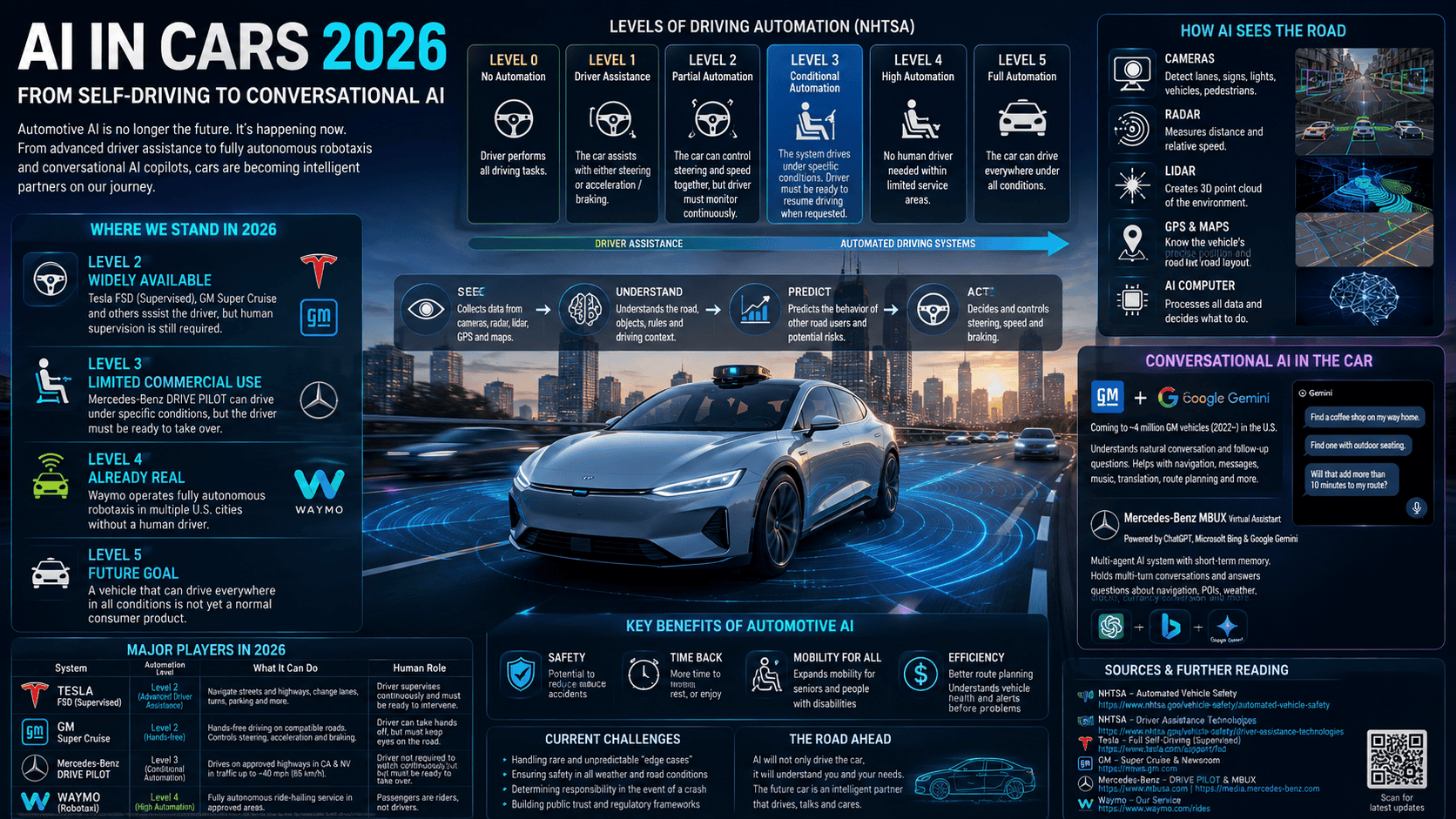
For more than a century, the car has primarily been a machine for moving people from one place to another. Engines became more powerful, safety improved, navigation became smarter, and cabins became more comfortable. But the basic relationship remained the same: people operated the car, and the car transported them.
AI is beginning to change that relationship. Cars are learning to understand natural language, explain their own functions, adapt to the people inside them, and turn travel time into usable time. The bigger change may be what happens next: the car can become not just transportation, but a place where people work, rest, and even live.
The Age of Talking to Your Car
Voice control in cars is not new. Drivers have long been able to say things such as “navigate home,” “play music,” or “lower the temperature.” The difference is that older systems usually required people to learn the commands the car could understand.
Generative AI is reversing that relationship. In 2026, Google began rolling out Gemini to cars with Google built-in, allowing drivers to speak more naturally, ask follow-up questions, search for stops along a route, control vehicle settings, and request information specific to their car.
A driver can say that it is foggy and freezing inside, and Gemini can understand the situation and adjust the heat and defroster. In supported EVs, drivers can ask about their current battery level or the expected battery level on arrival.
The important shift is simple: people once had to learn the language of the car. Now the car is beginning to understand the language of people.
Cars Are Beginning to Explain Themselves
Modern cars already generate enormous amounts of information: battery status, tire pressure, energy use, temperature, mileage, sensor readings, and warning messages. Yet having that information is not the same as making it understandable.
AI can become the layer that translates the machine into human language. Google says Gemini can draw on manufacturer-provided owner’s manuals to answer vehicle-specific questions, such as how to prepare a particular car for an automatic car wash or how to change a vehicle setting.
Instead of showing only a warning light or burying an answer in a manual, the car can increasingly explain what a feature does and what the driver should know.
The Car Is Also Learning About the Person
The next step is personalization. BMW expanded its Intelligent Personal Assistant in 2026 with Amazon Alexa+ AI technology. BMW says the system supports natural dialogue, understands context and intent, and can connect spoken requests with vehicle functions and navigation.
As these systems develop, familiar destinations, preferred cabin settings, entertainment choices, and frequently used functions can all become part of a more personalized experience. The car is moving from a machine that simply executes commands toward a space that adapts to the person using it.
The Time Inside the Car Is Becoming Part of the Product
Cars have traditionally competed on performance, range, fuel economy, safety, comfort, and price. Those measures still matter. But as people spend less of a journey actively controlling the vehicle, another question becomes more important: how valuable can the time inside the car become?
The technical progression of self-driving, crash rates, safety, public trust, and the point at which humans leave the driving task are examined separately in Everyday AI · Part 4-1 — Self-Driving.
Waymo’s Ojai offers a real example of a rider-first cabin. It has a low step, a completely flat floor, large displays, and an interior that Waymo describes as opening up like a “living room on wheels.”
Waymo has also introduced Gemini inside the Ojai. According to Waymo, Gemini in Waymo operates independently from the Waymo Driver: the driving system handles the road, while the conversational assistant helps riders with cabin controls, journey information, nearby places, and general questions.
One AI can handle movement while another helps the person inside. That separation points toward the car becoming a mobile AI space rather than simply a machine with one intelligent feature.
The Car Is Beginning to Borrow Functions From the Home
If the cabin can become a place to work, relax, watch, talk, or sleep, the boundary between transportation and living space starts to blur. Campervans and motorhomes have combined mobility and shelter for decades, but AI, connected controls, energy systems, and smart-home technology are pushing the idea further.
A Real Example: AC Future AI-THd
AC Future calls the AI-THd “America’s First AI-Transformer Home, Drivable.” The company describes it as a self-sufficient drivable home that expands from a relatively compact recreational vehicle into a transformer home on wheels.
According to AC Future, the AI-THd expands to around 400 square feet of living space. Its cockpit can be converted into a mobile office or a secondary bedroom, allowing the same physical space to change function after the vehicle stops.
AC Future also presents the AI-THd as an AI-enabled platform for smart, sustainable, and flexible living, combining the mobile-home concept with connected smart technologies and self-sufficiency features.
The significance of the AI-THd is not that every future car will look like it. It is that a real company is already designing a vehicle around the idea that transportation, work, rest, and living space can occupy the same platform.
For Someone Living Alone, Could the Car Replace a Home?
This idea becomes especially interesting for people who live alone. A one-person household may not need a large home if a smaller space can provide the essential functions of daily life: sleeping, working, resting, preparing simple meals, storing belongings, and moving from place to place.
A vehicle such as the AI-THd could function as a home in the morning, an office during the day, transportation when it needs to move, and a bedroom again at night. On a trip, the living space itself moves with the person instead of being left behind.
For some solo households, digital nomads, or people who value mobility more than floor area, this could become a genuine housing alternative. In places where housing costs are high, combining transportation and living space could also change the economics of what a person considers a home.
But a vehicle that can physically function like a home is not automatically a legal or practical replacement for a home.
The Address Problem
A home is more than a place to sleep. Modern societies use a fixed address for residency records, mail, banking, insurance, taxes, employment documents, and public services. Even if someone can live comfortably in a vehicle, the legal system may still require a recognized residential address.
Where Can It Stay?
Owning a mobile home does not mean it can be parked and occupied anywhere. Long-term parking, overnight stays, and vehicle habitation are governed by local rules. Widespread mobile living would still require legal places to stop, whether through RV parks, dedicated sites, or new forms of mobile-housing infrastructure.
Water, Waste and Electricity Still Matter
Daily life requires clean water, wastewater disposal, electricity, heating, cooling, cooking, and connectivity. Self-sufficiency technology can reduce dependence on fixed infrastructure, but it does not make these physical needs disappear. Long-term mobile living still requires reliable systems for replenishment, charging, maintenance, and waste disposal.
Insurance, Safety and Regulation Must Catch Up
A vehicle that is also a living space raises questions that ordinary cars do not. Which insurance covers a fire, theft, water damage, or an accident while the vehicle is being used as a home? What safety standards apply? How should cities regulate long-term occupancy? Technology can blur the line between car and home faster than laws and infrastructure can redraw it.
So it would be an exaggeration to say that vehicles such as the AI-THd are about to replace conventional housing for everyone. But for some people living alone, the idea is no longer absurd. If a compact mobile space can provide enough of the functions they actually use, the definition of “home” begins to change.
Instead of the home always waiting for the person, part of the living space could move with the person.
The Car Could Become the Next Major Personal AI Device
A smartphone has cameras, microphones, GPS, internet access, a display, and multiple sensors. A modern car has an even larger physical environment, its own operating systems, many sensors, connectivity, and the ability to move through the world.
With AI added to that environment, the car can increasingly sense, listen, interpret, explain, and interact. The competition between cars may therefore expand beyond speed, range, comfort, and design to another question: which car understands and assists the person inside it better?
What Happens When the AI Leaves the Car With You?
If an AI already understands your destinations, schedule, preferences, and routines in the car, there is little reason for that relationship to end when you park.
The same personal AI could help on a smartphone, continue the experience in the car, connect with lights and appliances at home, and assist with work elsewhere. At that point, AI is no longer tied to one device or one room. It begins to move with the person.
That leads directly to the next chapter: Everyday AI · Part 5 — Follow-Me AI.
FAQ
1. Is automotive AI the same as self-driving AI?
No. Self-driving AI focuses on perceiving the road, making driving decisions, and controlling vehicle movement. Automotive AI is broader and can include conversation, vehicle information, navigation, cabin controls, personalization, and assistance for the people inside. The stages, safety data, crash rates, trust issues, and transfer of the driving task are covered separately in Everyday AI · Part 4-1 — Self-Driving.
2. Is there really an AI vehicle that can be used like a home?
Yes. AC Future’s AI-THd is a real example. The company describes it as a drivable AI Transformer Home that can expand to around 400 square feet, with a cockpit that can become a mobile office or secondary bedroom.
3. Could a vehicle like this actually replace a home for someone living alone?
For some people, it could replace many of the practical functions of a small home by combining sleeping, working, resting, storage, and transportation in one mobile space. But long-term use still depends on parking, electricity, water, wastewater disposal, insurance, safety rules, and local regulations. It is more realistic to view it as an emerging housing alternative for certain lifestyles than as a universal replacement for conventional homes.
4. If someone lives in a vehicle, what happens to their address?
This is one of the biggest practical obstacles. A physical space may function as a home, but residency registration, mail, banking, insurance, taxes, employment records, and public services often depend on a legally recognized address. The exact rules differ by jurisdiction, so a mobile AI home does not automatically become a legal residential address. If this form of housing becomes more common, address and residency systems will have to evolve alongside the vehicles themselves.
The Car Is Becoming a Space That Moves With Us
For most of automotive history, progress meant helping humans operate machines more easily, safely, and comfortably. AI is beginning to change the relationship itself.
The car can understand natural speech. It can explain its own functions. It can adapt to the person inside. And as the need for constant human driving declines, the cabin can take on roles that once belonged to offices, lounges, hotel rooms, or homes.
Waymo’s “living room on wheels” and AC Future’s drivable AI Transformer Home are very different vehicles, but they point in the same direction: the car is becoming a place where people can spend time, work, rest, and in some cases live.
For people living alone, that change may eventually go further. A car may not eliminate the need for conventional housing, but it can begin to absorb functions that once belonged almost exclusively to the home. If address systems, parking, utilities, insurance, and regulation evolve with the technology, even the boundary between a vehicle and a home could become less fixed.
Until now, people left their homes and got into their cars. In the future, part of the home may move with the person.
And when the AI in the car connects with the AI on the phone, at home, and at work, the next shift begins: AI stops waiting in places and starts following the person.
Everyday AI · Part 5 — Follow-Me AI.