
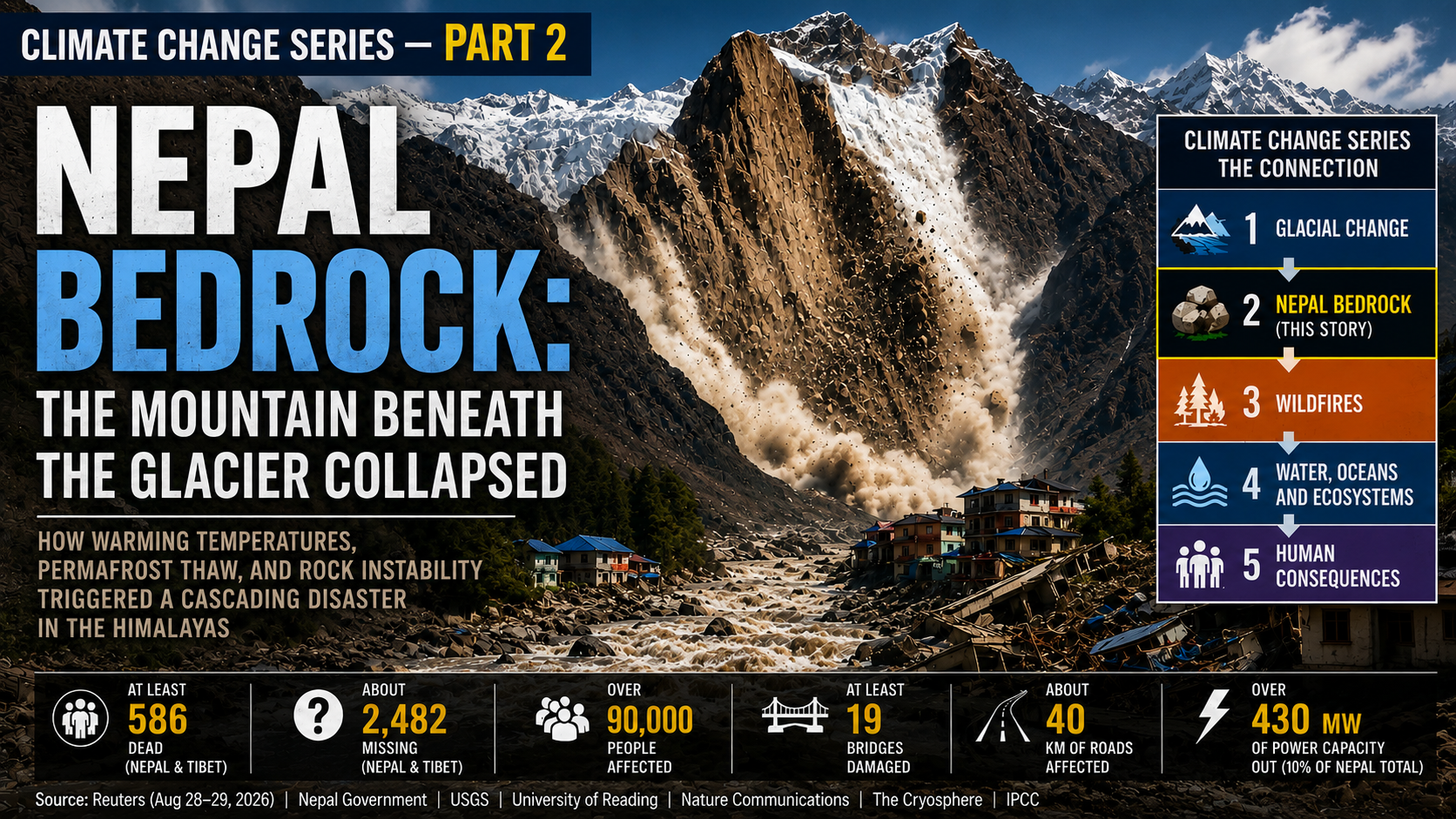
Climate Change Series
Series connection: Glacial change → Nepal’s bedrock and permafrost → Next: Wildfires → Water, oceans and ecosystems → Human consequences
The Mountain Beneath the Glacier Collapsed — A New Climate Risk Revealed by the Nepal Disaster
When we talk about climate change, one of the first images that comes to mind is melting glaciers. Shrinking glaciers, rising sea levels, and disappearing ice across the Arctic and high mountain regions are no longer unfamiliar sights.
But the massive disaster that struck the Nepal–Tibet border region on August 26, 2026, raises a deeper question: What if it is not only the glaciers that are changing, but also the stability of the mountains beneath them?
Recent satellite analysis suggests that this was not simply a case of part of a glacier breaking away. At an elevation of roughly 5,200 meters on the Langtang Lirung massif in Nepal, a huge mass of glacier ice appears to have detached together with the underlying bedrock. Researchers cited by the University of Reading estimated that the detached section may have been approximately 1 to 1.3 kilometers wide.
The falling ice, rock, and debris rushed down the valley. The U.S. Geological Survey reported that the initial collapse generated seismic energy equivalent to approximately a magnitude 5.2 earthquake. This was not simply a glacier collapse. It was a cascading disaster that began when part of a mountain came down together with the ice above it.
The Rock Inside Mountains Is Warming Too
Rock may appear permanent and unchanging. But the temperature inside mountain bedrock is not completely isolated from changes in the atmosphere.
A 2024 study published in Nature Communications analyzed subsurface temperature measurements from 64 boreholes across European mountain regions. Between 2013 and 2022, sites containing mountain permafrost experienced an average warming rate of about 0.41°C per decade at a depth of 10 meters. At some sites, the rate exceeded 1°C per decade, reaching as high as 1.77°C. Even at 20 meters, an average warming rate of approximately 0.24°C per decade was observed.
Warming is not confined to the air surrounding a mountain. Heat is penetrating into the mountain itself.
There Is Ice Hidden Inside Fractured Bedrock
Bedrock contains countless cracks and fractures. At high elevations, water can enter those fractures, freeze, and remain frozen for long periods. Permafrost does not exist only in frozen soil; ice can also persist inside cracks in mountain bedrock.
As bedrock temperatures rise and ice inside fractures begins to thaw, the mechanical relationship between ice and rock changes. Meltwater can move through fractures, and slopes that remained stable for long periods may become less stable. The IPCC has concluded with high confidence that glacier retreat and permafrost thaw can reduce mountain-slope stability.
Meltwater Can Penetrate Deep Into the Rock
A 2025 permafrost bedrock study found sudden rock-temperature changes of approximately 0.2°C to 0.7°C at depths of 2, 3, and 5 meters during periods of active water flow. Researchers also measured water pressure corresponding to a water head of as much as 11.8 meters within the fractured rock system.
The process can be summarized as: Rising temperatures → melting snow and ice → water entering fractures → changes in subsurface heat → permafrost degradation → changes in water pressure → reduced rock-slope stability.
When Glaciers Retreat, the Conditions Around the Mountain Change
A huge glacier is not simply a block of ice sitting on top of a mountain. Where glaciers have remained in contact with rock slopes for long periods, their mass, pressure, and thermal conditions interact with the surrounding mountain environment.
When a glacier retreats, rock that was once in contact with ice becomes exposed, while long-established loading and support conditions can change. The IPCC has concluded with high confidence that glacier retreat has destabilized adjacent rock and sediment slopes in many high mountain regions.
Rising temperatures → Glacier retreat → Bedrock warming → Thawing of permafrost and fracture ice → Increased movement of water → Changes in slope conditions → Greater potential for rock and ice instability.
Was the Nepal Disaster Caused by Climate Change?
Scientists have not established that climate change directly caused the 2026 Langtang Lirung collapse. The Himalayas are geologically active, and earthquakes, landslides, and rock-slope failures are natural hazards in the region. It would go beyond the available evidence to simply claim that global warming caused the mountain to collapse.
But a separate body of scientific evidence is becoming increasingly clear: climate change is altering the background conditions under which high-mountain hazards occur.
A better question may be: “In a warming world, how are the conditions that determine whether a mountain remains stable changing?”
One Collapse Became a Cascading Disaster
Rock and ice fell from high on the mountain. As the mass accelerated down the valley, it entrained additional rock, sediment, and debris. One mountain collapse developed into a chain of hazards: Bedrock failure → Glacier collapse → Rock-and-ice avalanche → Debris flow → River blockage → Flash flooding.
And Below the Mountain, There Were People
The changes began high in the mountains, but they did not remain there. The Nepal–Tibet disaster caused major loss of life and widespread damage to communities and infrastructure. Roads and bridges were destroyed or damaged, power-generation facilities and important cross-border transport routes were disrupted, and search and rescue operations became extremely difficult.
Behind every statistic is a human life. When a road disappears, rescuers may not be able to reach survivors. When a power facility fails, communities and local economies are affected. When a school or village is destroyed, what disappears is not simply a building. It is part of someone’s everyday life.
In the End, the Consequences Reach Humans
Glaciers melt high in the mountains. Permafrost thaws inside rock where we cannot see it. Changes in bedrock temperature are largely invisible to us.
But when a mountain collapses, there are people below it. When a river is blocked and then surges downstream, there are villages, schools, roads, power plants, and families in its path.
Climate change is not simply a question of how many degrees the global average temperature rises. Changes in the atmosphere affect ice. Changes in ice can affect mountain stability. Changes in mountains can alter rivers. And changes in rivers can reach human lives.
What happens to a mountain after the glacier above it disappears?
Until now, we have watched the ice melt. Perhaps we must also begin watching what is happening beneath it. And at the very end of this chain of changes, the ones who may pay the greatest price are human beings.
FAQ
What caused the 2026 Nepal glacier collapse and flood?
Current evidence indicates that a large rock-and-ice avalanche detached from the Langtang Lirung massif and developed into a cascading debris flow and flood. Scientists are still investigating the exact trigger.
Did climate change directly cause the Nepal disaster?
No direct attribution has been established. However, glacier retreat, warmer mountain conditions and permafrost degradation can reduce slope stability and may have contributed to the background conditions that made the collapse possible.
What is permafrost, and can it exist inside bedrock?
Permafrost is ground or rock that remains at or below freezing for at least two consecutive years. In high mountains, ice can persist inside cracks and fractures in bedrock, helping influence the mechanical and thermal conditions of a slope.
Why can thawing ice make a mountain slope less stable?
When ice inside fractures thaws, the relationship between rock, ice and water changes. Meltwater can penetrate fractures, transfer heat and alter water pressure, while the loss of frozen conditions can weaken already fractured slopes.
Can glacier retreat affect the rock beneath and beside a glacier?
Yes. As glaciers thin and retreat, surrounding rock can become exposed and long-established support, loading and temperature conditions can change. The effect varies by location, but glacier retreat is a recognized factor in high-mountain slope instability.
Could similar cascading disasters happen elsewhere in the Himalayas?
They can. High mountain regions can experience linked hazards in which rock or ice collapse leads to avalanches, debris flows, temporary river blockages and flash floods. Warming does not guarantee such an event, but it is changing the conditions in which these hazards occur.
Next in the Climate Change Series — Wildfires
The next article turns from frozen mountains to forests. As temperatures rise and prolonged dry conditions reduce moisture in soils and vegetation, trees, leaves, grasses, and dead wood can become more combustible fuel.
Climate change does not cause every wildfire ignition. Fires can begin through lightning, human activity, electrical infrastructure, and many other sources. But hotter and drier conditions can create an environment in which a small ignition is more likely to grow into a large and destructive wildfire.
Next question: Why can a small spark become a massive disaster in a hotter, drier world?