
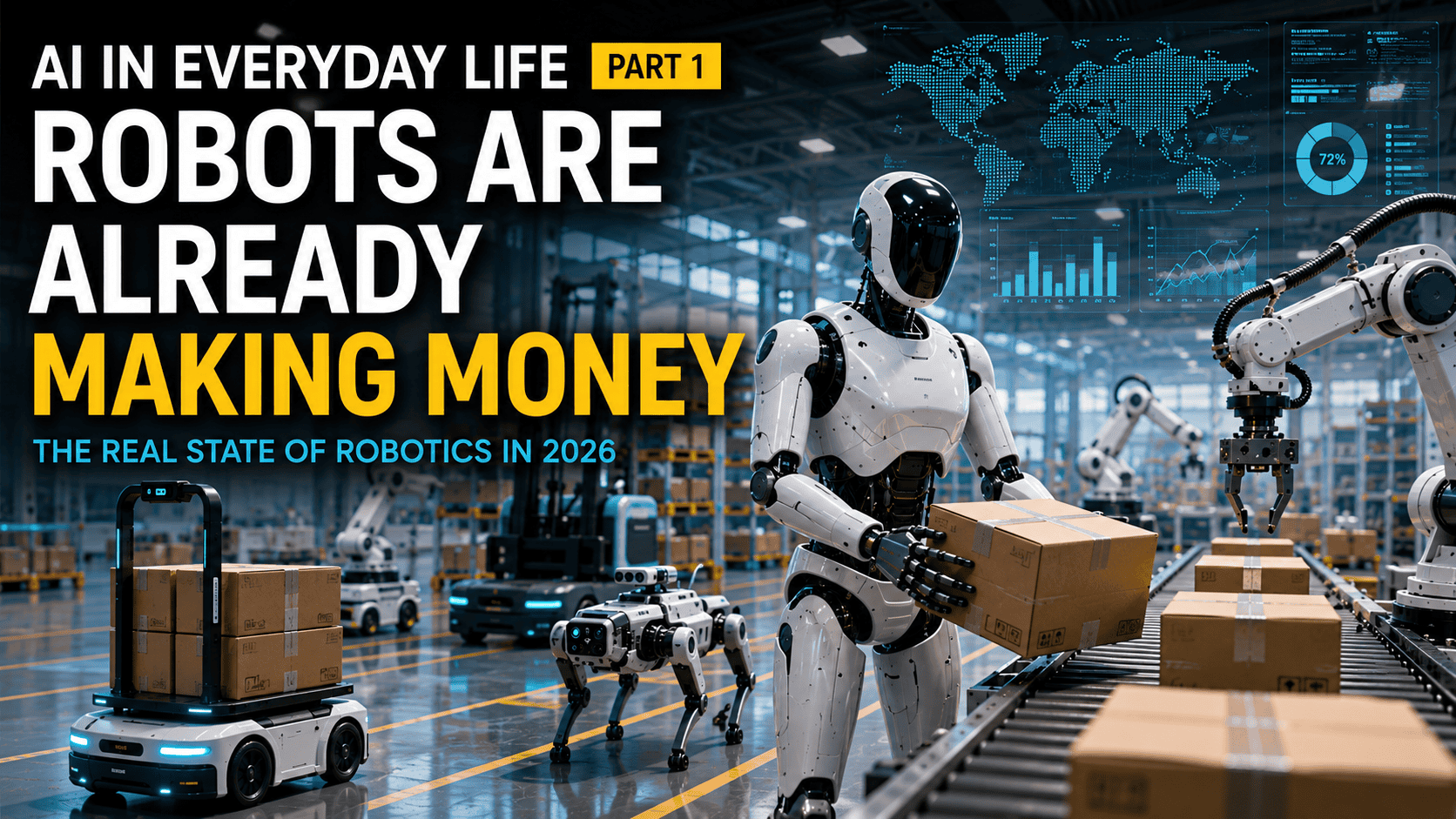
When people hear the word robot, they often picture a humanoid machine walking, talking or performing impressive demonstrations. But to understand the robotics industry in 2026, it is better to begin with two practical questions: how many robots are already doing real work, and are robotics companies actually making money?
The answer is increasingly clear. Robots are no longer only a future technology. Millions already work in factories, logistics robots are spreading through warehouses, medical robots are growing rapidly, and humanoids are now trying to become the next major commercial category.
More Than 4.66 Million Industrial Robots Are Already at Work
According to the International Federation of Robotics (IFR), the global operational stock of industrial robots reached about 4.664 million units in 2024. Around 542,000 new industrial robots were installed during the year, more than double the annual level of a decade earlier.
China alone installed about 295,000 units in 2024, roughly 54% of the global total. While the public is watching humanoid demonstrations, conventional robots are already deeply embedded in automotive, electronics, metalworking and other manufacturing industries.
Logistics and Medical Robots Are Expanding Fast
Factories are only part of the story. IFR reported around 200,000 professional service robots sold in 2024, with transportation and logistics accounting for approximately 102,900 units. These machines move goods through warehouses, hospitals, hotels and other facilities, helping businesses reduce walking time, improve throughput and address labor shortages.
Healthcare is another fast-growing area. IFR reported about 16,700 medical robots sold in 2024, up 91% from the previous year. Applications include rehabilitation, non-invasive therapy, surgery, diagnostics and laboratory work.
How Far Has the Robotics Market Already Come?
| Robot Market | Latest Scale (Units) | What It Shows |
|---|---|---|
| Industrial robots in operation | 4,664,000 units | Large-scale commercial deployment |
| New industrial installations | 542,000 units (2024) | Automation investment remains strong |
| China industrial installations | 295,000 units (2024) | World’s largest installation market |
| Transportation & logistics robots | 102,900 units sold (2024) | Rapid warehouse and transport adoption |
| Medical robots | 16,700 units sold (2024) | 91% year-over-year growth |
The key point is that robotics was already a substantial commercial industry before the current humanoid boom began.
Why Humanoid Robots Are Different
Traditional industrial robots are highly capable, but most are designed for narrow tasks. A welding robot welds. A mobile logistics robot moves goods. Humanoids promise something different: a more general-purpose machine that could eventually perform multiple tasks in environments already designed for the human body.
Doors, stairs, shelves, tools, workbenches and homes were built around human proportions. If a robot with arms, hands and legs becomes intelligent, safe and reliable enough, companies may be able to introduce it without rebuilding the entire environment around the machine.
2,056 Humanoid Robots Gathered in Beijing
The scale of development became visible in Beijing in August 2026. The second World Humanoid Robot Games brought together 2,056 robots from 666 teams across 16 countries. The event included 51 events, mixing sports with scenario-based tests designed around factories, restaurants, offices and emergency situations.
The important change is the question being asked. It is shifting from “Can a robot walk?” to “Can this robot perform useful work reliably?” Precision tasks such as cable connection, industrial assembly and material handling reveal far more about commercial readiness than a spectacular sprint.
Humanoid Installations Reached About 16,000 in 2025
Counterpoint Research estimates that around 16,000 additional humanoid robots were installed worldwide in 2025, with China accounting for more than 80% of installations. The five leading vendors together represented about 73% of the market.
| Rank | Company | 2025 Global Installation Share |
|---|---|---|
| 1 | AGIBOT | Nearly 32% |
| 2 | Unitree | About 27% |
| 3 | UBTECH | Just over 5% |
| 4 | Leju Robotics | About 5% |
| 5 | Tesla | Nearly 5% |
AGIBOT: From A1 to Commercial Scale
AGIBOT is one of the Chinese companies pushing toward general-purpose humanoids. Counterpoint notes that after the introduction of the AGIBOT A1 in 2023, the company expanded into multiple product lines and built its own production capability.
More importantly, humanoids are beginning to generate measurable sales. Counterpoint reported that global humanoid robot sales revenue exceeded $500 million in 2025. AGIBOT generated more than $140 million, ranking first worldwide, while Unitree and UBTECH ranked second and third. Together, the top three accounted for nearly 56% of global humanoid sales revenue.
Unitree Shows That Robotics Can Become a Real Business
Unitree first became widely known for quadruped robots before expanding into humanoids such as the H1 and G1. According to company filings reported by Reuters, Unitree’s revenue rose to nearly 1.7 billion yuan ($252 million) in 2025. The company was profitable, and overseas revenue accounted for more than 40% of sales during the disclosed reporting periods.
That does not mean all of Unitree’s revenue came from humanoids. It sells multiple robot categories. But the figures demonstrate something important: robotics companies can build substantial businesses from real product sales rather than relying only on research funding.
Sales Numbers Still Need Careful Interpretation
A robot being shipped is not the same thing as a robot performing productive work every day. Many current humanoid sales still go to research institutions, universities, training facilities and other early-stage users. Reuters has also noted that relatively few Unitree robots are yet used in commercial applications.
For investors and customers, the more useful questions are: Who bought the robot? Where is it working? How many hours does it perform useful tasks? Does it save enough labor or create enough value to justify its purchase and maintenance costs?
The Robot “ChatGPT Moment” Has Not Arrived Yet
Humanoid hardware is improving quickly, but general intelligence in the physical world remains difficult. Robots must understand unfamiliar objects, follow natural-language instructions, recover from mistakes and adapt to changing environments while remaining physically safe.
Unitree CEO Wang Xingxing said in August 2026 that robotics is moving toward a “ChatGPT moment” for embodied intelligence, while cautioning that a comparable software breakthrough could still take roughly two to ten years. The long-term competition may therefore be less about who builds the most human-looking body and more about who develops the most capable physical AI.
What Do Consumers Actually Think About Home Robots?
Consumer surveys reveal an important gap between curiosity and willingness to buy. In a November 2025 Altman Solon survey of more than 1,000 U.S. consumers, 65% said they were interested in owning an advanced home robot. But 69% were unwilling to pay more than $5,000, and about half expressed concern about having a human-sized advanced robot in the home.
A separate YouGov survey published in February 2025 found that 38% of U.S. adults were interested in a robot that could help with household tasks. Interest rose to 52% among adults aged 18–34. Consumers showed particularly strong interest in help with floor cleaning, dishwashing, laundry and home organization, while they were more cautious about sensitive responsibilities such as elder or child care.
South Korea participant study points in a similarly practical direction. Household chores received the highest willingness-to-use score among four home-robot task categories, with saving time and effort among the main reasons people wanted robotic assistance.
Does a Home Robot Have to Look Human?
Not necessarily. U.S.–U.K. participant study found that people often preferred specialized robots to general-purpose humanoids for in-home assistance, with safety, privacy and comfort among the concerns. A floor-cleaning robot does not need legs and arms. But a machine expected to climb stairs, open doors and use tools designed for people may benefit from a human-like form.
The Biggest Barriers to Home Humanoids
Factories are controlled environments. Homes are not. Children move unexpectedly, pets cross the floor, furniture changes position, objects are fragile and privacy matters. A useful household humanoid must be safe around people, reliable for long periods, affordable to maintain and capable of handling unfamiliar situations.
This is why factories and logistics centers may adopt humanoids before ordinary households do. They offer repetitive tasks and more predictable spaces where the economics of automation can be measured more easily.
FAQ
Are consumers interested in owning advanced home robots?
Yes, but interest is much higher than immediate purchase readiness. Altman Solon’s U.S. survey found 65% interest, while affordability and safety remained major barriers.
How much are consumers willing to pay?
Price is one of the biggest obstacles. In the Altman Solon survey, 69% of respondents were unwilling to pay more than $5,000, while 25% were unwilling to buy at any price.
What jobs do people actually want robots to do at home?
Consumers appear most interested in practical, repetitive work such as floor cleaning, dishwashing, laundry and home organization. The value proposition is simple: save time and effort on chores people would rather not do themselves.
What concerns consumers most?
Safety, privacy, price, reliability and repair costs are recurring concerns. A home robot may use cameras, microphones and cloud-connected AI, while a human-sized machine also creates physical safety questions.
Does a home robot have to look human?
No. Specialized robots may remain better for specific tasks. Humanoid form becomes more useful when a robot must navigate spaces and use tools that were originally designed for people.
Are humanoid robots already replacing workers?
Not on a broad general-purpose scale. Conventional industrial automation is already widespread, but humanoids remain early in commercialization. Many deployments are still pilots, research projects, training environments or narrowly defined industrial tasks.
The Number That Will Matter Most
The robotics industry is clearly moving from demonstrations toward commercialization. More than 4.66 million industrial robots already work in factories, logistics and medical robots are expanding, and the humanoid segment is beginning to produce measurable installations and revenue.
But the most important number will not be how many humanoids appear at a conference, how fast they can run or even how many are shipped.
The number that matters is how many robots perform useful work every day — and whether that work is safe, reliable and economically worthwhile.
If the industry can answer that question convincingly, humanoid robots will stop looking like futuristic demonstrations and start becoming the foundation of a major new industry.
Continue reading → Robots on the Battlefield