Author: Noah Kim

  • AI Chips · Part 2

    AI Chips · Part 2

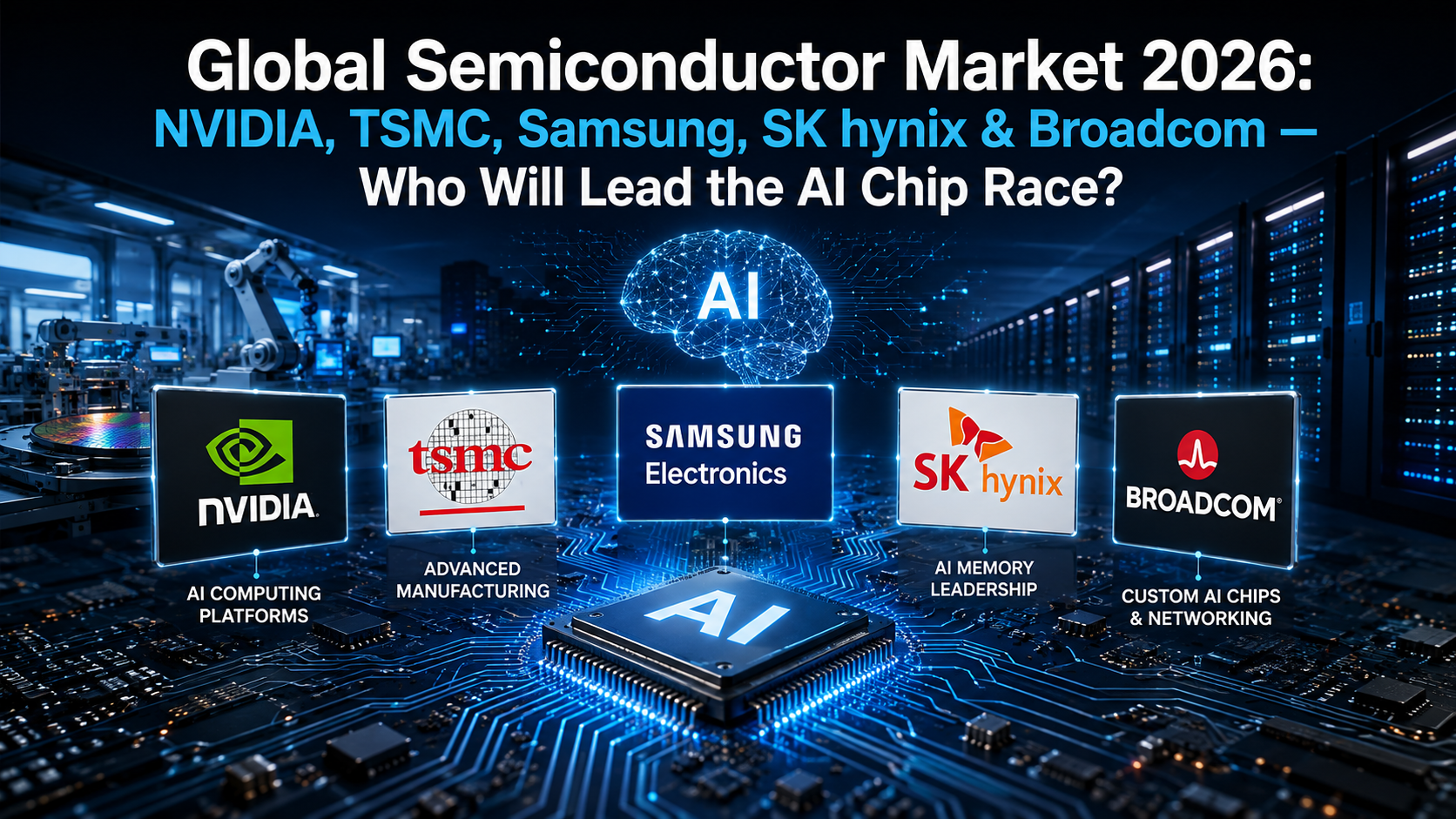
    Do you talk about AI stocks without knowing what a GPU actually does?

    People talk about NVIDIA stock. They follow the HBM competition involving Samsung Electronics and SK hynix. They compare ChatGPT with Google Gemini and debate which AI is better.

    But let’s change the question.

    What exactly does a GPU do?

    What does HBM do next to an AI processor? How is the NPU inside a smartphone or AI PC different from a GPU? And why are Google, Amazon and Microsoft developing their own AI chips?

    AI has become familiar to almost everyone. But the semiconductors that actually make AI work remain surprisingly unfamiliar.

    AI does not run on software alone. Something has to perform enormous amounts of computation. Something has to keep supplying data fast enough for those processors to continue working. Smartphones need to run AI without draining their batteries, while large AI models require enormous amounts of computing power.

    That is why there is no single chip called “the AI chip.” Different chips perform different jobs.

    In this article, we are not starting with stock prices or company valuations. We are going inside the chips themselves: what a GPU calculates, why an NPU is needed, why even a powerful GPU can be forced to wait if memory is too slow, and why major technology platforms are designing their own AI accelerators.

    AI Chips Are Not All the Same

    When people hear “AI semiconductor,” NVIDIA GPUs often come to mind first. But an AI system uses different types of chips for different jobs.

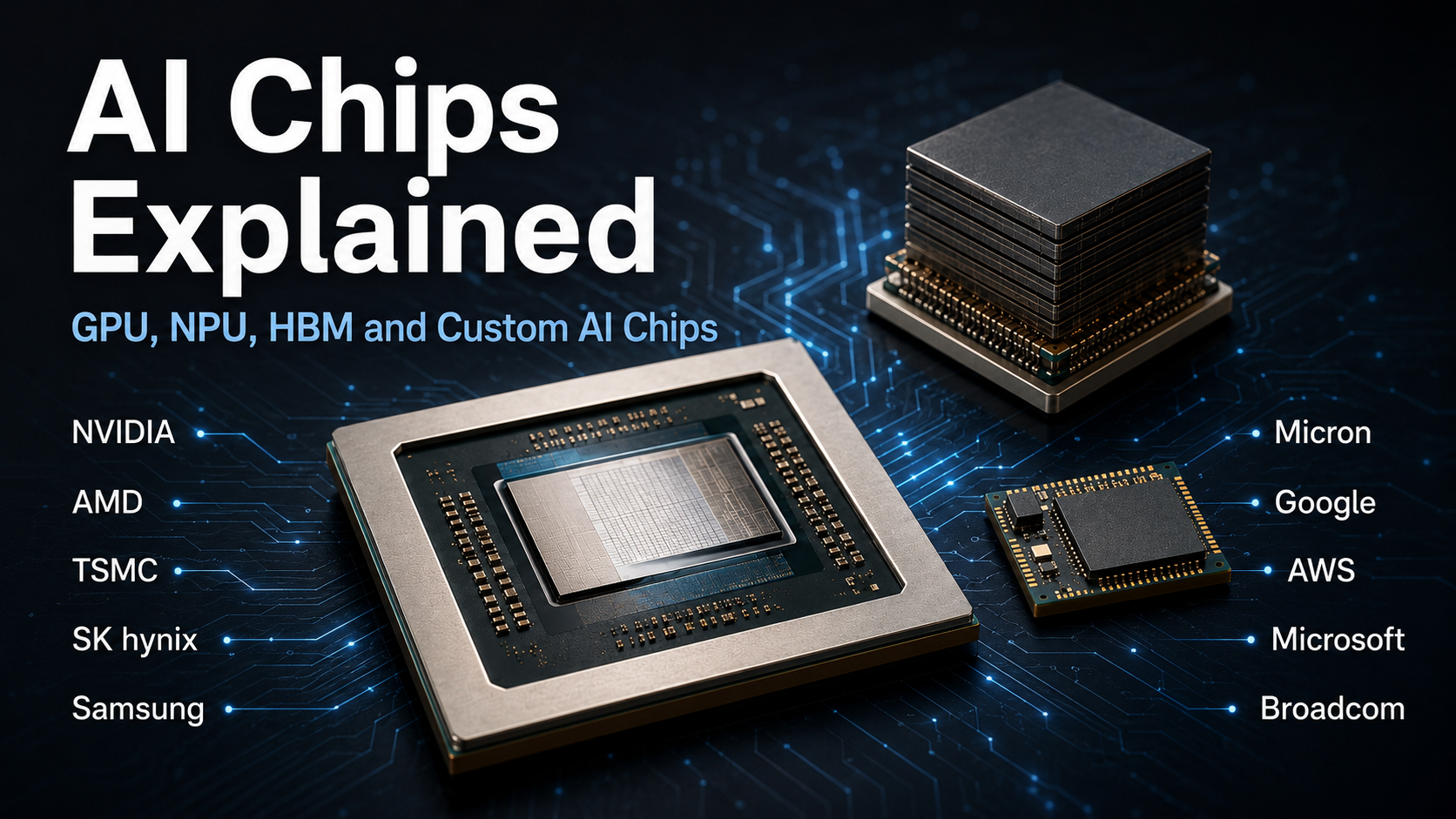
    GPU — performs enormous amounts of AI computation in parallel.

    NPU — performs neural-network operations efficiently with lower power consumption.

    HBM — supplies huge amounts of data to high-performance AI processors at very high speed.

    Custom AI chip — optimizes computing hardware for particular AI workloads.

    There is one important distinction. GPUs, NPUs and custom AI accelerators perform computation. HBM does not. HBM is memory.

    GPU — Thousands of Calculations Happening at Once

    GPU stands for Graphics Processing Unit. GPUs were originally developed to process computer graphics efficiently. A game screen contains enormous numbers of pixels and graphical operations that need to be calculated at the same time.

    That architecture turned out to be extremely useful for AI. Modern AI models repeatedly perform enormous numbers of matrix and vector operations.

    Imagine that one million similar calculations need to be completed. One person with a calculator could work through them one after another, or thousands of workers could divide the calculations and work on them simultaneously.

    The second approach is much closer to what makes a GPU powerful. A GPU contains large numbers of computing units designed to perform many operations in parallel.

    AI training, language-model inference, image generation and video generation all benefit from this type of massive parallel computation. That is how a processor originally associated with graphics became one of the most important computing engines of the AI era.

    A Current Example: NVIDIA Rubin

    NVIDIA’s Rubin generation shows where high-end AI GPUs are heading. Rubin includes up to 288GB of HBM4 and up to 22TB/s of memory bandwidth. The lesson is more important than the numbers: as GPUs become faster, the memory feeding them must become faster too.

    But Does a Faster GPU Automatically Mean Faster AI?

    No. A GPU can calculate extremely quickly, but it cannot calculate data that has not arrived yet.

    Imagine 100 of the world’s best chefs standing in a kitchen. They are incredibly fast. But what happens if one person slowly carries ingredients into the kitchen? The chefs wait.

    Something similar can happen in AI computing. As GPUs became dramatically faster, moving enough data to those processors became increasingly important. This brings us to HBM.

    HBM — Keeping the GPU Supplied With Data

    HBM stands for High Bandwidth Memory. Its job is straightforward: HBM supplies enormous amounts of data to GPUs and other AI accelerators at extremely high speed.

    If the GPU is the chef, HBM is both the ingredient storage area and the high-speed supply system bringing ingredients to the kitchen.

    HBM achieves high bandwidth partly by stacking multiple DRAM dies vertically and creating very wide data paths. Think of conventional memory as traffic moving quickly along a relatively narrow road. HBM takes a different approach: build a much wider highway so far more data can travel at the same time.

    This is why names such as HBM3E, HBM4 and HBM4E keep appearing in AI semiconductor news. As AI processors become more powerful, memory has to keep up.

    A Current Example: HBM4E

    HBM4 is part of the latest high-performance AI generation, while memory makers are already pushing toward HBM4E. In 2026, both SK hynix HBM4E and Samsung HBM4E samples reaching up to 16Gbps per pin. The reason for the evolution is simple: faster AI processors need faster access to data.

    Then Why Do We Need an NPU?

    If GPUs are so good at AI computation, why create another processor? The answer is power efficiency.

    Think about a smartphone. AI can identify people and objects in photos, recognize speech, improve camera images, translate language and perform other intelligent functions. Laptops increasingly use AI for cameras, audio, video calls and local features.

    Using a large, power-hungry processor for every small AI operation would be inefficient. A smartphone has an even stricter limitation: it needs to perform these tasks while running on a small battery.

    That creates a need for processors optimized specifically for neural-network workloads. That is where the NPU — Neural Processing Unit — comes in.

    NPU — A Specialist for AI Inside Your Device

    An NPU is designed to process neural-network operations efficiently. If a powerful GPU is like a huge factory capable of handling massive computing jobs, an NPU is more like a specialized production line designed to perform particular AI tasks efficiently and repeatedly.

    This distinction matters especially in smartphones and laptops. Some AI tasks can be processed directly on the device instead of sending everything to a remote server. This is commonly called on-device AI.

    Running appropriate AI workloads locally can reduce latency, allow some functions to work without a constant cloud connection and reduce the need to send every task to remote computing infrastructure.

    This is why comparing a GPU and an NPU only by asking which one is “faster” misses the point. They are designed for different jobs.

    A Current Example: Snapdragon X2 Elite

    Qualcomm’s Snapdragon X2 Elite family includes a Hexagon NPU delivering up to 85 TOPS for on-device AI. The number matters less than the reason the NPU is there: AI performance in a personal device must be balanced against power consumption and battery life.

    So Why Doesn’t Google Just Buy More GPUs?

    If GPUs already exist, why are companies such as Google, Amazon and Microsoft developing their own AI chips?

    Google has TPU. Amazon Web Services has Trainium. Microsoft has Maia.

    These companies are not simply trying to build another general-purpose GPU. They have a different motivation.

    Custom AI Chips — A Chip Does Not Have to Be Good at Everything

    One of the great strengths of GPUs is flexibility. They can support many different models and computing workloads.

    But imagine a company performing enormous volumes of similar AI workloads every day. At that scale, a chip optimized for the company’s own workloads can become extremely valuable.

    Instead of designing hardware to be good at everything, a company can optimize hardware around the AI operations it repeatedly performs.

    Google develops TPUs around its AI and cloud workloads. AWS develops Trainium for AI training and inference on its cloud platform. Microsoft develops Maia for large-scale AI processing within its own infrastructure.

    This changes the question we should ask. Instead of “Is this chip better than an NVIDIA GPU?”, ask “What workload was this chip designed to perform more efficiently?”

    Current Custom AI Chips

    Google’s eighth-generation TPU splits specialization between TPU 8t for large-scale training and TPU 8i for post-training and inference. AWS Trainium3 combines 144GB of HBM3E with 4.9TB/s of memory bandwidth. Microsoft’s Maia family follows the same broader trend: platforms want tighter control over the hardware running their most important AI workloads.

    GPU, NPU, HBM and Custom AI Chips at a Glance

    TypeWhat It DoesExamples
    GPUPerforms massive amounts of AI computation in parallelNVIDIA Rubin, AMD Instinct
    NPUProcesses AI workloads efficiently with lower power consumptionQualcomm Hexagon, Intel NPU
    HBMSupplies high-performance AI processors with data at very high speedHBM4, HBM4E
    Custom AI ChipOptimizes hardware for particular AI workloadsGoogle TPU, AWS Trainium, Microsoft Maia

    AI Semiconductor News Looks Different Once You Know the Jobs

    We began with a question: Do you talk about AI stocks without knowing what a GPU actually does?

    Now, when NVIDIA announces a new GPU, you do not have to stop at “the new GPU is faster.” You can ask what changed in computing performance, memory capacity and memory bandwidth.

    When Samsung Electronics or SK hynix announces new HBM technology, you can understand why that news is connected to increasingly powerful AI accelerators.

    When an AI PC advertises an NPU, you know why it should not automatically be compared with a high-end AI GPU using the same criteria.

    And when Google, Amazon or Microsoft announces another internally designed AI accelerator, you do not have to conclude simply that “another NVIDIA competitor has appeared.”

    Instead, ask: What does this chip calculate? What workload was it built for? How does it get the data it needs? Why did this company decide to design it?

    Those questions make AI semiconductor news much easier to understand.

    Conclusion: Remember the Job Before the Product Name

    You do not need to memorize every AI semiconductor product or technical term. Product names will change. New generations will keep arriving.

    The basic jobs are easier to remember.

    GPU performs massive AI computation.

    NPU performs AI operations efficiently with lower power consumption.

    HBM supplies AI processors with data at extremely high speed.

    Custom AI chips optimize computing for particular AI workloads.

    We already use AI every day. We discuss AI companies and their stocks. We compare AI services and argue about which models are better. We talk about how artificial intelligence could change business, work and everyday life.

    It is worth understanding what is happening underneath all of that software.

    AI does not end at the ChatGPT or Gemini interface on a screen. Behind that interface, semiconductors are calculating, moving data and consuming power at extraordinary speed.

    That is where another side of the AI revolution begins.
  • How AI Data Centers Work: GPUs, HBM and Networking Explained

    How AI Data Centers Work: GPUs, HBM and Networking Explained

    AI data center construction plans are appearing around the world at an extraordinary pace.

    Amazon, Microsoft, Google, Meta and other technology giants are pouring enormous amounts of capital into AI infrastructure, while governments increasingly view data centers and the energy systems behind them as matters of national competitiveness.

    J.P. Morgan estimates that capital spending by the five largest U.S. hyperscalers will reach about $697 billion in 2026.

    But there is a growing gap between announcing an AI data center and actually bringing one online. Buying GPUs is only the beginning. An AI data center also needs high-bandwidth memory, ultra-fast networking, storage, enormous amounts of electricity, cooling infrastructure, substations, transformers, financing, permits and, increasingly, support from local communities.

    The bottleneck in AI is moving from chips into the physical world.

    What Makes an AI Data Center Different?

    Traditional data centers have long supported websites, email, databases, cloud storage and enterprise applications. AI data centers face a different level of computational intensity.

    Training a large AI model can require hundreds or thousands of GPUs working together as one enormous computing system. And the computation does not stop after training. Every time someone asks an AI assistant a question, summarizes a document, generates an image or creates a video, another round of computation takes place. This is known as inference.

    JLL expects AI could account for roughly half of all data center workloads by 2030, with inference becoming the primary driver of AI-related data center growth.

    Everyday use of AI is itself becoming a major driver of data center demand.

    1. GPUs — The Computing Engines of AI

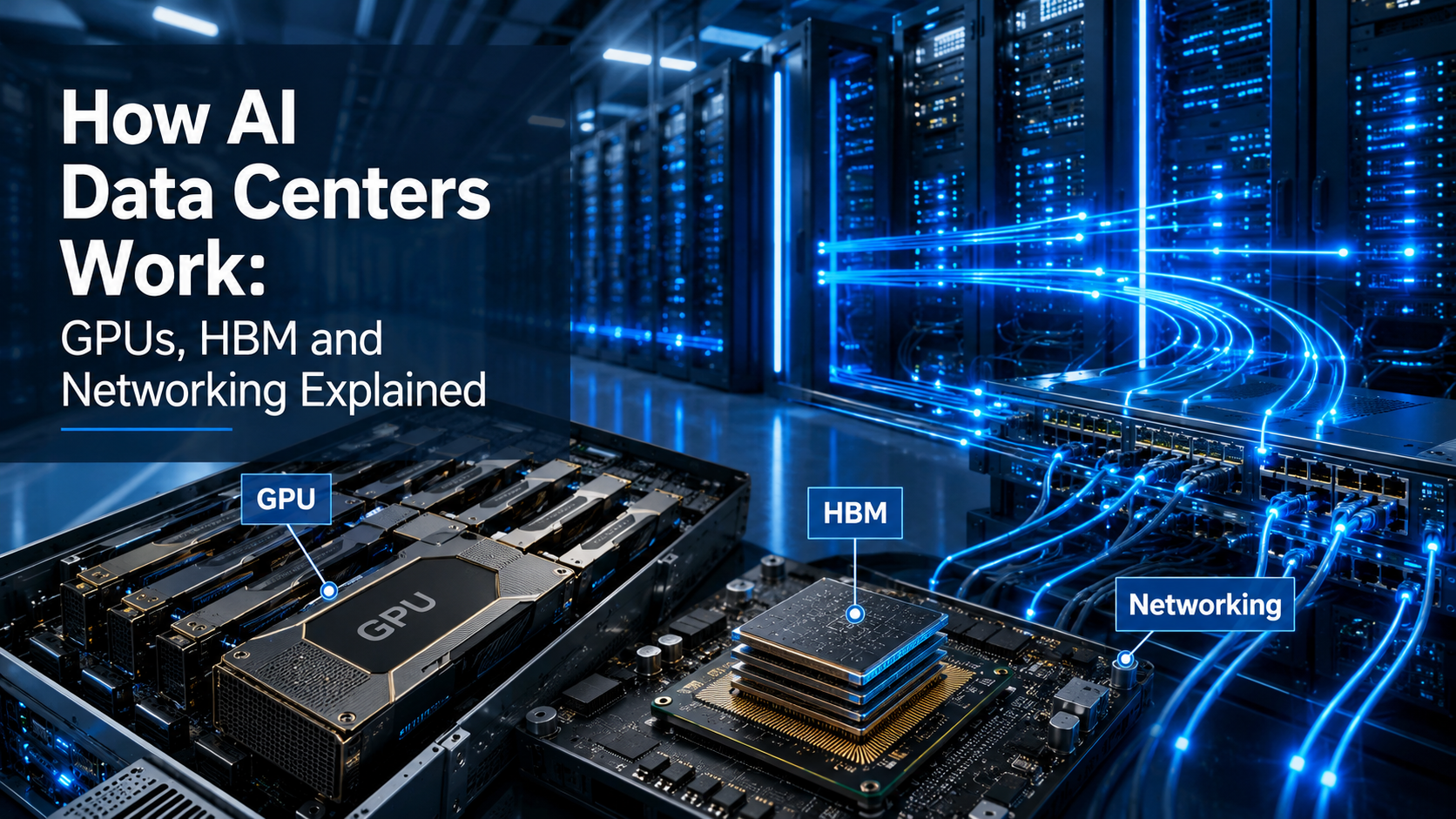
    GPUs perform much of the heavy computation inside modern AI data centers. CPUs are designed to handle a broad range of tasks, while GPUs are particularly effective at performing large numbers of similar mathematical operations in parallel. That makes them well suited to the matrix calculations used by large AI models.

    But faster GPUs do not automatically produce an equally faster AI system. Even the most powerful processor has to wait if the data required for its next calculation does not arrive in time. That is where HBM becomes critical.

    2. HBM — Keeping Expensive GPUs Fed With Data

    HBM stands for High Bandwidth Memory. A simple way to understand its role is to imagine a GPU as an extremely fast chef. A brilliant chef cannot work at full speed if ingredients arrive too slowly. HBM keeps large amounts of data close to the processor and delivers it at very high bandwidth, reducing the time the GPU spends waiting.

    As AI models grow, the amount of data moving through the system also grows. AI chip competition is therefore not simply a race for more raw computing power. The ability to deliver enormous amounts of data to those processors quickly is also a major part of performance.

    3. Networking — Turning Thousands of GPUs Into One System

    Large AI models cannot always be processed efficiently by a single GPU. Hundreds or thousands of accelerators may divide the same workload and continuously exchange data. If one GPU finishes its calculation but has to wait for information from another, valuable computing capacity sits idle.

    AI data centers therefore require networks with extremely high bandwidth and very low latency. Technologies such as high-speed Ethernet and InfiniBand play a critical role in allowing massive clusters of GPUs to operate as one computing system.

    The importance of connectivity is already visible in the business opportunities surrounding AI infrastructure. Reuters reported that STMicroelectronics expects roughly 80% of its more than $2 billion in AI data center revenue in 2027 to come from chips used in fiber-optic data links.

    The Core Structure of an AI Data Center

    ComponentMain RoleWhat Happens When It Becomes a Bottleneck
    GPUPerforms AI computationProcessing capacity falls
    HBMDelivers high-speed data to GPUsExpensive GPUs spend more time waiting
    NetworkingMoves data between GPUs and serversCommunication delays slow the cluster
    StorageStores and supplies models and dataData access becomes slower
    PowerKeeps the facility operatingExpansion or operation is restricted
    CoolingRemoves heat from high-density hardwarePerformance and operating capacity are limited

    The performance of an AI data center depends on how efficiently the entire system works together. A bottleneck in one part can leave expensive capacity elsewhere underused.

    4. Power Is Becoming a Real-World Bottleneck

    The rapid expansion of AI data centers is placing new pressure on electricity systems. According to the International Energy Agency, global data center electricity consumption is projected to more than double to around 945 TWh by 2030, slightly more than Japan consumes today. The IEA also expects data centers to account for nearly half of U.S. electricity-demand growth through 2030.

    But generating enough electricity is only part of the challenge. Transmission lines, substations, transformers and distribution infrastructure all have to be built or upgraded. The IEA notes that while a data center can become operational in roughly two to three years, the broader energy system often requires much longer planning and construction timelines.

    AI grows at software speed. Data centers are built at the speed of power plants and cities.

    5. Data Centers Can Be Built Faster Than They Can Get Power

    JLL’s 2026 Global Data Center Outlook shows that the average wait for a grid connection in primary data center markets now exceeds four years. By comparison, JLL reports an average global construction time of about 18 months for a 50 MW data center.

    In other words, a company can potentially build the facility faster than it can secure the electricity required to operate it. This is changing how developers choose locations. JLL describes “speed to power” as the primary criterion driving data center site selection.

    6. The 700 GW Problem and “Ghost Demand”

    The rush to secure electricity has created another problem. Reuters reported that U.S. utilities have received data center power requests totaling more than 700 GW — more than ten times the estimated current power consumption of all U.S. data centers.

    Texas halted new grid connections for data centers while authorities began examining whether proposed projects had credible ownership, financing and the ability to proceed. Similar measures have appeared elsewhere as utilities attempt to separate serious projects from speculative applications. The phenomenon has become known as “ghost demand.”

    An announced data center is not the same thing as a data center that will actually be built. An investment announcement, a request for electricity, the start of construction, the installation of AI hardware and commercial operation are separate stages. Operational capacity is therefore becoming a more meaningful measure than announced capacity.

    7. South Korea Faces the Same Power Challenge

    The pressure is not limited to the United States. In September 2026, South Korea’s energy minister estimated that new AI data centers and the expansion plans of Samsung Electronics and SK Hynix could add 25 to 30 GW of electricity demand, roughly comparable to the output of around 20 nuclear reactors, according to Reuters.

    The scale of the estimate shows why AI policy can no longer be separated from energy policy. Countries that want to become AI infrastructure hubs will increasingly have to plan computing capacity and electricity capacity together.

    8. More Computing Power Also Means More Heat

    Power creates another physical constraint: heat. As AI servers become more powerful and rack density rises, cooling them becomes more difficult.

    Traditional data centers have relied heavily on air cooling, but increasingly dense AI systems are accelerating the adoption of liquid cooling and other advanced thermal-management technologies. Pipes, racks, electrical systems and even parts of the building have to be designed around much higher computing density.

    Cooling can no longer be treated as something to solve after the servers arrive. It is becoming part of the original architecture of the AI data center.

    9. Cutting-Edge AI Can Still End Up Waiting for a Transformer

    Even after grid access is secured, developers still need transformers, generators, switchgear, UPS systems and cooling equipment. According to JLL’s 2026 Global Data Center Outlook, the average lead time for data center equipment is about 33 weeks globally. In the United States, the average is around 42 weeks — 83% longer than in 2019.

    JLL also found that 57% of data center projects experienced construction delays of three months or more in 2025, while some developers are ordering critical materials as much as 24 months in advance.

    There is an irony here. The world’s most advanced AI infrastructure can still be delayed by equipment such as transformers, switchgear and cooling systems. The technology may be digital, but its constraints are increasingly physical.

    10. AI Data Centers Have Become a Massive Financing Business

    AI data centers are not only technology projects. They are also enormous financial projects. JLL estimates that up to $3 trillion of investment will be required to support the global data center expansion through 2030.

    Financing becomes more difficult when power availability, permitting or equipment delivery remains uncertain. J.P. Morgan identifies power availability, supply-chain constraints and permitting timelines as major execution risks that can materially extend project schedules and affect financing structures.

    The financing market is also becoming more cautious. Reuters reported that AI-related debt issuance had reached nearly $500 billion by early August 2026, while delays involving electricity access, supply chains and political opposition were pushing lenders toward tougher terms and stronger safeguards.

    AI enthusiasm remains enormous, but capital is increasingly asking whether a project can actually be delivered.

    11. Community Support Is Becoming Part of the Infrastructure Equation

    Data centers may power digital services, but the facilities themselves occupy real land in real communities. They consume large amounts of electricity, can require significant water resources, operate cooling and backup systems, and may require new transmission infrastructure.

    The backlash has become increasingly visible in the United States. Reuters reported that 142 coordinated protests took place across 42 U.S. states in July 2026, reflecting concerns over resource use, local impacts and community consultation.

    For developers, community support is no longer a secondary public-relations issue. It can directly affect permitting, financing and construction schedules.

    12. Google Is Securing Power for Decades

    Google’s September 2026 investment announcement in Finland illustrates how the AI infrastructure race is changing. Reuters reported that Google plans to invest €13 billion in Finnish AI infrastructure over two years, including three new data centers in northern Finland.

    The more revealing part of the announcement may be the power agreement. Google signed a 22-year deal with Finnish energy company Fortum to purchase up to 50% of the output of one nuclear plant. It is Google’s first nuclear energy deal outside the United States.

    Big technology companies are no longer competing only to secure GPUs. They are beginning to secure electricity itself for decades. As AI infrastructure expands, the boundary between the computing industry and the energy industry is becoming less distinct.

    13. There Is a Long Distance Between Announcement and Operation

    The slowdown in some AI data center projects does not necessarily mean demand for AI is disappearing. In many cases, demand is growing so quickly that companies are competing to reserve land, electricity and equipment before every part of a project has been finalized.

    But a proposal still has to move through a long chain: site secured → power contracted → grid connection approved → permits obtained → equipment ordered → construction started → AI hardware installed → commercial operation.

    A delay at any one of those stages can push a multibillion-dollar project back by months or years. That is why planned capacity and operational capacity should not be treated as the same thing.

    14. The Real AI Bottleneck Is Changing

    For the past several years, much of the AI race has focused on access to GPUs. GPUs remain critical, but the competition is entering a different stage.

    The key issue is increasingly not how much computing hardware has been ordered, but how quickly that computing capacity can be brought online and how consistently it can be utilized.

    Seen this way, HBM shortages, network congestion, grid-connection delays, transformer shortages and cooling constraints are not unrelated problems. They are different versions of the same problem: turning expensive theoretical computing capacity into usable AI capacity.

    AI is expanding beyond semiconductors into energy, electrical infrastructure, construction, cooling and finance. The next competitive advantage may not come simply from owning the most GPUs. It may come from building an infrastructure system capable of keeping those expensive GPUs working instead of waiting.

    A Better Way to Read AI Data Center Announcements

    Large investment numbers will continue to dominate headlines. But a $10 billion or $20 billion announcement does not tell us how close a project is to actually running AI workloads.

    The more useful indicators are whether the site has been secured, electricity has been contracted, the grid connection has been approved, permits are complete, construction has begun, critical equipment has been ordered and a realistic operating date has been established.

    An announced data center and a data center capable of running AI are not the same thing.

    FAQ

    Is the GPU the most important part of an AI data center?

    The GPU is the core computing engine, but it does not determine total performance by itself. Bottlenecks elsewhere in the system can reduce the utilization of even the most advanced processors.

    Why is HBM so important?

    As GPUs become faster, they require larger amounts of data to be delivered at very high speed. HBM reduces the amount of time processors spend waiting for that data.

    Why are AI data center projects being delayed?

    Major causes include grid-connection delays, shortages of critical electrical equipment, permitting timelines, rising construction and financing costs, and community opposition.

    Will AI data center demand continue to grow?

    Current forecasts point to substantial growth. The IEA expects global data center electricity consumption to more than double to around 945 TWh by 2030, with AI as the most important driver of that increase.

    Conclusion

    One major change is becoming clear in the AI data center race.

    AI is no longer only a semiconductor competition.

    Grid connections can take longer than the buildings themselves. Advanced AI projects can be delayed by transformers and cooling equipment. Technology companies are signing multi-decade power agreements to secure enough electricity for future computing capacity.

    The faster AI develops, the more important the physical infrastructure behind it becomes.

    AI grows at software speed. Data centers are built at the speed of power plants and cities.

    That difference in speed is creating the next major competition.

    The bottleneck in AI is moving from chips into the physical world.

    The most important measure will increasingly be not how many data centers have been announced, but how much AI computing capacity can actually be brought online and kept running efficiently.

    That difference may become one of the defining competitive advantages for both companies and countries in the next stage of the AI era.

  • AI Writing, Images, and Video in 2026 — After Using Them Myself, I Could See Who Came Out on Top

    AI Writing, Images, and Video in 2026 — After Using Them Myself, I Could See Who Came Out on Top

    When you read articles comparing AI tools, you often see the same kinds of conclusions repeated.

    One AI is good for writing, another is good for images, and another is good for video.

    At first, I also thought these evaluations were simply about differences in features.

    But after using several AI tools continuously in real work, my view changed.

    Once I personally experienced the inconveniences and limitations of other AI tools, I began to understand why certain tools receive such high ratings in writing, image generation, and video.

    So this article is not a list of AI features.

    Instead, I will start with the problems I actually encountered in my own work and look at why Claude is highly rated for writing, why Midjourney is strong in images, and why Runway receives so much attention in video.

    And even the tools considered number one have clear weaknesses.

    1. Claude — Best for Writing

    At first, I did not think the differences between AI writing tools were that significant.

    ChatGPT writes reasonably well.

    Gemini also organizes information and produces fairly clean writing.

    If you only create a few short pieces, it may be difficult to say that one AI is clearly better than another for writing.

    But when you repeatedly revise a single article and work on it over a long period while trying to preserve previously established rules, different problems begin to appear.

    What I Learned From Using ChatGPT for Long Projects

    One of the biggest inconveniences I felt while working on long projects with ChatGPT was continuity.

    At the beginning, I explain the purpose of the project.

    I set the direction of the article, explain which expressions should not be used, decide the title format, and even describe sections that were previously revised.

    The AI understands all of this and works accordingly.

    The problem appears when the project becomes long.

    When I have to explain previously agreed rules or earlier context again, the process becomes exhausting.

    An AI that can write one good sentence and an AI that can maintain the original direction through dozens of revisions are not the same thing.

    After experiencing this, I began to understand why Claude receives strong evaluations for long-form writing and document work.

    In long articles, the ability to avoid losing the overall context is much more important than producing one impressive sentence.

    What I Learned From Using Gemini

    Gemini’s writing is quite well organized.

    That is an advantage when the goal is to organize information and explain something clearly.

    But depending on the nature of the article, being too organized can also feel like a weakness.

    The sentences were not wrong.

    The structure was clean.

    But at times, the writing felt less like a person sharing an experience and more like a polished report or corporate document.

    Especially in columns or experience-based articles, a human voice and rhythm can matter just as much as grammatical accuracy.

    After having this experience, it becomes easier to understand why people describe Claude’s prose as natural.

    Claude’s strength is not simply that it produces grammatically good sentences.

    What matters is its ability to connect the flow of a long article, understand the intention of the existing text, and preserve the overall voice even during revisions.

    In the end, the inconveniences I experienced while using other AI tools helped reveal what Claude does well.

    That Does Not Mean Claude Is Perfect

    Claude also has practical weaknesses.

    Long conversations, large documents, and complex tasks consume more usage.

    Ironically, the more you use Claude for the kind of long-form work where its strengths become most apparent, the more you have to pay attention to usage limits.

    And just because Claude produces natural writing does not mean it creates original ideas for you.

    The ability to write naturally and the ability to generate new ideas are different things.

    In the end, real experience, judgment, arguments, and conclusions still have to come from the person.

    That is why I rate Claude highly for writing, but I do not believe that simply handing a task to Claude automatically produces a good article.

    2. Midjourney — Best for AI Images

    The differences in image generation were easier to notice than the differences in writing.

    AI images often look impressive at first glance.

    People look natural, the lighting looks good, and the result can appear almost photographic.

    But when you start examining the images closely because you actually want to use them in content, problems begin to appear.

    I Found Something Strange in an Image I Created of Someone Driving

    I once generated a driving scene with Gemini.

    At first, I thought the image was very well made.

    The driver looked natural, and the inside of the car looked convincing.

    It looked like a photograph.

    But when I looked more closely, there was a problem.

    The positions of the people reflected in the mirror did not match the positions of the people actually sitting inside the car.

    Each individual element looked plausible.

    The people looked real.

    The mirror looked real.

    The car looked real.

    But when the three were connected as part of a single space, the scene no longer made sense.

    That was when I realized an important difference in AI image generation.

    Photorealistic and logically realistic are not the same thing.

    An image can look like a photograph without being logically correct.

    That Changed the Way I Saw Midjourney’s Strengths

    After creating many images, it becomes difficult to evaluate an image AI only by asking how realistically it can draw a person.

    Composition matters.

    Lighting matters.

    The relationship between colors matters.

    The balance between the subject and the background matters.

    And if you need to keep creating many images, visual consistency also matters.

    This is one reason Midjourney receives strong evaluations in image generation.

    Its strength is not simply generating objects. It is strong at making the entire result feel like a finished image.

    Features such as Style Reference and Personalization also make it possible to go beyond creating one good image and maintain a similar visual direction across multiple images.

    For people who constantly need new visuals for websites or YouTube, that consistency can be extremely important.

    Thinking back to the problem I experienced with Gemini makes this difference even clearer.

    When evaluating an image AI, the question should not only be,

    “How realistic does it look?”

    It should also be,

    “How convincingly is the entire scene constructed?”

    But Midjourney Also Has Weaknesses

    Midjourney is not perfect for every image task.

    One major problem is accurate text.

    Short phrases may work, but tasks that require long sentences, exact brand names, logo text, or especially non-Latin characters still require caution.

    So when creating an important featured image, it is more reliable not to ask the AI to do everything at once.

    It is better to let the AI create the image itself and then add the exact title and logo separately afterward.

    Even when using one of the best image AI tools, a human still has to manage the final accuracy.

    3. Runway — Best for AI Video

    Video is much more difficult than images.

    An image only has to work for one moment.

    A video has to continue working in the next moment.

    If a person starts walking, that person must remain the same person in the following scene.

    If a hand grabs an object, that object must not suddenly disappear.

    If someone opens a door, the hand should touch the handle before the door moves.

    Making one frame look convincing and understanding the flow of time are completely different problems.

    That is why, when you actually create AI video, it is difficult to use the first result immediately.

    If the movement looks strange, you generate it again.

    If the camera moves in an unwanted direction, you generate it again.

    If the character changes, you generate it again.

    If an object disappears, you have to generate it again.

    After repeating this process, you realize that the most important thing in video AI is not simply image quality.

    What matters is how reliably you can control movement.

    This is also one reason Runway receives strong evaluations in AI video.

    Its Gen-4.5 documentation emphasizes motion quality, prompt adherence, complex sequenced instructions, camera choreography, scene composition, and precise timing.

    Its focus is not only on generating video, but also on controlling movement and scenes.

    But Runway’s Weakness Is Very Practical

    Runway does not perfectly understand the laws of real-world physics either.

    Problems with causality and object persistence can still occur.

    An object may move before a hand touches it, or an object that is temporarily hidden may fail to reappear.

    And there is another problem that users feel even more directly.

    Money.

    AI video uses credits even when the generation fails.

    If you finally get one usable 10-second video, that does not mean the real cost was only the price of generating those 10 seconds.

    If four attempts failed before that, the actual cost was the cost of five generations.

    That is why there is a question in AI video that matters more than the monthly subscription fee.

    “On average, how many generations does it take to get one usable video?”

    That number determines the real cost.

    I Only Understood the Reason Behind the Number-One Rankings After Experiencing the Weaknesses of Other AI Tools

    At first, I thought AI rankings were simply evaluations.

    Claude is good for writing.

    Midjourney is good for images.

    Runway is good for video.

    But after actually using several AI tools myself, those statements began to mean something different.

    After working on long projects with ChatGPT and having to explain earlier context and rules again, I understood why maintaining context and writing style matters in long-form work.

    After using Gemini’s well-organized writing and sometimes feeling that it sounded mechanical, I understood why a natural writing voice matters.

    After discovering that the positions of people in a mirror did not match the real positions in a Gemini-generated driving image, I understood why photographic realism and the logical completeness of an entire scene are different problems.

    And when you look at the repeated-generation structure of AI video, you can also understand why movement stability and the cost of failure matter more than simply having the highest visual quality.

    So for me, these three choices are not simply rankings.

    Writing — Claude

    Because maintaining a natural writing style and the overall context of a long article is important.

    Images — Midjourney

    Because beyond simple realism, composition, atmosphere, style, and the overall aesthetic completeness of an image matter.

    Video — Runway

    Because the key is not the beauty of a single frame, but how well you can control a scene as it moves through time.

    But all three tools have weaknesses.

    Claude requires you to pay attention to usage limits during long projects.

    Midjourney is weak when exact text is required.

    Runway can produce physical inconsistencies, and repeated generations can become expensive.

    So the word “number one” should not be taken as an absolute judgment.

    The Best Way to Find the Right AI Was Not to Read a Feature List

    After using several AI tools in real work, the conclusion I reached was surprisingly simple.

    When choosing an AI tool, it is better to look first at the problems that repeatedly occur in the work you actually do rather than counting how many features a product has.

    If you constantly write long articles, what matters is how long the AI can preserve context and writing style.

    If you constantly create images, consistency in composition and style matters more than one flashy result.

    If you create video, the quality of the first demo matters less than how reliably you can revise and regenerate until you get the result you want.

    In the end, a good AI is not the AI that does everything best.

    The best AI for me is the one that solves the problems I encounter most often.

    And the interesting part is that I understood these differences more clearly when problems occurred while using other AI tools than when I read product descriptions.

    These differences are difficult to see in comparison charts that only show successful results.

    A failed image, project rules that had to be explained repeatedly, writing that felt too perfectly organized, and videos that had to be regenerated because they could not be used.

    Those experiences were what made it clearest which AI tools were good, and why.

    Frequently Asked Questions

    Which AI is best for writing in 2026?

    For my kind of long-form work, Claude stands out because maintaining context, tone, and continuity across a long article matters more than producing a few impressive sentences. Its main practical weakness is that long and complex conversations can consume more of the available usage allowance.

    Which AI is best for image generation in 2026?

    For my work, Midjourney stands out because composition, atmosphere, visual style, and consistency across multiple images matter as much as photorealism. Style Reference and Personalization are particularly useful when creating a series of visuals that need to share a consistent aesthetic.

    Which AI is best for AI video in 2026?

    Runway is my choice for video because video generation depends heavily on controlling motion, camera behavior, timing, and sequences of actions. Gen-4.5 supports detailed motion and camera instructions, although iteration is still a normal part of the process.

    Is there one AI tool that is best at everything?

    No. My experience is that the better question is which AI solves the problem you encounter most often. For long-form writing, that may be context and voice. For images, it may be composition and visual consistency. For video, it may be motion control and the number of generations required to produce one usable result.

  • How to Use AI to Save Time in Everyday Life — But…

    How to Use AI to Save Time in Everyday Life — But…

    AI has become one of the most practical time-saving tools in everyday life.

    In 2026, generative AI can organize a daily schedule, turn the contents of a refrigerator into a meal plan and shopping list, summarize information, compare options, and build the first draft of a travel itinerary in seconds.

    Tasks that once required searching, comparing, organizing, and planning can now be completed in a fraction of the time.

    That convenience is real.

    But another change is happening quietly alongside it.

    When AI takes over a task, it can also reduce the amount of thinking we do to complete that task ourselves.

    This does not mean AI is making people less intelligent. Current research does not support such a broad conclusion. What the evidence does suggest is that relying on technology can change how much we practice certain skills, including memory, learning, navigation, and critical thinking.

    It does mean that the relationship between convenience and cognition deserves closer attention.

    AI Is Giving Back the Small Minutes of Everyday Life

    The most useful forms of AI time-saving are often not dramatic. They happen in small, repetitive tasks that consume a few minutes here and there throughout the day.

    Planning a Day

    A busy day can involve work, exercise, appointments, shopping, family responsibilities, and dozens of smaller tasks.

    Before AI, organizing those commitments meant deciding priorities and fitting them into available time.

    Generative AI can now take those constraints and produce a workable first draft of a schedule almost instantly.

    The human role shifts from building the entire plan to reviewing and adjusting it.

    Shopping and Household Planning

    Deciding what to cook, checking what is already at home, identifying missing ingredients, and creating a shopping list are small tasks.

    But they happen repeatedly.

    Generative AI can turn a list of ingredients, household size, dietary preferences, and budget into meal suggestions and a shopping list.

    Saving ten minutes once is insignificant.

    Saving small amounts of time across hundreds of repetitive tasks is not.

    Travel Planning

    Travel planning makes the difference even clearer.

    A traveler once had to search destinations, compare accommodations, calculate travel times, select attractions, and assemble everything into a realistic itinerary.

    Generative AI can now create a useful starting itinerary from a destination, number of days, budget, and interests.

    It does not eliminate the need to verify current prices, schedules, availability, or local conditions.

    But it dramatically reduces the time required to create the first plan.

    This is one of AI’s clearest benefits in everyday life.

    Yet we have already experienced what happens when another technology removes a cognitive task from daily life.

    GPS Showed Us the Other Side of Convenience

    Before GPS navigation became common, finding an unfamiliar destination required active participation.

    Drivers studied maps.

    They remembered major roads and intersections.

    They noticed buildings and landmarks.

    They kept track of direction and continuously updated their position in relation to the destination.

    Taking a wrong turn required reconstructing the route.

    GPS changed that process.

    A driver can now enter a destination and follow a sequence of instructions without forming a detailed mental representation of the entire route.

    The convenience is undeniable.

    Research suggests that the cognitive change accompanying that convenience is also measurable.

    A 2020 study published in Scientific Reports examined lifetime GPS experience and several aspects of spatial memory among 50 regular drivers.

    People with greater lifetime GPS experience performed worse on measures of spatial memory when navigating without GPS.

    The researchers later retested 13 participants approximately three years after the initial study. The follow-up sample was small, so its results need to be interpreted cautiously. However, greater GPS use over that period was associated with steeper declines in hippocampal-dependent spatial memory, according to Scientific Reports.

    How GPS Use Was Associated With Changes in Navigation and Memory

    When humans navigate for themselvesChange associated with greater GPS use or relianceResearch measure
    Maintain a sense of location while navigatingLower spatial-memory performancer = -0.68
    Build a mental map of the environmentLower cognitive-map performancer = -0.52
    Notice and encode landmarksFewer landmarks noticedr = -0.67
    Learn the locations of objectsMore trials needed to learn locationsr = +0.62
    Rely on spatial-memory strategiesReduced spatial-memory strategy user = -0.47

    Note: The r value is a correlation coefficient. Values closer to ±1 indicate a stronger relationship; negative values indicate opposite directions, while positive values indicate the same direction.

    These findings do not mean GPS destroys the brain.

    They illustrate something more useful for understanding AI:

    When technology performs a cognitive task for us, we may spend less time exercising the abilities previously required to perform that task ourselves.

    GPS mainly outsourced navigation.

    Generative AI is beginning to outsource much more.

    Generative AI Goes Far Beyond Navigation

    Generative AI summarizes articles.

    It drafts emails.

    It searches and organizes information.

    It compares choices.

    It proposes ideas.

    It creates travel plans.

    It extracts key points from long documents.

    It can even help prepare a decision.

    Before these tools became widely available, many of these activities required a person to read, remember, compare, connect, and organize information before reaching a conclusion.

    Generative AI can compress much of that process.

    From the perspective of productivity, this is extraordinarily efficient.

    From the perspective of cognition, however, something else is happening.

    AI does not only reduce the time required to complete a task. It can also reduce the amount of cognitive effort required along the way.

    Technology Has Already Changed What We Remember

    GPS is not the only precedent.

    A well-known 2011 study published in Science examined how access to online information affects memory.

    Across four experiments, researchers found that when people expected information to remain available later, they were less likely to remember the information itself and more likely to remember where it could be found.

    The researchers described the Internet as a form of external, or “transactive,” memory.

    Humans were not simply forgetting.

    They were changing what they needed to remember. Science study on Internet access and memory.

    Generative AI extends this process.

    With a search engine, a person still has to examine search results, open sources, compare information, and construct an answer.

    Generative AI can perform much of that intermediate work and present the result as a coherent response.

    The amount of cognition that can be outsourced has therefore expanded.

    Greater Trust in AI Can Change How Much We Think

    A 2025 study from Microsoft Research and Carnegie Mellon University examined how generative AI affects critical thinking in knowledge work.

    The researchers surveyed 319 knowledge workers who provided 936 real-world examples of using generative AI at work.

    A significant pattern emerged.

    Higher confidence in generative AI was associated with less critical thinking, while greater confidence in one’s own ability was associated with more critical thinking.

    The study did not conclude that AI simply eliminates critical thought.

    Instead, it found that the nature of thinking changes.

    Human effort shifts from gathering information toward verifying it, from solving a task entirely from scratch toward integrating AI-generated responses, and from directly performing work toward supervising AI-generated work. Microsoft Research study on generative AI and critical thinking.

    That distinction matters.

    Generative AI may not stop us from thinking.

    It may change where, when, and how much we think.

    Learning Reveals a More Important Boundary

    Saving time on repetitive household tasks is not the same as saving time while learning something new.

    Learning depends partly on effort.

    Remembering, making mistakes, retrieving information, comparing ideas, and trying again may feel inefficient, but those processes are part of how durable knowledge is formed.

    A 2025 randomized controlled trial examined this issue directly.

    The study involved 120 undergraduate students learning AI-related material. Participants were randomly assigned either to use ChatGPT as a study aid or to study using traditional non-AI methods.

    Forty-five days later, they received a surprise knowledge-retention test.

    The traditional-learning group scored 68.5%, compared with 57.5% for the ChatGPT-assisted group.

    The 11-percentage-point difference was statistically significant (p = .002).

    The researchers suggested that unrestricted ChatGPT use may have reduced some of the cognitive effort needed for durable memory formation. Randomized controlled trial on ChatGPT and knowledge retention.

    This study should not be generalized to every form of generative AI use or every type of learning.

    It also does not prove that using AI inevitably damages memory.

    But it highlights an important distinction.

    Removing unnecessary effort can improve productivity. Removing the effort required for learning can remove part of the learning itself.

    Saving Time and Skipping Thought Are Not the Same Thing

    This is where the boundary becomes clearer.

    If generative AI turns a repetitive 30-minute administrative task into a five-minute task, it has returned 25 minutes to the user.

    That is valuable efficiency.

    But if those 30 minutes would otherwise have been spent understanding a difficult idea, evaluating conflicting evidence, practicing a new skill, or forming an independent judgment, eliminating the entire process has a different consequence.

    Creating a shopping list is not the same as understanding a complex subject.

    Formatting information is not the same as learning it.

    Producing a list of travel options is not the same as making an important personal decision.

    Summarizing a document is not always the same as understanding its argument.

    Tasks that consume time and tasks that require thought should not automatically be treated as the same kind of inefficiency.

    Generative AI is most valuable when it removes low-value repetition while preserving high-value thinking.

    The Value of the Time AI Gives Back

    There is another part of the time-saving argument that receives less attention.

    Suppose AI reduces a one-hour task to ten minutes.

    Fifty minutes have been saved.

    What happens to those fifty minutes determines much of the real value of the technology.

    They can become time with family.

    They can become exercise.

    Rest.

    Reading.

    Learning.

    Creative work.

    Conversation.

    Or simply time without another task demanding attention.

    In those cases, AI has not merely increased productivity. It has improved the way time can be used.

    But the same fifty minutes can immediately be filled with another task, more digital content, more work, and another demand for greater efficiency.

    Productivity may increase while the amount of genuinely free time remains unchanged.

    That is why the value of AI in everyday life cannot be measured only by the number of minutes it saves.

    The more meaningful measure is what those saved minutes become.

    Some Human Abilities Still Need to Be Used

    There is little reason to abandon generative AI, just as there is little reason to throw away GPS and return entirely to paper maps.

    The more useful approach is to divide tasks intelligently.

    Routine organization, first drafts of schedules, information sorting, formatting, and repetitive administrative work can often be delegated to AI.

    Learning, defining a problem, comparing conflicting evidence, checking whether an AI answer is correct, developing an independent opinion, and making important decisions deserve more human involvement.

    The distinction is particularly important in education.

    Getting an answer and reaching an answer are not always the same achievement.

    Struggling with a problem, recalling information, making mistakes, and connecting ideas can look inefficient.

    Yet those are precisely the moments when human cognitive abilities are being exercised.

    One of the most important skills in the AI era may therefore be more than knowing how to use AI well.

    It may also be knowing which parts of our thinking should not be outsourced.

    AI’s Best Time-Saving Role Is to Give Human Time Back to Humans

    GPS reduced the effort required to find our way.

    Search engines reduced the effort required to find information.

    Generative AI is now reducing the effort required to plan, organize, compare, summarize, and write.

    That is a genuine improvement in everyday life.

    But it also allows humans to outsource a broader range of cognitive activities than previous consumer technologies did.

    Research on GPS navigation, Internet memory, generative AI and critical thinking, and AI-assisted learning is beginning to show different parts of this transition.

    The lesson is not that technology should be rejected.

    It is that efficiency needs a better definition.

    AI creates real value when it removes repetitive work and gives people more time for the things that matter.

    When it removes the thinking required to learn, judge, remember, or understand, the trade-off becomes more complicated.

    The best use of generative AI is therefore not to eliminate human thought.

    It is to eliminate enough unnecessary work that humans have more time and attention for thought, learning, relationships, creativity, rest, and judgment.

    That is when saving time becomes something more valuable than productivity.

    It becomes human time.

    FAQ

    1. Does using generative AI make your memory worse?

    Current evidence does not justify saying that generative AI directly damages human memory. Research does suggest that outsourcing cognitive work can reduce the effort people devote to remembering, learning, or solving tasks themselves. The effect depends heavily on how the technology is used.

    2. Does GPS navigation really affect spatial memory?

    Research has found associations between greater GPS use or reliance and poorer performance on several spatial-memory measures, including cognitive mapping and landmark encoding. The evidence does not mean that GPS “damages the brain,” but it does suggest that heavy reliance can reduce the use of navigation-related cognitive skills.

    3. Should people use generative AI less?

    Not necessarily. The more useful distinction is what AI is being asked to do. Delegating repetitive organization can save valuable time. Delegating the thinking required for learning, verification, or important decisions has different consequences.

    4. What is the most useful way to use generative AI in everyday life?

    Use it to reduce repetitive work without surrendering important thinking. The greatest benefit comes when the time AI saves is redirected toward learning, relationships, creativity, rest, health, or decisions that still deserve human attention.

  • How Students Can Study With AI in 2026: Let AI Support Thinking, Not Replace It

    How Students Can Study With AI in 2026: Let AI Support Thinking, Not Replace It

    A student is looking at a difficult math problem.

    The student opens an AI assistant, enters the problem, and receives a complete solution within seconds.

    The homework is finished faster. But the next day, a similar problem appears on a test, and the student gets stuck again.

    This reveals one of the most important questions about AI in education:

    AI solving a problem is not the same as a student learning how to solve it.

    The best AI for students is therefore not necessarily the one that produces the fastest answer. A better study tool is one that helps students think, make mistakes, receive useful feedback, try again, and eventually complete the task without AI.

    Research on retrieval practice supports this general learning principle. A review indexed by the U.S. National Library of Medicine found that retrieving information from memory through testing can improve retention and recall more effectively than studying alone, especially when recall is repeated and accompanied by feedback, according to the PubMed-indexed review.

    A useful AI study cycle therefore looks like this:

    Learn → Try → Ask for Help → Try Again → Test Yourself Without AI

    AI belongs in the middle of the process. The student belongs at the beginning and at the end.

    Try Before You Ask

    The first attempt matters.

    Students do not need to get everything right before asking for help. In fact, discovering what they cannot yet do is part of learning.

    Suppose an English-speaking student is learning Spanish, French, Korean, or another foreign language.

    Instead of immediately asking AI to write ten sentences, the student can first write two or three sentences independently. Then the student might ask:

    Check my sentences. Do not rewrite everything. Point out my mistakes and explain why they are mistakes.

    Now AI is responding to work the student has already produced instead of producing the student’s work for them.

    The same principle works in math.

    Instead of entering an equation and asking, “Solve this,” a student can first attempt the problem and then ask:

    Do not give me the answer yet. Show me the first step where my reasoning went wrong.

    That small change turns AI from an answer generator into something closer to a tutor.

    Ask for Hints and Feedback Before Asking for Answers

    One of the most useful moments for AI is when a student knows that something is wrong but does not understand why.

    Traditional answer sheets usually show the correct answer. They do not always explain where the student’s reasoning broke down.

    AI can help fill that gap without taking over the task.

    For math, a student might ask, “Give me one hint only. Let me try again before giving another.”

    For English writing, the request could be, “Do not rewrite my paragraph. Find the weakest part of my argument and explain why it is weak.”

    For history, the student can ask AI to question an explanation instead of providing a new one. For science, the student can explain a process first and ask AI to identify missing concepts through questions.

    In each case, the student still has to think.

    The Education Endowment Foundation describes feedback as a powerful tool for learning and has published a systematic review examining which feedback approaches improve student attainment. The broader lesson for AI-assisted study is that feedback should help a learner understand what to do next, rather than simply replacing the learner’s work. EEF feedback review.

    The better question is often not “What is the answer?” but “Where did my thinking go wrong?”

    Make AI Ask the Questions

    Most people use AI in one direction:

    Student asks → AI answers

    For studying, reversing that relationship can be more useful.

    On an exam, the student does not get to ask all the questions. The exam asks the student.

    AI can be used the same way.

    Suppose a student has just studied photosynthesis. After reading the textbook, the student can close the book and tell AI:

    Quiz me on photosynthesis one question at a time. Do not show the answer until I respond.

    The student answers. AI gives feedback. Then it asks another question.

    If the student gets something wrong, AI can keep track of the weak concept and return to it later.

    This requires the student to retrieve information from memory rather than simply reread an explanation. The PubMed review on the testing effect reports that recall-based testing, repeated over time and accompanied by feedback, is especially useful for learning. See the research review.

    A study session can therefore become:

    Ask me one question at a time.

    Do not reveal the answer before I respond.

    Keep track of the concepts I miss.

    At the end, test me again only on those concepts.

    Education-focused AI products are increasingly moving in this direction. In 2026, Google described student-oriented Gemini features built around guided learning, personalized practice, quizzes, and identifying areas where students need more work. The significance is not the brand itself; it is the shift from simply producing answers toward supporting practice and feedback. Read Google’s 2026 education update.

    Different Subjects Need Different Kinds of Help

    AI should not be used the same way in every subject.

    The important question is not which AI brand a student uses. The question is: What kind of thinking does this subject require from the student?

    SubjectWhat the Student Should DoHow AI Can Help
    Foreign LanguageSpeak and write independentlyCorrect mistakes, practice conversation, ask follow-up questions
    EnglishInterpret texts and build argumentsChallenge interpretations, identify weak reasoning, give writing feedback
    MathAttempt the problem firstGive limited hints and identify the first incorrect step
    History & Social StudiesConnect evidence, causes and perspectivesAsk comparison questions and suggest areas to investigate
    ScienceExplain processes in the student’s own wordsIdentify missing concepts and test understanding

    Foreign Language: Make the Student Produce the Language

    For an English-speaking student learning Spanish, French, Korean, or another language, the goal is not to make AI produce perfect sentences. The student has to produce the language.

    A useful request could be: “Have a short conversation with me in Spanish at my level. Ask one question at a time and correct important mistakes after I answer.”

    Another approach is: “Give me five vocabulary words. I will write a sentence with each word before you correct me.”

    The progression is simple: See it → Understand it → Use it → Get feedback → Use it again without help.

    English: Read, Interpret, Argue and Revise

    For English classes, especially literature and essay writing, AI should not provide the interpretation first.

    After reading a text, the student should first decide what happened, why a character acted in a certain way, and what idea the author may be exploring.

    Then AI can challenge the student’s interpretation: “Here is my interpretation. Ask me three questions that force me to defend it using evidence from the text.”

    For writing, a better request is: “Do not rewrite my essay. Identify one claim that needs stronger evidence.”

    AI then becomes a thinking opponent and editor rather than a ghostwriter.

    Math, History and Science: Keep the Thinking With the Student

    In math, the hint should be smaller than the problem. The student attempts the problem, receives one hint, tries again, and eventually solves a similar problem without help.

    In history and social studies, AI can help students connect causes and perspectives. A student studying the Industrial Revolution might build a chain such as Technology → Factories → Employment → Urbanization → Social change, and then compare how a factory owner and a factory worker might have viewed those changes differently.

    Historical facts, dates, quotations, and evidence should still be checked against textbooks, teacher-provided materials, primary sources, or reliable secondary sources.

    In science, students can explain a process first and then ask AI to question the gaps. A student studying photosynthesis might say, “Here is my explanation. Do not explain it again. Ask me questions about any important concepts I missed.”

    Across all five subjects, the principle is the same: the student should produce something before AI improves it.

    Study From the Material You Are Actually Learning

    If an exam is based on a teacher’s 30-page PDF, an answer drawn from the entire internet may not be the best study material.

    The test is based on those 30 pages.

    Where possible, AI study should therefore begin with the material the student is actually expected to learn.

    A student can provide class notes, teacher-approved documents, or assigned PDFs and ask AI to identify the major concepts in those materials. Then the student can ask for questions based only on those sources.

    If the student misses a question, the next request can be: “Tell me which section I should review, but let me find the answer myself.”

    Google’s 2026 Study Notebooks work is one example of this source-based direction, allowing students to build study experiences around their own learning materials. Read about Study Notebooks in Gemini.

    Again, the product is not the main lesson. The principle is: limit AI to what the student is actually trying to learn.

    Let the Help Fade as Learning Improves

    Good tutoring does not create permanent dependence. Neither should good AI use.

    At the beginning of a difficult topic, the student may need a fuller explanation. Later, only a hint may be necessary. Then AI may simply check an answer. Eventually, the student should not need it.

    A useful progression is:

    Explanation → Hint → Question → Check → No AI

    Consider math. The first problem may require an explanation. The second may require one hint. The third is solved independently and checked afterward. The fourth is completed entirely without AI.

    Foreign-language learning can follow the same pattern. First, the student sees examples. Then the student creates sentences and receives corrections. Later, the student writes independently. Eventually, the student uses the language without waiting for generated sentences.

    AI has succeeded when the student needs less of it.

    Always Finish by Trying Again Without AI

    A study session should not end with an AI response.

    The final step should be independent performance.

    If AI created a history timeline, close it and rebuild the timeline from memory.

    If AI corrected a foreign-language sentence, write a new sentence without assistance.

    If AI provided a math hint, solve a similar problem independently.

    If AI helped with a scientific explanation, close the AI and explain the process aloud in your own words.

    That reveals the difference between:

    “The AI understood it.”

    and

    “I understand it.”

    This may be the most useful self-check in AI-assisted learning.

    Parents and Teachers Can Ask a Better Question

    Instead of asking students only, “Did you use AI?”, parents and teachers can ask:

    “What can you explain now that you could not explain before?”

    Then follow with:

    “Show me without opening the AI.”

    If the student can explain the concept independently, solve another problem, or defend an interpretation with evidence, AI may have supported real learning.

    If the student immediately has to reopen the AI response, the material may not yet belong to the student.

    UNESCO’s guidance on generative AI in education emphasizes a human-centred approach, including protection of human agency, privacy, age-appropriate use, and responsible educational practice. UNESCO AI education guidance.

    For younger students in particular, parents and schools should also check the age requirements of specific AI services and make sure children do not casually share personal information.

    FAQ

    Should students use AI for homework?

    Yes, if school rules allow it. Students should try first and use AI for hints, explanations, or feedback rather than letting AI do the work.

    What is the best way to study with AI?

    Try the task, ask for a hint, try again, and then test yourself without AI.

    Can AI give incorrect information?

    Yes. Important facts, dates, calculations, and references should be checked against reliable sources or class materials.

    Conclusion: The Best AI Helps Students Become Independent of AI

    Students do not need AI simply to finish homework faster.

    AI can explain difficult ideas, identify mistakes, provide a small hint, challenge an argument, ask practice questions, and help students discover what they still do not understand.

    But all of these functions should lead toward the same result:

    The student can eventually do the work independently.

    A strong AI-assisted learning process looks like this:

    Learn → Think → Try → Get a Hint or Feedback → Try Again → Test Yourself Without AI

    If AI solves every problem, the AI may appear impressive. That is not the real goal of education.

    The better outcome is much simpler:

    A student can do something independently today that they could not do independently yesterday.

    That is where AI can provide its greatest educational value.

    The best AI for a student is the AI that eventually becomes unnecessary.

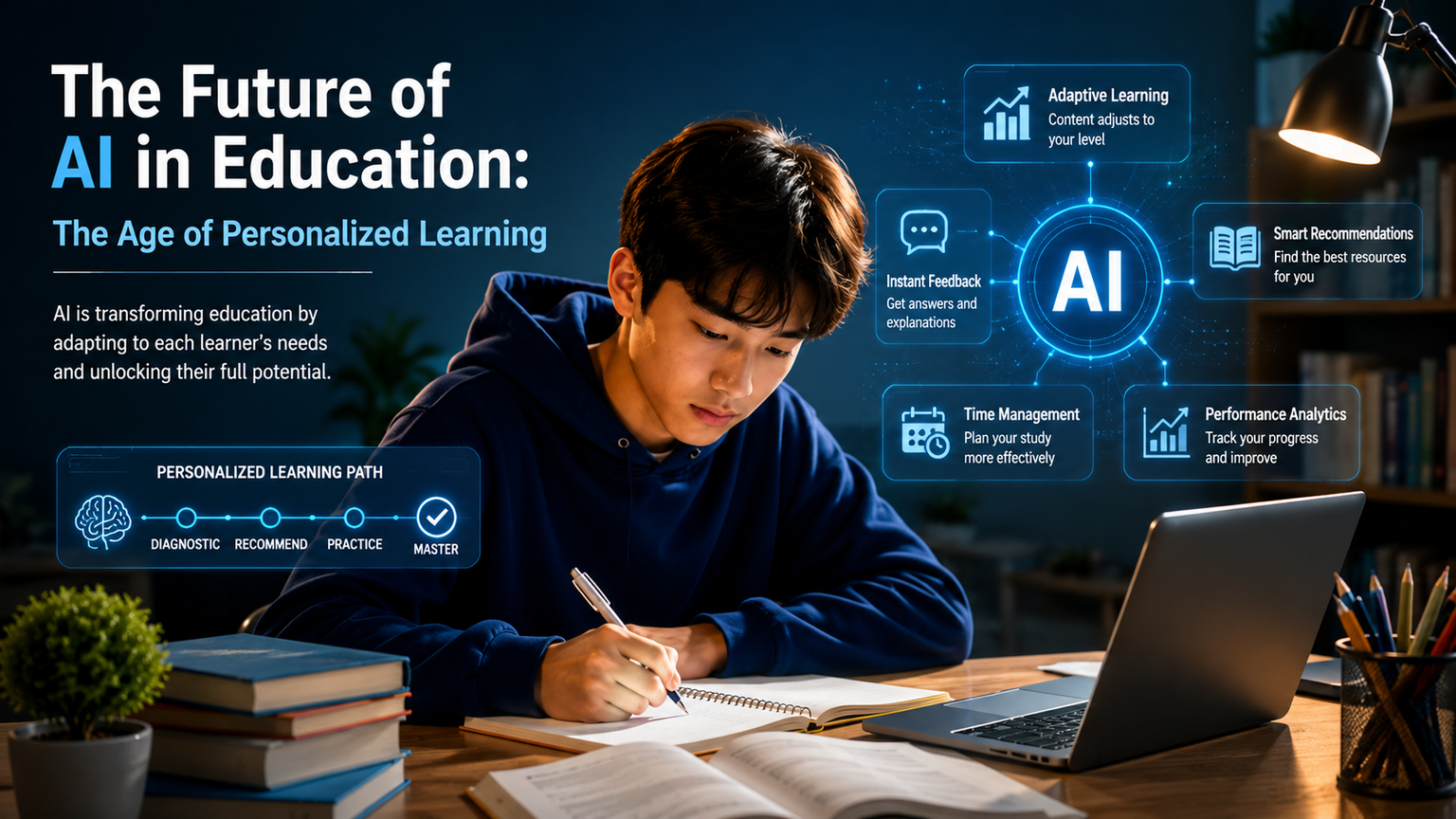
    Related reading: For a broader look at personalized learning, AI tutors, student engagement, and the future of education, read Future of AI in Education.

  • AI for Small Business in 2026: Start With the Receipt, Not the Chatbot

    AI for Small Business in 2026: Start With the Receipt, Not the Chatbot

    When people talk about AI for small business, they often start with chatbots.

    They think about writing marketing copy, answering emails, creating social media posts, or generating images.

    But for a restaurant, salon, retail store, local service business, or online shop, the best place to start may be far less exciting.

    Start with the receipt.

    You buy supplies and receive a receipt. You put it in your pocket, an envelope, or a drawer. Days or weeks later, someone takes it out again, checks the date, identifies the vendor, enters the amount, checks the tax, chooses an expense category, and records the same information in a spreadsheet or accounting system.

    The information already existed when the transaction happened. Someone is simply entering it again.

    That is a useful way to think about AI and automation in a small business:

    Before using AI to create more work, look for work your business is already doing twice.

    AI adoption among small businesses is growing quickly. According to QuickBooks business insights, 80% of U.S. businesses with 0–100 employees said they regularly use AI-enabled tools, and 41% said they use them daily. Among businesses using AI, 24% said AI had shortened their workdays, while 12% said it had made their workdays longer.

    A separate 2025 U.S. Chamber of Commerce report found that 58% of small businesses said they used generative AI, up from 40% in 2024 and 23% in 2023. The surveys use different definitions and samples, so the percentages should not be directly compared, but both point in the same direction: AI use is becoming increasingly normal in small business.

    But adoption is not the interesting part. The more important question is:

    Where is the business still moving the same information by hand?

    Start With the Receipt

    Small businesses generate expenses all day. A restaurant buys ingredients. A salon orders products. A repair business buys parts. A store pays for packaging. An employee uses a company card.

    Every transaction creates another piece of information that eventually has to be recorded.

    The traditional workflow often looks like this:

    Purchase → Keep receipt → Find it later → Read it → Enter the data → Categorize the expense → Enter it into another system → Check it again

    There is obvious duplication.

    A more efficient workflow can begin at the moment the transaction happens. The receipt is photographed with a phone. Document-recognition software extracts information such as the date, vendor, total and tax. The expense is categorized or prepared for the accounting system, and a person checks the result.

    Purchase → Receipt photo → Data extraction → Expense categorization → Accounting workflow → Human review

    The goal is not to remove the human. It is to move the human from data entry to verification and judgment.

    This matters because many small businesses still manage financial information through fragmented processes. The same QuickBooks survey reported that 53% of U.S. small businesses used spreadsheets for financial management, while 31% still used pen and paper. More than one-third, 36%, reported problems caused by poor integration between their different digital systems.

    What Can Receipt Automation Actually Save?

    A real business example helps put the idea into perspective.

    Smile Box, a small U.K. business, was processing around 200 receipts every week. In a customer case study published by Dext, the business reported saving around 20 hours per month after changing the way those receipts were handled.

    There is an important qualification. This is a vendor-published customer case study, not an independent academic study. It does not mean every business will save 20 hours.

    What it does demonstrate is more useful: if a business processes a large number of receipts and repeatedly enters the same information by hand, there is a measurable process worth examining.

    Before buying any software, measure your own business. How many receipts do you process every month? How much time does month-end expense entry take? How often are receipts lost? How many times does the same transaction information get entered into different systems?

    Those numbers matter more than an AI feature list.

    Once the Receipt Becomes Data, the Business Becomes Easier to See

    Digitizing a receipt is not the final goal. The real value begins when the information inside that receipt becomes usable business data.

    Consider this simple illustrative example:

    Expense CategoryThis MonthQuestion to Ask Next
    Materials$2,300Did material costs rise faster than revenue?
    Advertising$700Did new customer acquisition rise too?
    Shipping$420Is shipping cost per order increasing?

    When those numbers exist only inside a pile of receipts, an owner may simply feel that expenses are rising.

    Once the information is structured, better questions become possible. Which expense increased the most compared with last month? Did material costs rise faster than revenue? When advertising spending increased, did new customer acquisition increase as well?

    An expense receipt has now become more than proof of purchase. It has become part of the operating picture of the business.

    The same principle applies to customers.

    Imagine someone sends a message asking: “Do you have an appointment available Friday at 3 p.m.?”

    An employee replies and books the appointment. Operationally, the job appears finished. But from a business-data perspective, several questions remain.

    Was this a new or returning customer? Which service did they request? Where did they discover the business? Did they attend the appointment? Did they return later? How much revenue did the visit generate?

    If that information remains buried inside messages or employee memory, it cannot easily be measured.

    The goal is not to collect every possible piece of customer information. The goal is to turn the information that genuinely matters into something the business can use.

    Use Gemini After You Have Something Worth Analyzing

    This is where an AI system becomes more useful.

    If a business has almost no organized data and asks an AI, “How can I increase my sales?”, the answer will probably be generic: improve customer service, run promotions, use social media, or strengthen marketing.

    Those ideas may be reasonable, but they are not an analysis of that particular business.

    Now imagine that six months of revenue, expenses, advertising spending, new customers, returning customers, appointments and cancellations have been organized.

    The questions can become much more specific:

    • Compare revenue growth with material-cost growth over the past six months.
    • Find the weakest day of the week by revenue.
    • Compare changes in advertising spending with changes in new customer acquisition.
    • Identify any month when appointments increased but revenue did not.

    Gemini is one example of an AI tool that can be used at this stage. Google’s Gemini Apps documentation says users can upload spreadsheets and other files to get answers, summaries and insights based on their contents, and Gemini can generate charts from uploaded spreadsheet data.

    But there is an important distinction between finding a pattern and proving a cause.

    Suppose advertising spending rose at the same time as revenue. An AI system may suggest that advertising caused the increase. That conclusion may be wrong. Seasonality, pricing, a new employee, a competitor closing nearby, better weather, or many other factors may have contributed.

    AI can help identify the pattern and suggest the next question. The business still has to verify the explanation.

    Find the Places Where Information Is Entered Twice

    Once expenses and customer data are becoming structured, look at what happens between systems.

    A new inquiry arrives through a website. An employee reads it. The customer name is entered into a booking system. The same information is entered into another customer record. A staff member is notified. A confirmation message is sent. An appointment is added to a calendar.

    One customer has caused the same information to move through several systems.

    That is another strong automation candidate.

    New inquiry → Customer record → Booking → Staff notification → Customer confirmation

    An automation platform such as Zapier is one example of a technology that can connect these steps. But the product itself is not the point.

    The important question is: Why is a person carrying the same information from one system to another?

    A small pet resort called Waggles provides a useful example. According to a customer case study published by Zapier, the business automated parts of its scheduling, customer communication and administrative workflow and reported saving 15 to 20 hours per week, while reducing administrative time by 75%. The company also reported handling more customers without adding staff.

    Again, this is a vendor-published customer story, not proof that another business will achieve the same result.

    The lesson is not “use Zapier and save 20 hours.” The lesson is: measure automation by the work it actually removes.

    Suppose an automation service costs $30 per month. After introducing it, you measure that an employee saves five hours per month. If that employee’s time costs the business $25 per hour:

    5 hours × $25 = $125

    Subtract the $30 software cost:

    $125 − $30 = $95

    That gives a simple potential monthly time-value of $95.

    A proper calculation should go further. Did errors decrease? Did customer response times improve? Were fewer appointments missed? Did employees gain more time for revenue-producing work? Did maintaining the automation create additional work?

    The useful question is not, “How many AI features does this software have?” It is, “What work disappeared after we started paying for it?”

    Some Decisions Should Stay Human

    Not every repetitive-looking process should be handed to AI.

    Receipt extraction, routine data transfer, reminders, basic classification and document organization can often be checked easily by a person.

    Tax filings, contracts, legal disputes, employee conflicts, hiring and firing decisions, major financial commitments and other high-impact decisions require a different level of judgment.

    Small-business owners themselves appear to recognize this boundary. A 2026 QuickBooksbusiness owners found that 42% expected a future in which humans continue to lead while AI assists them. Only 6% expected AI to make most business decisions. When asked about high-stakes cost-cutting and growth advice, 37% trusted a human expert, compared with 20% who would trust AI alone.

    Data security creates another boundary.

    Customer personal information, employee records, payment information, contracts, tax documents and confidential financial information should not simply be copied into an AI service because doing so is convenient.

    The U.K. National Cyber Security Centre warns that generative AI systems can present incorrect statements as facts and can be vulnerable to prompt-injection attacks that may lead to unintended behavior or the disclosure of confidential information.

    Before using sensitive business data with an AI service, a business should understand where the data is stored, how long it is retained, what administrator controls exist, and whether the information can be deleted.

    And if customer names, phone numbers, payment details or other personal information are not needed for the analysis, the simplest protection is often to remove or anonymize them before uploading the data.

    FAQ

    What AI should a small business start with?

    Do not start with a product. Start with the business process that consumes the most repetitive time. If several hours every month are spent entering receipts, start there. If missed appointments are the bigger problem, organize customer and booking data first. Choose the problem before choosing the software.

    Is photographing receipts really worth automating?

    It can be when a business processes many receipts and later enters the information manually. Receipt handling is repetitive, the required fields are usually predictable, and the output can be checked against the original document. The Smile Box case study reported around 20 hours saved per month, but remember that this was a vendor-published customer case, not a guaranteed result for every business.

    Why not recommend one receipt app as the best?

    Because the best choice depends on the country, tax system, accounting software, number of employees, document volume and existing workflow. A tool that works extremely well for one business may create more work for another. The better question is: “Does this fit our existing accounting workflow and reduce actual data-entry time?”

    Where can Gemini be useful for a small business?

    Gemini can be useful after a business has structured data worth analyzing. For example, a business might use spreadsheet data to compare monthly expenses, identify weak sales periods or examine changes in advertising spending and customer acquisition. Google documents support for Gemini spreadsheet analysis.

    Does AI actually save small businesses time?

    Sometimes, but not automatically. In QuickBooks’ July 2026 survey, 24% of AI-using respondents said AI had shortened their workdays, while 12% said their workdays had become longer. That is why implementation should be measured. If an AI tool adds another dashboard, another subscription and another process without eliminating existing work, it may not be an improvement.

    How should a small business calculate automation ROI?

    Start with time. Measure how long the process takes before automation and again afterward. Then compare the value of the time saved with subscription, setup and maintenance costs. After that, consider other measurable effects such as fewer errors, faster customer responses, fewer missed appointments or increased capacity.

    Can I upload my customer list or sales records directly to Gemini?

    Not without considering what the file contains. First check the service’s data-handling terms and your own business policies. If an analysis does not require customer names, phone numbers, payment information or other identifying data, remove or anonymize those fields before uploading the file. Do not provide sensitive data simply because the AI does not need you to type it manually.

    Can AI replace an accountant or tax professional?

    AI can reduce administrative work such as extracting receipt information, organizing documents and identifying patterns. That is different from taking professional responsibility for accounting treatment, tax filings or regulatory compliance. High-impact accounting and tax decisions should receive appropriate professional review.

    Conclusion: A Good AI Strategy Can Start With One Receipt

    A small business does not need a grand AI strategy to begin.

    You buy something today. A receipt appears. Instead of putting it in a drawer, you capture it. The receipt becomes expense data. Over time, that data shows where money is going.

    Customer inquiries and appointments become another layer of operating data. Once reliable information exists, an AI system such as Gemini can help examine patterns. And when employees are repeatedly moving the same information between systems, those steps can be candidates for automation.

    The progression is simple:

    Receipt → Expense → Customer → Data → Analysis → Automation

    So perhaps the first question for a small business should not be:

    “Which AI should we buy?”

    A better question is:

    “Did someone in our business enter the same information twice today?”

    If the answer is yes—and a receipt is sitting in a pocket waiting to be typed into a system again later—that receipt may be the best place to start.

  • 10 Practical Ways to Use AI at Work in 2026

    10 Practical Ways to Use AI at Work in 2026

    AI at work is often explained as a list of features: write emails, summarize documents, analyze data, build presentations, and automate repetitive tasks.

    But that does not answer the question most employees actually have:

    Where does AI fit into a normal working day, and where should it stop?

    By mid-2026, AI had already become part of everyday work for a large share of U.S. employees. Gallup reported in July 2026 that 52% of U.S. employees used AI in their role, 30% used it a few times a week or more, and 15% used it daily. Among AI users, writing, research, and problem-solving were among the most common uses.

    Productivity gains are real, but they are not universal. A study of 5,179 customer support agents found that access to a generative AI assistant increased issues resolved per hour by 14% on average, with much larger gains for less-experienced workers. At the same time, research with 758 BCG consultants showed a more complicated picture: AI made people faster and improved performance on tasks inside its capabilities, but could hurt accuracy on tasks outside that boundary. Harvard researchers describe this uneven boundary as a “jagged technological frontier.”

    That leads to a more useful way to think about AI at work. Do not begin by asking which jobs AI can take over. Begin by asking where your day repeatedly slows down because you have to organize, summarize, compare, structure, or prepare information before you can make a decision.

    The best role for AI is often not replacing the decision. It is reducing the friction before the decision.

    1. 8:40 AM — Start With the Mess, Not a Perfect Plan

    Most workdays do not begin with a clean schedule. You open your inbox and find customer questions, a message from your manager, documents that need review, a meeting that starts in twenty minutes, and several tasks competing for the same afternoon.

    Instead of asking AI to “plan my day,” give it the actual mess.

    Imagine that your morning begins with 14 customer emails, two meetings, three documents to review, four tasks due today, and two items waiting on someone else.

    A more useful prompt would be:

    “Separate these items into four groups: decisions I must make today, tasks waiting on someone else, items I can finish in 30 minutes or less, and work that can wait. Do not change the deadlines.”

    Now AI is not deciding what matters most. It is turning a crowded list into something you can inspect.

    The final priority should still be yours. A manager may know that a seemingly small customer issue is strategically important, or that a meeting can be moved even though the calendar says otherwise. AI sees the information you provide; it does not automatically understand every hidden business priority.

    2. 9:10 AM — Let AI Disassemble an Email Before It Drafts the Reply

    Suppose a customer sends a long message saying that an order from last month has not arrived, a previous support request went unanswered, they want a new delivery date, and they also want to know whether a refund is possible.

    The slow part may not be writing the reply. The slow part is identifying everything that actually needs an answer.

    Instead of immediately asking AI to draft a response, ask:

    “Break this email into the questions and actions we must address. Mark anything that requires verification. Do not invent an answer for missing information.”

    • Check the current shipping status.
    • Review the earlier customer-service record.
    • Confirm the expected delivery date.
    • Check the refund policy that applies to this order.
    • Decide whether an apology or service recovery is appropriate.

    Only after those points are verified should a final response be written or approved.

    This is a better use of AI because it reduces the chance of missing part of the customer’s request. It also matches the way AI is increasingly used in real workplaces: Gallup’s 2026 data show that writing, research, and problem-solving are among the most common tasks employees perform with AI.

    3. 9:50 AM — Read a Long Document Backwards

    A common mistake is asking AI to summarize a long document and then assuming the summary contains everything important.

    A safer approach begins with the decision you need to make.

    Imagine reviewing a 30-page vendor proposal. If the real question is whether the agreement is ready for approval, ask AI to locate the sections related to:

    • Total cost and additional fees
    • Contract term and renewal conditions
    • Termination conditions
    • Deadlines and service commitments
    • Responsibilities and unresolved risks

    Then go back to the original pages and verify the wording yourself.

    AI can reduce the time needed to find relevant sections. It should not become the final authority on legal language, financial commitments, deadlines, or obligations. The useful workflow is locate first, verify second, decide third.

    4. 10:45 AM — Turn a Meeting Into Work Before Everyone Forgets It

    The meeting ends. Everyone remembers the discussion, but a few days later the same question appears: “Who agreed to do what?”

    Instead of asking AI to create a polished meeting summary that nobody reads, ask it to separate the meeting into decisions, unresolved issues, owners, and deadlines.

    DiscussionAI-Structured OutputHuman Check
    Product launch timingTarget launch: OctoberConfirm the exact date
    Marketing budgetSarah prepares a revised budgetConfirm owner and budget scope
    Website changesComplete changes by FridayConfirm scope and deadline
    Pricing disagreementDecision required at next meetingConfirm decision maker

    The table above is an illustrative example, but the workflow is practical. AI becomes more valuable when it converts conversation into the structure required for action.

    Before sharing the result, verify names, deadlines, and responsibilities against the original notes or transcript. A small mistake in an action item can become a much larger operational problem.

    5. 11:30 AM — Ask AI to Find the Question Hidden Inside the Data

    Suppose a spreadsheet shows that sales fell last month. Asking “Why did sales fall?” is dangerous because the data may show what changed without proving why it changed.

    Consider this illustrative dataset:

    ProductJuly SalesAugust Sales
    A$40,000$39,000
    B$32,000$19,000
    C$21,000$22,000

    Total sales fell from $93,000 to $80,000, a decline of $13,000. Product B fell by $13,000, Product A fell by $1,000, and Product C rose by $1,000. That tells us where to investigate first, but it does not prove the cause.

    A better prompt is:

    “Identify which product contributed most to the overall decline. Then list the additional data I would need before claiming a cause.”

    The next questions might involve unit volume, price changes, inventory shortages, regional performance, promotions, returns, or competitor activity.

    This changes AI from an answer machine into an investigation assistant. It can help identify a pattern and suggest the next question. It cannot automatically know the business reason behind the pattern.

    6. 1:20 PM — Use AI When You Do Not Yet Know What to Search For

    Research often becomes slow before the real research begins. You may know the general topic but not the terminology, companies, technologies, regulations, or questions that matter.

    Suppose you want to understand the AI semiconductor industry. Instead of asking AI to write the final explanation immediately, ask it to build a research map first.

    • GPU and NPU
    • HBM memory
    • Foundry manufacturing
    • AI networking
    • Data-center power demand
    • Major chip designers and manufacturers
    • Supply-chain constraints
    • Capital spending
    • Market size and growth

    Then verify each factual area using the most appropriate source: company filings for company numbers, government agencies for policy, technical documentation for product capabilities, and established research or news organizations for current developments.

    Use AI to find the questions. Use reliable primary or authoritative sources to find the facts.

    7. 2:10 PM — Turn a Blank Presentation Into Something You Can Criticize

    A blank slide can waste more time than a bad first draft.

    Instead of asking AI to create an entire presentation, tell it who the audience is and what decision you need from them.

    If managers are deciding whether to adopt an AI customer-support system, a useful first structure might include:

    • The current support problem
    • Current operating cost
    • Expected benefit
    • Effect on employees
    • Privacy and security risks
    • Implementation cost
    • Deployment timeline
    • The decision management must make

    Now you have something to challenge. Remove weak assumptions, change the order, add real evidence, and replace generic AI language with facts specific to the organization.

    The value of that division of labor is supported by the BCG field experiment involving 758 consultants. For tasks within AI’s capabilities, participants using GPT-4 completed work more than 25% faster, achieved more than 40% higher human-rated performance, and completed over 12% more tasks. But the same research also showed that AI’s value changes sharply when the task moves outside its strengths.

    That is why AI can be excellent at creating the first structure without being qualified to make the final business judgment.

    8. 3:00 PM — Give Repetitive Work a Standard Shape

    Some tasks are not difficult. They are simply repeated.

    Weekly updates, customer summaries, project reports, follow-up notes, and internal announcements often use the same structure again and again.

    A reusable AI-assisted template can look like this:

    Situation — What happened this week?

    Important Change — What is different from last week?

    Required Action — What needs to happen next?

    Deadline — When must it be completed?

    Each week, provide the new facts and let AI organize them into the same structure. The benefit is not just faster writing. Consistency makes reports easier for other people to scan, compare, and act on.

    This is where AI stops being only a writing tool and starts becoming a workflow standardization tool.

    9. 4:00 PM — Ask AI to Attack Your Draft

    AI does not always need to create something. Sometimes its more useful role is to criticize something you already created.

    Before sending an important proposal, report, or email, try prompts such as:

    • “Act as a CFO who does not want to approve this proposal. Identify the five weakest claims.”
    • “If a competitor publicly challenged this report, which claim would be easiest to attack?”
    • “Find sentences that sound confident but are not supported by evidence.”
    • “What important question would a skeptical reader still have after reading this?”

    This can expose weaknesses that are easy to miss after working on the same document for hours.

    You do not have to accept every suggestion. The purpose is to create another angle of review before a human makes the final call.

    10. 4:50 PM — End the Day by Preparing Tomorrow

    The last ten minutes of the day are often spent trying to remember what was not finished.

    Suppose your notes contain four loose items:

    • Waiting for John’s answer
    • Revise the budget sheet
    • Prepare materials for tomorrow’s customer meeting
    • Check a new supplier’s pricing

    AI can reorganize those notes into a cleaner handoff to tomorrow:

    Must continue tomorrow: Customer meeting materials

    Waiting on someone else: John’s answer

    Can be postponed if necessary: Supplier pricing review

    Needs a decision: Direction for the budget revision

    Review the list yourself before leaving. Tomorrow morning, instead of reconstructing yesterday from memory, you already have a starting point.

    The Real Productivity Gain Happens Between Tasks

    The biggest value of AI at work may not come from writing faster.

    It may come from reducing the small delays between one task and the next: reading an email and deciding what it means, finishing a meeting and deciding what happens next, opening a document and deciding where to look, seeing a spreadsheet and deciding what question to ask, or starting a presentation and deciding how to structure it.

    These transitions consume more time than most people notice.

    AI’s most useful productivity role is often not removing human judgment. It is shortening the time it takes to reach the next human judgment.

    The research also explains why organizations should avoid one-size-fits-all promises. In the customer-support study, average productivity rose by 14%, but gains were much larger for novice and lower-skilled workers and minimal for the most experienced workers. In the BCG experiment, AI produced major gains on some tasks but created risk on others. The useful question is therefore not “How much productivity does AI add?” but “Which specific part of this workflow is AI actually good at?”

    Where AI Should Stop

    As AI becomes easier to use, the boundary around sensitive information becomes more important.

    The U.S. Cybersecurity and Infrastructure Security Agency advises users to avoid sharing sensitive or confidential information with AI models, including workplace company data and personal details. Its Secure Our World AI guidance makes the rule simple: do not share something with an AI service if you would not want it exposed publicly.

    That means employees should be especially careful with:

    • Customer personal data
    • Unpublished contracts
    • Internal financial information
    • Passwords or authentication information
    • Employee records
    • Medical or other sensitive personal information
    • Trade secrets
    • Unreleased products or business plans

    Organizations may provide approved enterprise AI systems with different privacy, retention, and security controls. Employees should follow their organization’s policies and the terms of the specific service they are using.

    There is another boundary: accuracy. The U.K. National Cyber Security Centre warns that generative AI can produce incorrect statements as facts, commonly called hallucinations. Its AI and cyber security guidance also highlights risks including bias, prompt injection, and the exposure of confidential information.

    Important calculations, names, dates, quotations, sources, financial figures, legal wording, and business commitments should therefore be checked against the original source.

    A confident sentence is not the same thing as a verified fact.

    A Practical Order for Bringing AI Into Your Workday

    You do not need to attach AI to every task at once. Start with work that has three characteristics:

    • It happens repeatedly.
    • It takes time to prepare or organize.
    • A human can easily review the result.

    A practical order might be email classification, meeting action items, recurring reports, document navigation, data-question generation, and draft review.

    Measure whether the process actually saves time and improves quality. If it does, expand. If it creates extra checking work or introduces unacceptable risk, pull it back.

    The “jagged frontier” matters because two tasks that look similar to a human may be very different for an AI system. The strongest workflow is not blind automation. It is deliberate division of labor between the machine and the person responsible for the outcome.

    FAQ

    Does AI actually make employees more productive?

    Yes, in some tasks. The study of 5,179 customer-support agents found a 14% average increase in issues resolved per hour after workers gained access to a generative AI assistant. The BCG consultant experiment also found substantial gains in speed, task completion, and human-rated performance for tasks inside AI’s capabilities. Those numbers should not be treated as a universal productivity rate because results vary by worker, task, tool, and workflow.

    Should employees use AI for every task?

    No. AI is most useful when the task matches its strengths and the output can be reviewed. Research on the jagged technological frontier showed that AI can improve performance dramatically on some knowledge-work tasks while making people more likely to accept a wrong answer on tasks outside that frontier.

    Can AI-generated summaries or analysis be trusted without checking them?

    No. Generative AI can produce incorrect statements in convincing language. Important figures, dates, sources, quotations, contractual terms, and conclusions should be verified against the original material.

    Is it safe to upload company documents to ChatGPT or another AI service?

    It depends on the organization’s policy and the specific service being used. Employees should not upload confidential, personal, or sensitive information to a public AI service unless it is explicitly permitted. Enterprise services may offer different data-handling controls, but company policy should come first.

    What is the easiest way to start using AI at work?

    Choose one small recurring task that takes time but does not require major judgment. Good starting points include classifying emails, extracting meeting action items, organizing recurring reports, locating sections in long documents, or challenging a draft. Review the output yourself and expand only when the workflow proves useful.

    Can AI make important business decisions for me?

    AI can help prepare a decision by organizing evidence, comparing options, identifying missing information, and challenging assumptions. Final responsibility should remain with the person or organization accountable for the decision, especially when money, legal obligations, employment, security, health, or sensitive personal information is involved.

    Conclusion — The Best AI Workflow Keeps the Human Decision

    AI becomes more useful at work when it stops being treated as a machine that must do everything.

    Let AI organize the mess.

    Let AI locate the parts of a document that deserve attention.

    Let AI turn a meeting into action items.

    Let AI find the next question hidden inside the data.

    Let AI create a first structure and challenge a draft.

    Then let the human verify the evidence and decide what matters.

    Using AI well at work in 2026 is not about handing over more and more responsibility. It is about knowing exactly where AI can reduce friction, where verification is required, and where human judgment must remain in control.

  • The Future of AI in Education: The Age of Personalized Learning

    The Future of AI in Education: The Age of Personalized Learning

    Information checked: September 4, 2026

    Artificial intelligence is beginning to change education in a fundamental way. For decades, most classrooms have followed a similar model: one teacher explains the same material to many students, and the class moves forward at roughly the same pace.

    But students are not the same.

    One student may understand a concept after a single explanation, while another may need to hear it three different ways. A student who loses interest in a math worksheet may stay focused for hours on football statistics, games, cars, space, music, or history.

    This is where AI can change the learning model. Instead of giving every student the same explanation, AI-powered education can adapt explanations, examples, practice, feedback, and pacing to the learner’s level, interests, and responses.

    The OECD Digital Education Outlook 2026 says generative AI can support learning as a tutor, partner, or assistant when it is guided by clear pedagogical goals. The same report also warns that using general-purpose AI to complete tasks can improve immediate performance without necessarily producing lasting learning gains.

    What Is AI-Powered Personalized Learning?

    Personalized learning means adapting education to the needs of an individual learner.

    Traditional digital learning often gives every student the same video, reading, or quiz. AI can respond more dynamically.

    A student struggling with fractions might receive a simpler explanation using pizza slices. A student who already understands fractions could move to ratios or probability. A football fan could learn percentages through shot-conversion rates. A student interested in cars could explore physics through speed, braking distance, and acceleration.

    Personalization is therefore not only about making a problem easier or harder. It is also about changing how the same idea is explained.

    The Biggest Learning Problem Is Not Always Difficulty

    Students do not lose focus only because a subject is difficult. Sleepiness, boredom, and lack of interest can also shut down attention.

    However, true sleep deprivation and classroom boredom are different problems.

    Sleep Deprivation Comes First

    No amount of entertaining content can fully compensate for too little sleep. The U.S. CDC guidance explains that adequate sleep is important for student attention and academic performance, and recommends 8 to 10 hours of sleep per day for teenagers ages 13 to 18.

    If a student is genuinely sleep-deprived, the first solution is more sleep, not more stimulation.

    Boredom Is a Different Problem

    If a well-rested student loses attention only when a lesson feels irrelevant, the problem may be engagement rather than sleep. That is where personalization can matter.

    AI can change the example, the format, the difficulty, or the next question before the learner completely disengages. The goal is not to force students to stay awake. It is to give them a reason to stay curious.

    Personalization Should Include Interests, Not Just Ability

    Many personalized-learning systems focus on performance: what the student knows, what the student missed, and what difficulty should come next.

    The next step is to consider what the student actually cares about.

    The same percentage lesson can use football statistics, game probabilities, cooking ratios, shopping discounts, or music streaming data. The mathematical idea remains the same, but the entry point changes.

    Khan Academy’s teacher tools include a Khanmigo feature called Make it Relevant!, which is designed to connect lesson content to students’ lives and interests in order to boost engagement.

    This is an important shift. Personalized education should not only ask, “What level is this student?” It should also ask, “What makes this student want to know more?”

    Real Examples of AI-Powered Learning

    1. Khanmigo: An AI Tutor That Asks Questions

    Khan Academy describes Khanmigo as an AI-powered tutor and teaching assistant. Rather than simply giving a final answer, it can use questions, hints, and explanations to help a learner continue thinking.

    For example, if a student is stuck on an equation, an AI tutor can ask what operation should be applied to both sides instead of immediately revealing the answer. The objective is to support the student’s reasoning rather than replace it.

    Khan Academy’s Khanmigo community guidance emphasizes learning, exploration, deeper thinking, and academic integrity rather than using AI as a shortcut around the learner’s own work.

    How Much Does It Cost? AI Tutoring vs. Private Education

    For parents, one of the most practical questions is simple: How much does AI tutoring cost each month compared with private education?

    South Korea offers a useful comparison because private education is widely used. According to the Korea education survey, average monthly spending was about $339 per student across all students and about $447 per month among students who actually participated in private education. These dollar amounts are approximate conversions using the September 4, 2026 Seoul reference exchange rate reported by Yonhap News Agency; exchange rates change over time.

    By comparison, Khan Academy lists its individual Khanmigo plans. Those individual plans are currently available only in the United States, so the price should be treated as an example of low-cost AI tutoring rather than a service that every family worldwide can buy under the same conditions.

    ComparisonTraditional Private EducationAI Tutor Example
    Typical monthly cost exampleAbout $447 per month among South Korean students participating in private educationKhanmigo U.S. Learner or Parent plan: $4 per month
    Repeated questionsDepends on class size, schedule, and teacher availabilityCan repeat explanations and questions on demand
    Personalized pacingVaries by academy, class, and tutorCan adapt explanations and practice to the learner
    Schedule and test managementStrong advantageMore limited
    Human observation and motivationStrong advantageLimited
    Peer interactionAvailable in group classesUsually limited

    This is not a direct price comparison between identical services. Private academies provide human supervision, fixed schedules, test preparation, accountability, and social interaction. AI tutoring has a different strength: low-cost access to repeated explanations, practice, feedback, and questions at almost any time.

    The more useful question is therefore not, “Can AI eliminate private education?” It is: Which parts of paid tutoring truly require a human teacher, and which parts can a low-cost AI tutor handle effectively?

    For some students and subjects, AI may reduce the amount of paid tutoring needed rather than replace it completely.

    2. Kahoot!: Turning Passive Material into Interactive Practice

    AI can also make learning more engaging by changing the format of the lesson. Kahoot! says its AI tools can generate interactive quizzes and games from topics, PDFs, and web pages.

    Instead of listening to a long explanation without interruption, students can predict what happens next, answer questions, receive instant feedback, and participate throughout the lesson.

    A history lesson, for example, can stop at a turning point and ask, “What do you think happened next?” or “What decision would you have made?” The student becomes a participant rather than a passive listener.

    3. Duolingo: Making Language Practice Feel Like a Conversation

    Duolingo’s AI-powered Video Call with Lily gives learners conversational practice with an AI character. Duolingo says Lily adjusts to the learner’s skill level and can respond in real time as the conversation develops.

    This changes the learning experience. Memorizing vocabulary from a list feels very different from trying to use the same language in a simulated conversation. AI can add context, spontaneity, and a reason to keep responding.

    AI Can Teach at Different Speeds

    Students rarely learn at exactly the same speed. In a conventional classroom, a teacher must keep the group moving. Some students may advance before they are ready, while others repeat material they already understand.

    AI-supported systems can provide extra examples and practice when a learner is struggling and introduce more advanced work when the learner is ready. The learning path can change according to progress instead of following only a fixed calendar.

    Instant Feedback Matters

    Learning can slow down when a student has to wait days to understand why an answer was wrong. AI can respond while the student is still working on the problem.

    But the best educational AI should not always reveal the answer immediately. It can ask:

    • What do you think the next step should be?
    • Why did you choose that answer?
    • Can you solve the problem another way?
    • Which part is confusing?
    • What evidence supports your conclusion?

    The OECD warns that outsourcing cognitive work to general-purpose AI can improve task performance without creating the same learning gains. Educational AI is more valuable when it preserves effort, reasoning, and independent thinking.

    AI Can Help Teachers Too

    The future of AI in education is not only about students. Teachers may benefit just as much.

    AI can help generate lesson ideas, practice questions, differentiated materials, rubrics, and discussion prompts. According to the OECD Digital Education Outlook 2026, 37% of lower-secondary teachers used AI for their work in 2024, and 57% agreed that AI helps write or improve lesson plans.

    If repetitive preparation takes less time, teachers can spend more time observing students, explaining difficult ideas, and providing human support.

    The most realistic model is not teacher versus AI. It is teacher plus AI.

    Where AI Could Be Most Useful

    Learning SituationHow AI Can HelpHuman Role Still Needed
    Different learning speedsAdjust difficulty, examples, and practice based on progressSet learning goals and decide when intervention is needed
    Students who are stuckOffer hints, alternative explanations, and step-by-step questionsDiagnose deeper misconceptions and provide encouragement
    Students losing interestUse relevant examples, quizzes, and interactive activitiesObserve real emotions, motivation, and classroom behavior
    Practice and reviewGenerate targeted exercises and immediate feedbackEnsure practice matches the curriculum and learning objectives
    Language learningProvide conversational practice and role-playGuide cultural meaning, nuance, and communication skills
    Teacher preparationSuggest questions, materials, rubrics, and differentiated activitiesVerify accuracy and make professional instructional decisions

    The Limits and Risks of Personalized AI Learning

    1. AI Can Be Wrong

    Generative AI can produce incorrect, incomplete, or misleading information. Important facts, calculations, and educational materials should be checked against reliable sources.

    2. Overdependence Can Weaken Learning

    If students use AI whenever work becomes difficult, they may finish assignments without developing the underlying knowledge and skills. Productive struggle, practice, and independent thinking still matter.

    3. Fun Should Not Become the Goal

    Interest and enjoyment are powerful ways to bring a student into a lesson, but not every part of learning will feel like a game. AI should not remove every difficult moment. Its job is to make difficult learning meaningful enough that the student wants to continue.

    4. Privacy and Student Data Matter

    Personalization may involve information about a learner’s progress, mistakes, interests, and conversations. Schools and families should understand what data is collected, how it is protected, and whether a tool is appropriate for the student’s age.

    5. Teachers Remain Essential

    Education involves motivation, judgment, relationships, emotional support, classroom culture, and social learning. AI can expand what teachers can do, but it does not remove the need for human educators.

    What the Future Classroom May Look Like

    A future classroom may combine whole-class teaching, small-group discussion, hands-on projects, independent practice, and AI-supported tutoring.

    A teacher might introduce a concept to the class and then let students practice at different levels. AI could provide extra examples to students who are stuck, more advanced problems to students who are ready, and interactive questions to students whose attention is fading.

    If a student shows strong interest in one topic, AI could also help connect that interest to another subject: football to statistics, cars to physics, dinosaurs to biology and geology, or music to mathematics and language.

    The teacher would still decide what matters, observe the student as a person, and judge whether the learner truly understands.

    How Parents and Teachers Can Use Educational AI Wisely

    • Use AI to explain and guide, not simply to supply final answers.
    • Ask students to explain the reasoning in their own words after receiving AI help.
    • Connect examples to the student’s real interests whenever possible.
    • Verify important facts, calculations, and educational materials.
    • Choose tools with appropriate privacy, age, and learning safeguards.
    • Keep teachers, parents, and other trusted adults involved in important learning decisions.
    • Balance AI-supported learning with reading, writing, discussion, physical activity, creativity, and real-world experience.

    One simple test is especially useful. After AI explains something, ask the student: “Can you explain it again in your own words?”

    If the student cannot explain it, the AI may have solved the problem without the student actually learning it.

    Curiosity May Be the Real Starting Point of Personalized Learning

    Students are not machines. They have attention, emotions, interests, and curiosity.

    A truly personalized education system should therefore measure more than scores and mistakes. It should also notice what makes a learner’s eyes light up.

    Interest creates questions. Questions lead to information. Information can lead to books, videos, new vocabulary, experiments, museums, biographies, history, science, and eventually self-directed learning.

    The most valuable role for AI may not be studying on behalf of the child. It may be keeping the child’s curiosity alive long enough to reveal the next question and the next path.

    FAQ

    Can AI replace a private academy or human tutor?

    Not completely. AI is strong at repeated explanations, practice, feedback, and on-demand questions. Human teachers are still better at motivation, accountability, emotional support, test strategy, and observing the learner as a whole person.

    Can AI help students stay focused?

    It can help when attention drops because the lesson feels irrelevant or too easy, too hard, or too passive. AI can change examples, difficulty, and interaction. But it cannot replace adequate sleep when a student is genuinely sleep-deprived.

    How much can an AI tutor cost each month?

    Prices vary widely. One current example is Khanmigo’s U.S. Learner and Parent plans at $4 per month. For context, South Korean students who participated in private education spent about $447 per month on average in 2025 after conversion to U.S. dollars. These are not equivalent services, but the difference shows why low-cost AI tutoring is attracting attention.

    Conclusion

    AI is making personalized education more realistic. Students can receive explanations at the moment they need them, practice at an appropriate level, ask questions repeatedly, and use learning examples connected to their interests. Teachers can gain new tools for planning, differentiation, and feedback.

    The economic impact may also matter. When private education can cost hundreds of dollars per month, an AI tutor that provides some forms of individualized support at a much lower price becomes a meaningful option for families.

    AI will not eliminate the need for teachers or private education. But it may reduce how much paid tutoring some students need, particularly for repeated explanations, practice, language conversation, and basic feedback.

    The deeper change, however, may be moving from personalizing only a student’s level to personalizing the student’s interest.

    A sleep-deprived student needs sleep first. But when a student is losing interest, the goal of AI should not simply be to keep that student awake. It should be to keep the student wondering what comes next.

    The most valuable educational AI may not be the one that gives the fastest answer.

    It may be the one that makes a student ask “Why?” one more time.

    Related reading: For practical ways students can use AI without replacing their own thinking, read AI Study Guide 2026.

  • AI Chips · Part 1

    AI Chips · Part 1

    Introduction

    The global semiconductor industry is entering one of the most important transitions in its history.

    Artificial intelligence is no longer driving demand for just one type of chip. Modern AI data centers require powerful GPUs and custom accelerators, advanced foundry processes, high-bandwidth memory, high-speed networking, and sophisticated packaging technologies working together as a single system.

    That shift is changing the competitive landscape.

    In 2026, five companies stand out for the strategic positions they hold across the AI semiconductor ecosystem: NVIDIA, TSMC, Samsung Electronics, SK hynix, and Broadcom.

    These companies do not compete in exactly the same market. Instead, each controls—or is attempting to control—a critical part of the AI computing infrastructure.

    NVIDIA is pushing the boundaries of AI accelerators and complete computing platforms. TSMC remains central to manufacturing many of the world’s most advanced chips. Samsung is combining memory, foundry, logic, and advanced packaging capabilities. SK hynix has built a powerful position in high-bandwidth memory. Broadcom is rapidly expanding in custom AI accelerators and AI networking.

    So which company is best positioned to lead the next phase of the AI chip race?

    The answer depends on which part of the semiconductor value chain becomes the most valuable.

    1. NVIDIA — Building the AI Computing Platform

    NVIDIA has become one of the most influential companies in the AI semiconductor industry because its strategy extends far beyond selling individual GPUs.

    The company is increasingly building complete AI computing platforms that combine processors, networking, software, and rack-scale infrastructure.

    Its next-generation Rubin platform illustrates this approach.

    According to NVIDIA’s official Rubin technical overview, the platform is built around six major chips designed to work together as one AI computing system.

    • Vera CPU — manages data and control flow for the AI system and works closely with Rubin GPUs.
    • Rubin GPU — performs the core AI computation for large-scale training and inference.
    • NVLink 6 Switch — links multiple Rubin GPUs with high-bandwidth, low-latency rack-scale connectivity.
    • ConnectX-9 SuperNIC — provides high-speed networking between AI servers and racks.
    • BlueField-4 DPU — offloads networking, storage, security, and infrastructure tasks from the main processors.
    • Spectrum-6 Ethernet Switch — connects large numbers of AI servers across high-speed Ethernet networks.

    The objective is clear: NVIDIA wants to optimize the entire AI computing system rather than improve the GPU alone.

    Major Strengths

    NVIDIA’s greatest advantage is its combination of hardware and software.

    Its ecosystem connects AI accelerators with networking technology and a large software platform used by developers and enterprises around the world.

    This creates a competitive advantage that is difficult to reproduce simply by designing a faster chip.

    Who Is NVIDIA Best Positioned to Serve?

    • Hyperscale AI data centers
    • Generative AI training
    • Large-scale AI inference
    • Enterprise AI infrastructure
    • AI factories and supercomputers

    Key Opportunity

    The continued growth of AI training and inference could keep demand for NVIDIA’s platforms extremely strong.

    Rubin also demonstrates how the company is trying to reduce the cost of running increasingly complex AI models, making efficiency as important as raw computing performance.

    Key Risk

    NVIDIA’s success is attracting intense competition.

    Cloud companies are developing more custom AI chips, while semiconductor companies are increasingly targeting specialized AI workloads.

    The biggest question is therefore not whether NVIDIA will remain important, but whether general-purpose GPU platforms will continue to capture as much value as custom accelerators become more capable.

    2. TSMC — The Manufacturing Backbone of Advanced Chips

    If NVIDIA represents the computing engine of the AI boom, TSMC represents much of the manufacturing foundation behind advanced semiconductor products.

    TSMC’s importance comes from its position as a leading pure-play semiconductor foundry.

    Many semiconductor designers rely on advanced manufacturing processes that would be extraordinarily expensive and technically difficult to build independently.

    According to TSMC’s 2025 Annual Report, its 2-nanometer N2 technology entered high-volume manufacturing in the fourth quarter of 2025, with a rapid production ramp expected in 2026.

    TSMC also says N2P and A16 are scheduled for volume production in the second half of 2026.

    Major Strengths

    TSMC’s competitive strength is manufacturing technology combined with massive production experience.

    Advanced semiconductor manufacturing requires far more than shrinking transistor dimensions. Yield, reliability, power efficiency, packaging, and the ability to manufacture enormous quantities consistently are equally important.

    TSMC has built an ecosystem around those capabilities.

    Who Is TSMC Best Positioned to Serve?

    • Advanced AI accelerators
    • High-performance computing chips
    • Smartphone processors
    • Custom silicon
    • Next-generation data-center processors

    Key Opportunity

    As AI chips become larger, more complex, and more power-hungry, demand for advanced process technologies is likely to remain strategically important.

    This means TSMC can benefit from the AI race even when its customers compete against each other.

    Key Risk

    Semiconductor manufacturing has become a geopolitical priority.

    Governments around the world are investing heavily in domestic semiconductor production, while competitors are attempting to close the technology gap.

    TSMC must therefore expand globally while preserving the manufacturing efficiency and technological leadership that made its business model so powerful.

    3. Samsung Electronics — The Integrated Semiconductor Challenger

    Samsung occupies a unique position in the semiconductor industry.

    Unlike companies focused primarily on one segment, Samsung operates across memory, foundry manufacturing, logic technology, and advanced packaging.

    That integrated structure could become increasingly important as AI chips evolve from individual components into highly integrated systems.

    One of Samsung’s most important battlegrounds is high-bandwidth memory.

    In February 2026, Samsung began mass production and commercial shipment of HBM4, according to Samsung HBM4 details.

    Samsung’s HBM4 uses advanced 1c DRAM and a 4-nanometer logic base die and delivers up to 3.3 TB/s of bandwidth.

    In May 2026, the company also began shipping HBM4E samples to major customers, as detailed in Samsung’s official HBM4E announcement.

    Major Strengths

    • DRAM
    • HBM
    • Semiconductor foundry
    • Logic design
    • Advanced packaging

    Who Is Samsung Best Positioned to Serve?

    • AI accelerators
    • Data centers
    • Smartphones
    • Memory-intensive computing
    • Custom semiconductor solutions

    Key Opportunity

    HBM represents one of Samsung’s biggest opportunities.

    As AI accelerators become more powerful, memory bandwidth becomes increasingly important. Faster processors provide limited benefits if data cannot reach them quickly enough.

    Samsung is therefore attempting to establish a stronger position not simply as a memory supplier, but as an integrated AI semiconductor solutions provider.

    Key Risk

    Samsung competes simultaneously against highly specialized companies.

    It faces TSMC in advanced foundry manufacturing and SK hynix in HBM, while also competing across broader memory markets.

    Its challenge is turning its enormous technological breadth into consistent leadership in the industry’s most profitable segments.

    4. SK hynix — The AI Memory Specialist

    The AI boom has transformed high-bandwidth memory from a relatively specialized semiconductor product into one of the industry’s most strategically important technologies.

    SK hynix has been one of the biggest beneficiaries of that transformation.

    HBM stacks multiple DRAM dies vertically to provide extremely high data bandwidth. This makes it particularly important for AI accelerators that must move enormous amounts of data between memory and processors.

    SK hynix completed development of HBM4 and prepared its mass-production system in 2025.

    In June 2026, SK hynix shipped 12-layer HBM4E samples to major customers. The product reaches speeds of up to 16 Gbps per pin, according to SK hynix’s official HBM4E announcement.

    Major Strengths

    SK hynix’s greatest strength is specialization.

    The company has built deep experience in advanced HBM development and manufacturing, including technologies designed to manage heat, power consumption, and increasingly complex chip stacking.

    Those capabilities are becoming more valuable as AI accelerators consume more data and electricity.

    Who Is SK hynix Best Positioned to Serve?

    • AI accelerator manufacturers
    • Hyperscale data centers
    • AI servers
    • High-performance computing systems
    • Next-generation AI infrastructure

    Key Opportunity

    Memory may become an increasingly important performance bottleneck.

    An extremely powerful GPU cannot reach its potential if memory cannot deliver data quickly enough.

    That means HBM suppliers could capture a growing share of the economic value created by AI infrastructure.

    Key Risk

    Competition is intensifying.

    Samsung is pushing aggressively into HBM4 and HBM4E, while memory technology changes quickly.

    SK hynix therefore needs to maintain technological leadership while expanding production capacity without creating excessive supply.

    5. Broadcom — The Custom AI Chip and Networking Challenger

    Broadcom may receive less consumer attention than NVIDIA, but it has become one of the most important companies to watch in the AI semiconductor race.

    Its strength lies in two areas that could become increasingly valuable: custom AI accelerators and high-performance networking.

    Large cloud companies operate AI infrastructure at enormous scale. At that level, even small improvements in performance per watt or computing cost can translate into significant savings.

    This creates a strong incentive for hyperscalers to develop specialized accelerators optimized for their own workloads.

    Broadcom is positioned to benefit from this trend.

    According to Broadcom’s official fiscal Q2 2026 results, AI semiconductor revenue reached $10.8 billion, up 143% year over year, driven by demand for custom AI accelerators and AI networking. Broadcom also said it expected AI semiconductor revenue of approximately $16 billion in the following quarter.

    Major Strengths

    Broadcom combines custom semiconductor expertise with networking technology.

    That is strategically important because an AI data center is not simply a collection of processors.

    Thousands of accelerators must communicate with each other rapidly and efficiently. Networking therefore becomes part of the computing architecture itself.

    Who Is Broadcom Best Positioned to Serve?

    • Hyperscale cloud providers
    • Custom AI accelerator programs
    • AI data-center networking
    • Large distributed computing systems

    Key Opportunity

    The biggest opportunity is the growth of custom AI silicon.

    If major technology companies increasingly design accelerators specifically for their own AI workloads, the semiconductor market could become less dependent on one universal computing architecture.

    Broadcom could be one of the largest beneficiaries of that shift.

    Key Risk

    Custom chips require enormous customers and long development cycles.

    The market may also remain concentrated among a relatively small number of hyperscale companies.

    Broadcom’s AI growth could therefore become heavily influenced by the investment decisions of a limited group of very large customers.

    Big 5 Comparison

    Company AI StrengthMain Opportunity
    NVIDIAGPUs, networking, software, rack-scale systemsContinued AI training and inference growth
    TSMC2nm and advanced foundry technologiesGrowing demand for leading-edge chips
    SamsungHBM, memory, foundry, packagingIntegrated AI semiconductor solutions
    SK hynixHBM3E, HBM4 and next-generation HBMRising memory bandwidth requirements
    BroadcomCustom accelerators and AI networkingHyperscaler adoption of custom chips

    Strategic Position & Key Challenges

    NVIDIA

    Strategic Position: AI computing platform leader
    Key Challenge: Growing competition from custom AI accelerators developed by major cloud companies.

    TSMC

    Strategic Position: Advanced semiconductor manufacturing leader
    Key Challenge: Geographic concentration, geopolitical risks, and the enormous cost of expanding advanced manufacturing capacity.

    Samsung Electronics

    Strategic Position: Integrated semiconductor supplier across memory, foundry, and advanced packaging
    Key Challenge: Strong competition in both advanced foundry manufacturing and high-bandwidth memory.

    SK hynix

    Strategic Position: Leading supplier of high-bandwidth memory for AI systems
    Key Challenge: Maintaining technological leadership as competition in HBM intensifies.

    Broadcom

    Strategic Position: Key provider of custom AI chips and high-speed networking technologies
    Key Challenge: Growth depends heavily on large hyperscale customers and continued investment in custom AI infrastructure.

    How to Understand the AI Semiconductor Race

    Instead of asking which company is simply the largest, investors and technology watchers should ask a different question:

    Which semiconductor bottleneck (the most limiting or constrained part of the system) will become the most valuable?

    If AI accelerator performance remains the dominant factor, NVIDIA could retain enormous strategic power.

    If advanced manufacturing capacity becomes the limiting factor, TSMC’s importance could increase further.

    If memory bandwidth becomes the critical constraint, SK hynix and Samsung could capture more value.

    And if hyperscalers increasingly replace general-purpose accelerators with custom silicon, Broadcom could become an even more important competitor.

    The semiconductor race is therefore not one competition.

    It is several interconnected races happening simultaneously.

    Practical Tips for Following the Semiconductor Market

    When evaluating these companies, avoid focusing only on quarterly revenue or stock-price movements.

    Watch the technology roadmaps.

    For NVIDIA, follow new AI platforms and adoption by hyperscalers.

    For TSMC, watch advanced-node production, yields, capacity expansion, and advanced packaging.

    For Samsung and SK hynix, monitor HBM qualification, production capacity, bandwidth, power efficiency, and major customer adoption.

    For Broadcom, watch growth in custom AI accelerators and AI networking revenue.

    Most importantly, follow how these technologies interact.

    The winner of the AI semiconductor era may not be the company producing the fastest individual chip. It may be the company that controls the most difficult bottleneck in the overall AI computing system.

    FAQ

    Which company currently has the strongest position in AI accelerators?

    NVIDIA remains the central company to watch because of its combination of GPUs, networking, software, and complete AI computing platforms. However, custom accelerators are becoming an increasingly important competitive force.

    Why is TSMC so important if it does not design NVIDIA-style GPUs?

    TSMC manufactures advanced chips for semiconductor designers. As leading-edge manufacturing becomes more difficult and expensive, the ability to produce advanced chips reliably at scale becomes a major strategic advantage.

    Why is HBM important for artificial intelligence?

    AI processors need enormous amounts of data at very high speeds. HBM provides much higher bandwidth than conventional memory architectures, helping reduce the data-transfer bottleneck between processors and memory.

    Are Samsung and SK hynix direct competitors?

    Yes, particularly in memory and HBM. However, Samsung also operates a large semiconductor foundry business, giving it a broader business structure than SK hynix.

    Why is Broadcom important in AI?

    Broadcom is benefiting from growing demand for custom AI accelerators and AI networking. Its position could become increasingly important if hyperscale cloud companies continue developing specialized chips for their own AI infrastructure.

    Who will ultimately win the AI chip race?

    There may not be a single winner.

    AI infrastructure depends on accelerators, memory, foundries, networking, packaging, and software. NVIDIA, TSMC, Samsung, SK hynix, and Broadcom each occupy different strategic positions within that ecosystem.

    Conclusion

    The global semiconductor race in 2026 is no longer simply about producing smaller or faster chips.

    It is about controlling the infrastructure required to build artificial intelligence at massive scale.

    NVIDIA is building complete AI computing platforms. TSMC is manufacturing many of the world’s most advanced semiconductor designs. Samsung is combining memory, foundry, logic, and packaging capabilities. SK hynix is pushing the limits of high-bandwidth memory. Broadcom is expanding rapidly in custom AI accelerators and networking.

    That makes the competition far more complex than a traditional ranking of semiconductor companies.

    The next phase of the industry will be determined by computing performance, memory bandwidth, manufacturing capacity, networking speed, energy efficiency, and the ability to integrate all of these technologies.

    The company that solves the industry’s most difficult bottleneck may ultimately capture the greatest value.

    And in the AI era, that bottleneck can change surprisingly quickly.

    Continue with AI Semiconductors Part 2 to explore the technologies behind the AI chip ecosystem in more detail.

  • 5 Hottest Stock Markets in the World in 2026: Taiwan, Japan, Brazil, Italy, and the Netherlands

    5 Hottest Stock Markets in the World in 2026: Taiwan, Japan, Brazil, Italy, and the Netherlands

    Global stock markets have produced some extraordinary returns in 2026.

    As of early September, Taiwan, Japan, Brazil, Italy, and the Netherlands are the five strongest-performing country markets based on major country ETFs.

    But one country is conspicuously missing from that list.

    South Korea.

    Only a few months ago, South Korea was one of the hottest stock markets in the world. On May 6, the KOSPI crossed 7,000 for the first time after an extraordinary rally powered by AI and semiconductor stocks.

    By September, however, the picture had changed. According to justETF’s country-market data, Taiwan, Japan, Brazil, Italy, and the Netherlands occupied the top five positions based on 2026 performance measured in euros as of September 5.

    So what happened to South Korea?

    And why have these five markets moved ahead? The interesting part is that they are not being driven by the same story.

    Taiwan is riding the global AI and semiconductor boom. Japan is experiencing a corporate revaluation. Brazil is tied to commodities, interest rates, and emerging-market capital. Italy reflects renewed interest in European financial and value stocks. The Netherlands occupies a critical position in the global semiconductor equipment supply chain.

    Let’s look at those five markets first. Then we will come back to South Korea.

    The Five Hottest Stock Markets Right Now

    Country2026 YTD ReturnThe Main Story
    Taiwan76.36%AI and advanced semiconductors
    Japan23.22%Corporate revaluation and shareholder returns
    Brazil22.88%Commodities, rates and emerging-market capital
    Italy19.52%Banks, industrials and European value
    Netherlands19.30%Semiconductor equipment and advanced technology

    These figures are based on country ETF performance as of September 5, calculated in euros using the largest ETF tracking each respective country index.

    That distinction matters. Returns measured in local currencies or U.S. dollars can look different because exchange rates affect investor returns.

    1. Taiwan — The World Buys AI, Taiwan Builds Its Heart

    Taiwan is in a league of its own in 2026. Its leading country ETF was up 76.36% by September 5, far ahead of every other market in the ranking.

    But the real story is not the percentage. It is what the world is spending money on.

    Technology companies around the world are pouring enormous amounts of capital into AI data centers. Those data centers need GPUs, advanced processors, servers, memory, networking equipment, and an increasingly sophisticated semiconductor supply chain.

    Taiwan sits near the center of that system. TSMC is the world’s dominant manufacturer of many advanced chips used in AI computing, while Taiwan is home to a much broader ecosystem of electronics, servers, components, and semiconductor suppliers. TSMC’s planned U.S. investment has reached $265 billion in Arizona.

    The effect extends beyond chip factories. Foxconn reported that its August revenue jumped 51.98% year over year, supported by strong AI demand.

    That is why Taiwan has become one of the clearest stock-market expressions of the global AI boom. But its greatest strength is also its biggest vulnerability.

    If global AI infrastructure spending continues, Taiwan remains directly in the path of that spending. If enthusiasm for AI investment weakens, the same concentration in technology and semiconductors could amplify the downside. Geopolitical tension across the Taiwan Strait also remains an unavoidable risk.

    So the most important question for Taiwan is not whether the market has already risen 76%.

    Will the world continue spending enormous amounts of money on AI infrastructure?

    2. Japan — A Market the World Ignored for Decades Is Being Repriced

    Japan tells a completely different story. Its 2026 rally is not simply another version of Taiwan’s AI boom.

    For decades, Japanese equities carried a familiar reputation: high-quality companies and large cash holdings, but often disappointing capital efficiency and weak shareholder returns.

    That perception has been changing. Pressure for better corporate governance, greater capital efficiency, higher dividends, and share buybacks has encouraged investors to reconsider how Japanese companies should be valued.

    Japan also remains strong in industries that matter again: semiconductor equipment, factory automation, precision machinery, robotics, and automobiles.

    Japan’s country ETF was up 23.22% in 2026 as of September 5.

    That gain tells a very different story from Taiwan’s surge. Japan did not suddenly become a new technology superpower. It already had globally competitive companies. What changed was how investors valued them.

    If Japanese companies use their capital more efficiently, return more money to shareholders, and improve profitability, those businesses may deserve higher valuations than they received in the past.

    Is this simply another rally, or is the market finally breaking away from decades of chronic undervaluation?

    3. Brazil — You Do Not Need AI to Have One of the World’s Hottest Markets

    Brazil changes the story again. There is no TSMC-style semiconductor giant driving this market.

    Instead, Brazil is influenced heavily by commodities, interest rates, currency movements, domestic demand, and global flows into emerging markets. Yet Brazil’s country ETF was up 22.88% for the year as of September 5.

    Brazil is a major producer of iron ore, oil, agricultural commodities, and other natural resources. That means its stock market often responds to forces very different from those driving American or Asian technology stocks.

    Global economic growth matters. Commodity demand matters. China matters. Brazilian interest rates matter. And the Brazilian real matters enormously to international investors.

    This is what makes Brazil particularly interesting in a year dominated by AI headlines. It demonstrates that a stock market does not need a booming technology sector to become one of the world’s strongest performers.

    An investor looking at Taiwan is largely watching AI infrastructure and semiconductor demand. An investor looking at Brazil is watching a different world: commodities, rates, currencies, domestic growth, and emerging-market capital flows.

    4. Italy — A Country Does Not Need Rapid Economic Growth for Its Stocks to Rise

    Italy may be the biggest surprise on the list.

    When people think about the Italian economy, high government debt and relatively slow long-term growth often come to mind. Yet Italy’s country ETF was up 19.52% in 2026 as of September 5.

    That reveals an important lesson about investing: a strong economy and a strong stock market are not necessarily the same thing.

    Stock prices begin with expectations. A fast-growing economy can produce disappointing investment returns when its companies are already extremely expensive. A slower-growing economy can produce strong stock-market returns when companies start from lower valuations and conditions improve.

    Italy’s market includes major banks, industrial companies, energy businesses, automakers, and globally recognized luxury brands. European banks were positioned for stronger profits from lending and trading in 2026.

    Italy’s rally therefore does not mean the country suddenly transformed into a high-growth economy. It tells a subtler story: after years in which American technology companies dominated investor attention, comparatively inexpensive parts of Europe are attracting capital again.

    5. Netherlands — A Small Country With an Outsized Role in the Chip Industry

    The Netherlands looks small beside the United States, Japan, or China. But economic size alone does not explain its importance to modern technology.

    AI chips require extraordinarily complex manufacturing equipment, precision engineering, materials, software, and global supply chains. The Netherlands occupies a critical position in that system.

    Dutch companies play important roles in semiconductor equipment and technology, meaning the country can benefit from the same long-term investment cycle driving global demand for advanced chips.

    The Netherlands’ country ETF had gained 19.30% in 2026 by September 5.

    This shows how the AI boom spreads far beyond the companies whose names appear on consumer products. The companies designing AI chips matter. The companies manufacturing them matter. But the companies supplying the machines required to produce those chips matter too.

    So What Happened to South Korea?

    Now we can return to the question from the beginning.

    Earlier this year, South Korea looked almost unstoppable. AI enthusiasm and semiconductor stocks — particularly Samsung Electronics and SK Hynix — transformed the Korean market into one of the world’s biggest equity stories.

    On May 6, the KOSPI crossed 7,000 for the first time.

    But extraordinary rallies create extraordinary expectations. Investors started questioning whether record earnings tied to AI could continue at the pace markets had begun to expect.

    On July 7, the KOSPI fell 4.9% as major chipmakers tumbled on AI-related concerns. The decline was severe enough to trigger a temporary trading halt.

    The important point is that Korea’s semiconductor business did not suddenly collapse. The stock market was reacting to expectations. When prices rise extremely quickly, even strong earnings can disappoint investors if those investors were expecting something even better.

    And Korea’s underlying semiconductor story remains remarkably strong. By early September, South Korea export data, already surpassing the previous full-year record.

    Even more striking, semiconductor exports from January through August surged 169.6% year over year to $281 billion as global AI demand continued to support Korean chipmakers.

    That creates one of the most interesting contradictions in global markets this year. South Korea’s fundamental semiconductor export story remains exceptionally strong, but its stock market moved so quickly that even powerful business growth could not prevent extreme volatility when investor expectations changed.

    South Korea therefore did not simply go from a bull market to a failed market. It became a vivid example of what happens when real earnings growth and even faster investor expectations collide.

    The Most Important Question Is Not Which Market Rose the Most

    Taiwan is being driven by AI and advanced semiconductors. Japan is undergoing a corporate and valuation reset. Brazil is moving with commodities, interest rates, currencies, and emerging-market capital. Italy reflects renewed interest in European banks, industrials, and value stocks. The Netherlands shows how a relatively small country can become essential to the global technology supply chain.

    And South Korea offers another lesson entirely.

    The hottest market today is not guaranteed to remain the hottest market a few months from now.

    That is why a ranking of the world’s best-performing stock markets should never end with only one question: “Which country went up the most?”

    A much more useful question is: “Why did it rise — and will that reason still exist in 2027?”

    The answer to that question matters far more than this year’s ranking.

    FAQ

    Which stock market has performed the best in 2026?

    As of September 5, Taiwan leads the country ETF ranking with a 76.36% year-to-date return in euro terms. Its performance has been closely tied to the global AI boom and Taiwan’s central role in advanced semiconductor manufacturing.

    Why is South Korea no longer among the top five?

    South Korea experienced an extraordinary semiconductor-driven rally earlier in 2026, followed by a sharp correction as expectations surrounding AI stocks became extremely high. Importantly, semiconductor export data, showing that stock-market volatility did not mean the underlying chip industry had collapsed.

    Does a hot stock market mean it is a good time to invest?

    No. A market that has already risen sharply may still have strong fundamentals, but high past returns do not guarantee future gains. Investors should examine why the market rose, current valuations, currency risk, concentration, and whether the main growth drivers can continue.

    Could today’s top five markets look completely different in 2027?

    Yes. The 2026 ranking is a snapshot, not a prediction. AI spending, interest rates, commodity prices, currencies, corporate earnings, and geopolitical events can all change market leadership. South Korea’s rapid rise and subsequent volatility in 2026 show how quickly global rankings can change.

    This article is for general informational purposes only and does not constitute investment advice or a recommendation to buy or sell any stock, ETF, or country market. Country ETF returns vary depending on the measurement date, benchmark, and currency.