
Information checked: September 4, 2026
Artificial intelligence is beginning to change education in a fundamental way. For decades, most classrooms have followed a similar model: one teacher explains the same material to many students, and the class moves forward at roughly the same pace.
But students are not the same.
One student may understand a concept after a single explanation, while another may need to hear it three different ways. A student who loses interest in a math worksheet may stay focused for hours on football statistics, games, cars, space, music, or history.
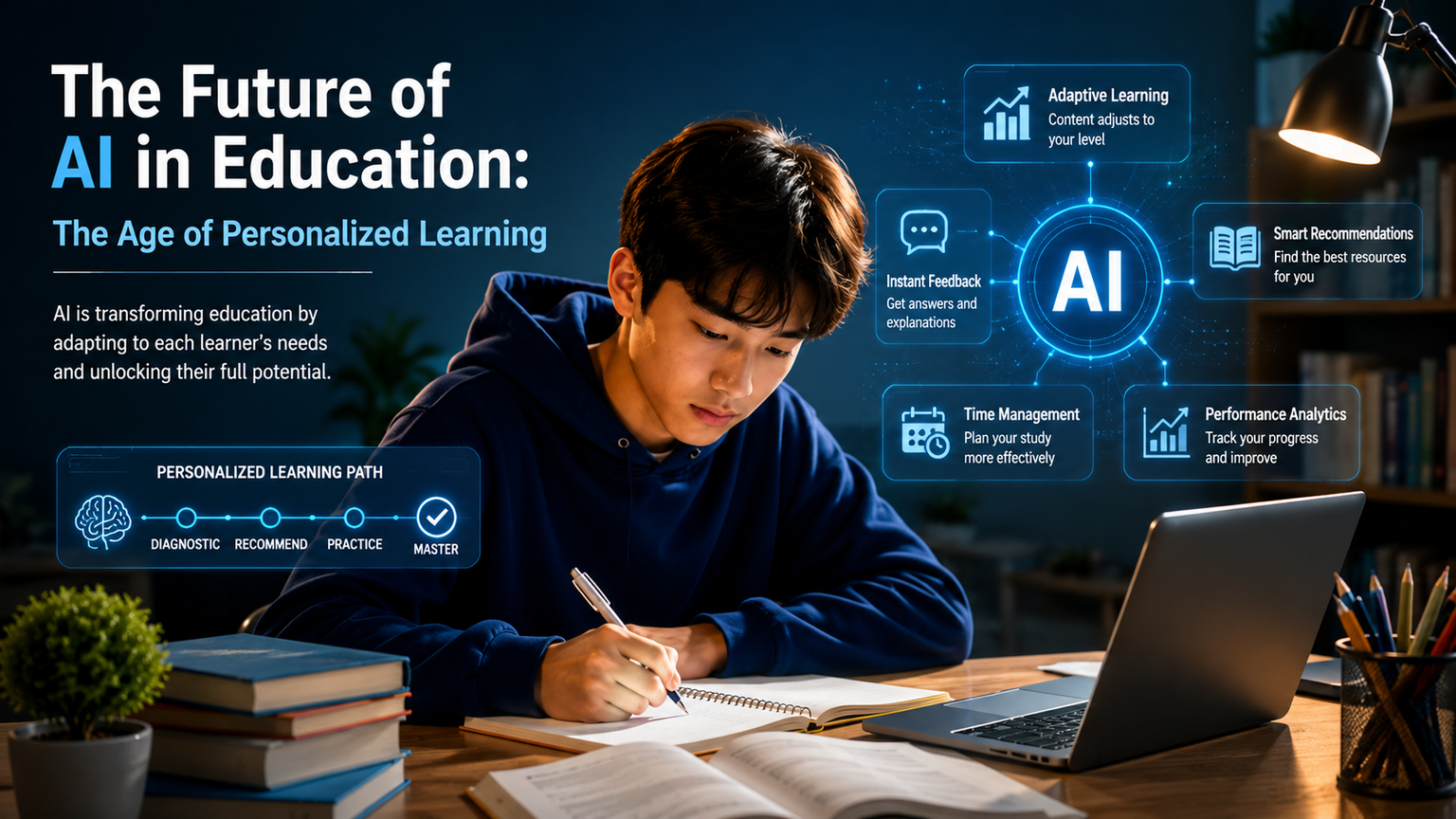
This is where AI can change the learning model. Instead of giving every student the same explanation, AI-powered education can adapt explanations, examples, practice, feedback, and pacing to the learner’s level, interests, and responses.
The OECD Digital Education Outlook 2026 says generative AI can support learning as a tutor, partner, or assistant when it is guided by clear pedagogical goals. The same report also warns that using general-purpose AI to complete tasks can improve immediate performance without necessarily producing lasting learning gains.
What Is AI-Powered Personalized Learning?
Personalized learning means adapting education to the needs of an individual learner.
Traditional digital learning often gives every student the same video, reading, or quiz. AI can respond more dynamically.
A student struggling with fractions might receive a simpler explanation using pizza slices. A student who already understands fractions could move to ratios or probability. A football fan could learn percentages through shot-conversion rates. A student interested in cars could explore physics through speed, braking distance, and acceleration.
Personalization is therefore not only about making a problem easier or harder. It is also about changing how the same idea is explained.
The Biggest Learning Problem Is Not Always Difficulty
Students do not lose focus only because a subject is difficult. Sleepiness, boredom, and lack of interest can also shut down attention.
However, true sleep deprivation and classroom boredom are different problems.
Sleep Deprivation Comes First
No amount of entertaining content can fully compensate for too little sleep. The U.S. CDC guidance explains that adequate sleep is important for student attention and academic performance, and recommends 8 to 10 hours of sleep per day for teenagers ages 13 to 18.
If a student is genuinely sleep-deprived, the first solution is more sleep, not more stimulation.
Boredom Is a Different Problem
If a well-rested student loses attention only when a lesson feels irrelevant, the problem may be engagement rather than sleep. That is where personalization can matter.
AI can change the example, the format, the difficulty, or the next question before the learner completely disengages. The goal is not to force students to stay awake. It is to give them a reason to stay curious.
Personalization Should Include Interests, Not Just Ability
Many personalized-learning systems focus on performance: what the student knows, what the student missed, and what difficulty should come next.
The next step is to consider what the student actually cares about.
The same percentage lesson can use football statistics, game probabilities, cooking ratios, shopping discounts, or music streaming data. The mathematical idea remains the same, but the entry point changes.
Khan Academy’s teacher tools include a Khanmigo feature called Make it Relevant!, which is designed to connect lesson content to students’ lives and interests in order to boost engagement.
This is an important shift. Personalized education should not only ask, “What level is this student?” It should also ask, “What makes this student want to know more?”
Real Examples of AI-Powered Learning
1. Khanmigo: An AI Tutor That Asks Questions
Khan Academy describes Khanmigo as an AI-powered tutor and teaching assistant. Rather than simply giving a final answer, it can use questions, hints, and explanations to help a learner continue thinking.
For example, if a student is stuck on an equation, an AI tutor can ask what operation should be applied to both sides instead of immediately revealing the answer. The objective is to support the student’s reasoning rather than replace it.
Khan Academy’s Khanmigo community guidance emphasizes learning, exploration, deeper thinking, and academic integrity rather than using AI as a shortcut around the learner’s own work.
How Much Does It Cost? AI Tutoring vs. Private Education
For parents, one of the most practical questions is simple: How much does AI tutoring cost each month compared with private education?
South Korea offers a useful comparison because private education is widely used. According to the Korea education survey, average monthly spending was about $339 per student across all students and about $447 per month among students who actually participated in private education. These dollar amounts are approximate conversions using the September 4, 2026 Seoul reference exchange rate reported by Yonhap News Agency; exchange rates change over time.
By comparison, Khan Academy lists its individual Khanmigo plans. Those individual plans are currently available only in the United States, so the price should be treated as an example of low-cost AI tutoring rather than a service that every family worldwide can buy under the same conditions.
| Comparison | Traditional Private Education | AI Tutor Example |
|---|---|---|
| Typical monthly cost example | About $447 per month among South Korean students participating in private education | Khanmigo U.S. Learner or Parent plan: $4 per month |
| Repeated questions | Depends on class size, schedule, and teacher availability | Can repeat explanations and questions on demand |
| Personalized pacing | Varies by academy, class, and tutor | Can adapt explanations and practice to the learner |
| Schedule and test management | Strong advantage | More limited |
| Human observation and motivation | Strong advantage | Limited |
| Peer interaction | Available in group classes | Usually limited |
This is not a direct price comparison between identical services. Private academies provide human supervision, fixed schedules, test preparation, accountability, and social interaction. AI tutoring has a different strength: low-cost access to repeated explanations, practice, feedback, and questions at almost any time.
The more useful question is therefore not, “Can AI eliminate private education?” It is: Which parts of paid tutoring truly require a human teacher, and which parts can a low-cost AI tutor handle effectively?
For some students and subjects, AI may reduce the amount of paid tutoring needed rather than replace it completely.
2. Kahoot!: Turning Passive Material into Interactive Practice
AI can also make learning more engaging by changing the format of the lesson. Kahoot! says its AI tools can generate interactive quizzes and games from topics, PDFs, and web pages.
Instead of listening to a long explanation without interruption, students can predict what happens next, answer questions, receive instant feedback, and participate throughout the lesson.
A history lesson, for example, can stop at a turning point and ask, “What do you think happened next?” or “What decision would you have made?” The student becomes a participant rather than a passive listener.
3. Duolingo: Making Language Practice Feel Like a Conversation
Duolingo’s AI-powered Video Call with Lily gives learners conversational practice with an AI character. Duolingo says Lily adjusts to the learner’s skill level and can respond in real time as the conversation develops.
This changes the learning experience. Memorizing vocabulary from a list feels very different from trying to use the same language in a simulated conversation. AI can add context, spontaneity, and a reason to keep responding.
AI Can Teach at Different Speeds
Students rarely learn at exactly the same speed. In a conventional classroom, a teacher must keep the group moving. Some students may advance before they are ready, while others repeat material they already understand.
AI-supported systems can provide extra examples and practice when a learner is struggling and introduce more advanced work when the learner is ready. The learning path can change according to progress instead of following only a fixed calendar.
Instant Feedback Matters
Learning can slow down when a student has to wait days to understand why an answer was wrong. AI can respond while the student is still working on the problem.
But the best educational AI should not always reveal the answer immediately. It can ask:
- What do you think the next step should be?
- Why did you choose that answer?
- Can you solve the problem another way?
- Which part is confusing?
- What evidence supports your conclusion?
The OECD warns that outsourcing cognitive work to general-purpose AI can improve task performance without creating the same learning gains. Educational AI is more valuable when it preserves effort, reasoning, and independent thinking.
AI Can Help Teachers Too
The future of AI in education is not only about students. Teachers may benefit just as much.
AI can help generate lesson ideas, practice questions, differentiated materials, rubrics, and discussion prompts. According to the OECD Digital Education Outlook 2026, 37% of lower-secondary teachers used AI for their work in 2024, and 57% agreed that AI helps write or improve lesson plans.
If repetitive preparation takes less time, teachers can spend more time observing students, explaining difficult ideas, and providing human support.
The most realistic model is not teacher versus AI. It is teacher plus AI.
Where AI Could Be Most Useful
| Learning Situation | How AI Can Help | Human Role Still Needed |
|---|---|---|
| Different learning speeds | Adjust difficulty, examples, and practice based on progress | Set learning goals and decide when intervention is needed |
| Students who are stuck | Offer hints, alternative explanations, and step-by-step questions | Diagnose deeper misconceptions and provide encouragement |
| Students losing interest | Use relevant examples, quizzes, and interactive activities | Observe real emotions, motivation, and classroom behavior |
| Practice and review | Generate targeted exercises and immediate feedback | Ensure practice matches the curriculum and learning objectives |
| Language learning | Provide conversational practice and role-play | Guide cultural meaning, nuance, and communication skills |
| Teacher preparation | Suggest questions, materials, rubrics, and differentiated activities | Verify accuracy and make professional instructional decisions |
The Limits and Risks of Personalized AI Learning
1. AI Can Be Wrong
Generative AI can produce incorrect, incomplete, or misleading information. Important facts, calculations, and educational materials should be checked against reliable sources.
2. Overdependence Can Weaken Learning
If students use AI whenever work becomes difficult, they may finish assignments without developing the underlying knowledge and skills. Productive struggle, practice, and independent thinking still matter.
3. Fun Should Not Become the Goal
Interest and enjoyment are powerful ways to bring a student into a lesson, but not every part of learning will feel like a game. AI should not remove every difficult moment. Its job is to make difficult learning meaningful enough that the student wants to continue.
4. Privacy and Student Data Matter
Personalization may involve information about a learner’s progress, mistakes, interests, and conversations. Schools and families should understand what data is collected, how it is protected, and whether a tool is appropriate for the student’s age.
5. Teachers Remain Essential
Education involves motivation, judgment, relationships, emotional support, classroom culture, and social learning. AI can expand what teachers can do, but it does not remove the need for human educators.
What the Future Classroom May Look Like
A future classroom may combine whole-class teaching, small-group discussion, hands-on projects, independent practice, and AI-supported tutoring.
A teacher might introduce a concept to the class and then let students practice at different levels. AI could provide extra examples to students who are stuck, more advanced problems to students who are ready, and interactive questions to students whose attention is fading.
If a student shows strong interest in one topic, AI could also help connect that interest to another subject: football to statistics, cars to physics, dinosaurs to biology and geology, or music to mathematics and language.
The teacher would still decide what matters, observe the student as a person, and judge whether the learner truly understands.
How Parents and Teachers Can Use Educational AI Wisely
- Use AI to explain and guide, not simply to supply final answers.
- Ask students to explain the reasoning in their own words after receiving AI help.
- Connect examples to the student’s real interests whenever possible.
- Verify important facts, calculations, and educational materials.
- Choose tools with appropriate privacy, age, and learning safeguards.
- Keep teachers, parents, and other trusted adults involved in important learning decisions.
- Balance AI-supported learning with reading, writing, discussion, physical activity, creativity, and real-world experience.
One simple test is especially useful. After AI explains something, ask the student: “Can you explain it again in your own words?”
If the student cannot explain it, the AI may have solved the problem without the student actually learning it.
Curiosity May Be the Real Starting Point of Personalized Learning
Students are not machines. They have attention, emotions, interests, and curiosity.
A truly personalized education system should therefore measure more than scores and mistakes. It should also notice what makes a learner’s eyes light up.
Interest creates questions. Questions lead to information. Information can lead to books, videos, new vocabulary, experiments, museums, biographies, history, science, and eventually self-directed learning.
The most valuable role for AI may not be studying on behalf of the child. It may be keeping the child’s curiosity alive long enough to reveal the next question and the next path.
FAQ
Can AI replace a private academy or human tutor?
Not completely. AI is strong at repeated explanations, practice, feedback, and on-demand questions. Human teachers are still better at motivation, accountability, emotional support, test strategy, and observing the learner as a whole person.
Can AI help students stay focused?
It can help when attention drops because the lesson feels irrelevant or too easy, too hard, or too passive. AI can change examples, difficulty, and interaction. But it cannot replace adequate sleep when a student is genuinely sleep-deprived.
How much can an AI tutor cost each month?
Prices vary widely. One current example is Khanmigo’s U.S. Learner and Parent plans at $4 per month. For context, South Korean students who participated in private education spent about $447 per month on average in 2025 after conversion to U.S. dollars. These are not equivalent services, but the difference shows why low-cost AI tutoring is attracting attention.
Conclusion
AI is making personalized education more realistic. Students can receive explanations at the moment they need them, practice at an appropriate level, ask questions repeatedly, and use learning examples connected to their interests. Teachers can gain new tools for planning, differentiation, and feedback.
The economic impact may also matter. When private education can cost hundreds of dollars per month, an AI tutor that provides some forms of individualized support at a much lower price becomes a meaningful option for families.
AI will not eliminate the need for teachers or private education. But it may reduce how much paid tutoring some students need, particularly for repeated explanations, practice, language conversation, and basic feedback.
The deeper change, however, may be moving from personalizing only a student’s level to personalizing the student’s interest.
A sleep-deprived student needs sleep first. But when a student is losing interest, the goal of AI should not simply be to keep that student awake. It should be to keep the student wondering what comes next.
The most valuable educational AI may not be the one that gives the fastest answer.
It may be the one that makes a student ask “Why?” one more time.
Related reading: For practical ways students can use AI without replacing their own thinking, read AI Study Guide 2026.