
Melting glaciers can bring more water at first — but eventually, they may leave communities with less.
When There Is Too Much Water, Why Worry About Drought?
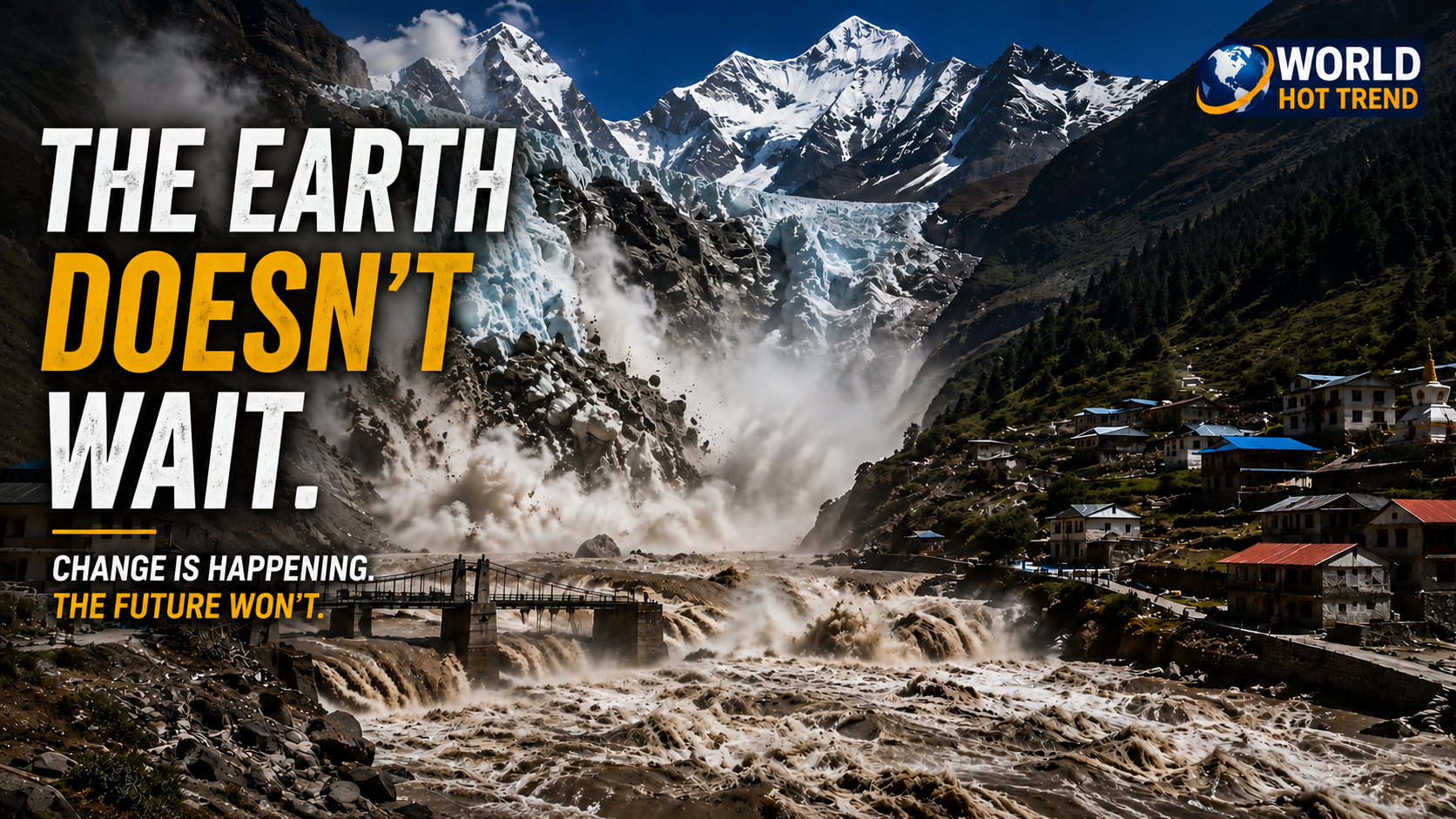
A massive torrent rushes down from the mountains.
Roads and bridges are cut off. Villages are engulfed by water, mud and debris. People flee from the sudden surge.
The catastrophic flash flood that struck the Nepal–Tibet border region on August 26, 2026, was not simply an ordinary case of heavy rain causing a river to overflow.
According to Reuters, current satellite and seismic analysis indicates that the disaster began when the lower part of a Himalayan glacier collapsed, carrying ice, rock, snow and sediment roughly 1,200 meters down to the valley floor.
But the disaster raises another question.
If global warming is melting glaciers, shouldn’t that mean there will be more water?
Scientists are also warning about the opposite future: Water scarcity.
And behind water scarcity may come drought, drying soils and damage to agriculture.
How can devastating floods and severe water shortages emerge from the same changing climate?
To understand that paradox, we first need to stop thinking of glaciers as simply giant blocks of ice. They are also enormous natural reservoirs high in the mountains.
1. Glaciers Are Giant Reservoirs in the Mountains
For centuries, snow and glaciers across the Himalayas have stored water. During colder periods, water accumulates as snow and ice. During warmer seasons, some of it gradually melts and flows into rivers.
That water supports drinking supplies, agriculture, hydropower and ecosystems. A glacier, therefore, is more than a mountain of ice. It is a massive natural water-storage system.
The problem is that rising temperatures are shrinking that reservoir. Reuters reports that Nepal’s mountains have lost nearly one-third of their glacier ice in roughly three decades.
2. How Did This Flood Begin?
One of the most striking aspects of this disaster is that the initial explanation changed as scientists examined the evidence.
Early reports suggested that a magnitude 4.4 earthquake might have triggered the glacier collapse. Later analysis indicated that the seismic event itself was associated with the enormous collapse of glacial ice and rock.
According to AP and Reuters, the glacier may not have fallen because the ground shook. The ground shook because the glacier fell.
3. The Collapse May Have Created a Giant Natural Dam
The disaster may not have ended with the initial collapse. Preliminary scientific analysis suggests another critical event may have followed.
A huge volume of ice, rock and debris appears to have entered the Lhende Khola river system. Researchers are examining whether this material temporarily blocked the river. If so, water could have accumulated behind a natural dam before the blockage failed or was overtopped.
Possible sequence:
Massive glacier and rock collapse → ice and debris plunge into the valley → strong seismic signal → debris enters and may block the river → temporary natural dam → water accumulates → blockage fails or is overtopped → massive surge of water, mud and debris → catastrophic flooding.
According to AP, at some downstream locations, water levels reportedly rose by as much as nine meters in about 30 minutes.
According to Reuters, authorities have also monitored a dammed lake upstream for possible secondary flooding, underscoring that this remains an evolving disaster.
4. Did Climate Change Cause This Glacier to Collapse?
This is where we need to be careful. We cannot say that yet.
Scientists are still investigating exactly why this particular glacier collapsed at that particular moment. The most accurate statement is: the glacier collapse appears to have triggered the catastrophic flood, but whether climate change directly caused this specific collapse remains under investigation.
According to Reuters and AP, the broader trend is clearer: warming is accelerating glacier loss and changing snow, ice, permafrost and slope stability across high mountain regions.
5. When Glaciers Melt, There Can Initially Be More Water
Melting ice produces water. So shouldn’t melting glaciers mean more water rather than water scarcity? For a while, that can be true.
The IPCC explains that as glaciers shrink in a warmer climate, water is released from long-term ice storage. At first, glacier runoff increases because the glacier melts faster and more water flows downhill.
According to IPCC, this creates an apparent paradox: the ice is disappearing, yet the water is increasing. But that does not necessarily mean the region has gained a more secure water supply.
6. Eventually, the Direction Can Reverse
Glaciers are not infinite. As they continue shrinking, eventually there is less ice available to melt. This leads to an important concept: Peak Water.
The IPCC explains that glacier runoff initially rises as warming accelerates melting. Eventually it reaches a turning point — Peak Water — after which the glacier has become smaller and its contribution to downstream river flow begins to decline. In many mountain regions, glaciers and their basins have already passed Peak Water.
When glaciers are large: snow and ice are stored → they melt gradually during warmer and drier periods → water continues flowing into rivers.
While glaciers are rapidly shrinking: meltwater increases → river flow can temporarily increase.
After glaciers become much smaller: less ice remains in storage → less meltwater is available during dry periods → water shortages can become more serious.
According to IPCC, today’s excess water and tomorrow’s water scarcity can be different stages of the same process.
7. Then Why Can Drought Become Worse?
Glaciers are not the only part of the water system changing. Climate change also affects rainfall patterns, evaporation, snowmelt and groundwater.
Another apparent contradiction emerges: more intense rainfall and greater drought risk can exist within the same changing climate.
If enormous amounts of rain fall within a short period, much of the water can rush into rivers rather than being gradually stored in soil and groundwater. Then a prolonged dry period may follow.
According to IPCC, the critical question is not simply how much rain fell this year. It is also: When did it fall? Where did it fall? How quickly did it fall? The problem is increasingly about the timing of water.
8. Floods and Droughts Are Not Always Opposites
We normally think of floods and droughts as complete opposites. A flood means too much water. A drought means too little.
But under a changing climate, both can affect the same region at different times:
Intense rainfall → rapid runoff → flooding → prolonged period without rain → higher temperatures and increased evaporation → drying soils → drought.
If these stresses continue: rising temperatures → unstable water supplies → floods and droughts → drying soils → agricultural losses → land degradation → food insecurity.
Climate change is not simply about the weather becoming a little warmer. It ultimately becomes a question of water, food, cities, economies and people’s lives.
9. But There Is Another Uncomfortable Question
Climate change raises a question that is difficult to avoid: Are the countries that contributed most to the problem the same countries suffering the greatest consequences?
Since the Industrial Revolution, today’s developed economies have used enormous quantities of coal, oil and natural gas to industrialize. This helped create economic wealth and higher standards of living, but it also released vast amounts of carbon dioxide into the atmosphere.
IPCC assessments show a very large historical emissions contribution from developed regions, while Least Developed Countries have contributed only a very small share. This historical responsibility should be distinguished from today’s changing emissions landscape.
10. Historical Emissions and Disaster Impacts Side by Side
Historical CO₂ emissions and disaster deaths are different statistical measures. They should not be presented as a simple mathematical ‘offender rate versus victim rate.’ But placing them side by side helps illustrate the imbalance between historical emissions and vulnerability to disasters.
| Measure | Developed Countries | Least Developed Countries (LDCs) |
|---|---|---|
| Historical cumulative fossil-fuel & industrial CO₂ emissions | Large historical contribution | Very small historical contribution |
| Global disaster deaths, 2015–2024 | No directly comparable single figure in the cited UN dataset | About 29% |
| Share of population among reporting countries | — | About 12% |
| Reported direct disaster economic losses, 2015–2024 | — | Nearly 13% |
| Share of total GDP in cited reporting | — | About 1.36% |
| Overall picture | Greater historical responsibility and generally stronger resilience capacity | Low historical contribution but disproportionately high disaster vulnerability |
According to the United Nations’ 2026 SDG reporting, Least Developed Countries represented about 12% of the population among reporting countries but accounted for 29% of global disaster deaths between 2015 and 2024. LDCs also accounted for nearly 13% of globally reported direct economic losses over the same period while representing just 1.36% of total GDP.
11. Nepal’s Mountain Communities Did Not Create the Industrial Revolution
Did a family living in a remote mountain village in Nepal decide the course of global industrialization over the past 150 years? Did they build enormous factories around the world? Did they burn vast quantities of coal and oil for generations? No.
Yet when glaciers and rocks collapse and a wall of water and debris races down a valley, those communities may be among the first to lose their homes, farmland and livelihoods.
The places that benefited most from industrialization are not necessarily the places most vulnerable to climate-related disasters. That is why climate change cannot be viewed only as an environmental issue.
12. This Is Where Climate Justice Enters the Debate
Climate change eventually becomes a question of responsibility and fairness.
Who emitted carbon for generations while building economic prosperity? Who benefited most from that growth? Who is producing the most greenhouse gases today? And who is paying the greatest price when disaster strikes?
It would be inaccurate to place all present-day responsibility solely on developed countries. The global emissions landscape has changed dramatically since the Industrial Revolution. That is why both questions matter: Who contributed most historically? And who is emitting the most today?
Yet another question remains. Is it fair to demand exactly the same sacrifices from countries that already used fossil fuels to industrialize and accumulate wealth and from countries that are only beginning to develop? And when a country that contributed very little to historical emissions suffers a catastrophic disaster, who should pay for adaptation and recovery?
This is where climate change becomes more than an environmental issue. It becomes a question of economics, inequality, responsibility and international politics.
13. If Earth Has So Much Water, Why Can We Still Run Out?
Water itself is not suddenly disappearing from the planet. The oceans still contain an enormous amount of water. During a flood, a city can be surrounded by enormous quantities of water.
But that does not mean the water can immediately be used for drinking or agriculture.
For people, the crucial issue is whether usable freshwater is available in the right place, at the right time and in the right form.
According to IPCC, a region can experience a devastating flood today and still face water shortages during the dry season months later. The water challenge of the future is increasingly about where water is, when it arrives, how it is stored and how it is managed.
FAQ
Q1. Did an earthquake cause the Nepal glacier collapse?
According to AP, current evidence indicates that the strong seismic signal was associated with the glacier and rock collapse itself rather than a conventional earthquake first shaking the glacier loose.
Q2. Did the glacier collapse create a natural dam?
According to AP, preliminary evidence suggests that debris may have temporarily blocked the river and amplified the flood when the blockage failed or was overtopped. Scientists are still reconstructing the exact sequence.
Q3. Did climate change directly cause this disaster?
According to Reuters, that has not yet been established. Warming is changing glaciers and mountain stability, but the specific trigger of this individual collapse remains under investigation.
Q4. If glaciers are melting, why could there eventually be less water?
According to IPCC, glaciers function as natural reservoirs. Runoff can increase at first, but after Peak Water a smaller glacier contributes less water to rivers, especially during hot and dry periods.
Q5. How can floods and droughts happen in the same region?
According to IPCC, water availability depends on timing, intensity, storage, evaporation and seasonality. A region can receive too much water very quickly and still have too little during a later dry period.
Q6. Why are Least Developed Countries particularly vulnerable?
According to United Nations data, many Least Developed Countries have contributed relatively little to historical emissions while having fewer resources for resilient infrastructure, early warning, emergency response and recovery. LDCs accounted for 29% of global disaster deaths in 2015–2024 despite representing about 12% of reporting countries’ populations.
Q7. Does that mean developed countries are solely responsible for climate change?
According to IPCC, historical responsibility and current annual emissions are different questions. Today’s emissions landscape includes major emerging economies as well as developed economies.
Q8. Why does the Nepal disaster matter to people living far away?
According to IPCC, mountain snow and ice are part of larger water systems. Changes can affect downstream freshwater, agriculture, ecosystems, hydropower and food security, while illustrating a wider global problem of water arriving at the wrong time or in the wrong form.
Conclusion — Why Worry About Water in an Age of Floods?
Images from Nepal show an overwhelming amount of water.
But if we trace that torrent back toward the mountains, a very different story emerges.
A massive glacier collapsed. The impact generated seismic energy powerful enough to be initially interpreted as an earthquake. Ice, rock and debris then entered the river system, and scientists are investigating whether a temporary natural dam formed before accumulated water broke through and magnified the flood.
Over a longer timescale, another problem emerges.
Today, there may be too much water.
If the enormous natural reservoir stored in glaciers continues to shrink, however, one day there may be too little.
And the people who suffer first and most severely are not necessarily the people who contributed most to the problem.
That leaves us with more than one question:
Why did so much water arrive all at once?
What happens to future water supplies if the glaciers continue disappearing?
And finally, the most uncomfortable question:
Why are the benefits of industrialization and the costs of climate change so often borne by different people?
Nepal’s catastrophic flood may be more than a natural disaster in one part of the world. It may be a glimpse of what happens when glaciers, water, climate and global inequality collide in a single event.