
Introduction
The global semiconductor industry is entering one of the most important transitions in its history.
Artificial intelligence is no longer driving demand for just one type of chip. Modern AI data centers require powerful GPUs and custom accelerators, advanced foundry processes, high-bandwidth memory, high-speed networking, and sophisticated packaging technologies working together as a single system.
That shift is changing the competitive landscape.
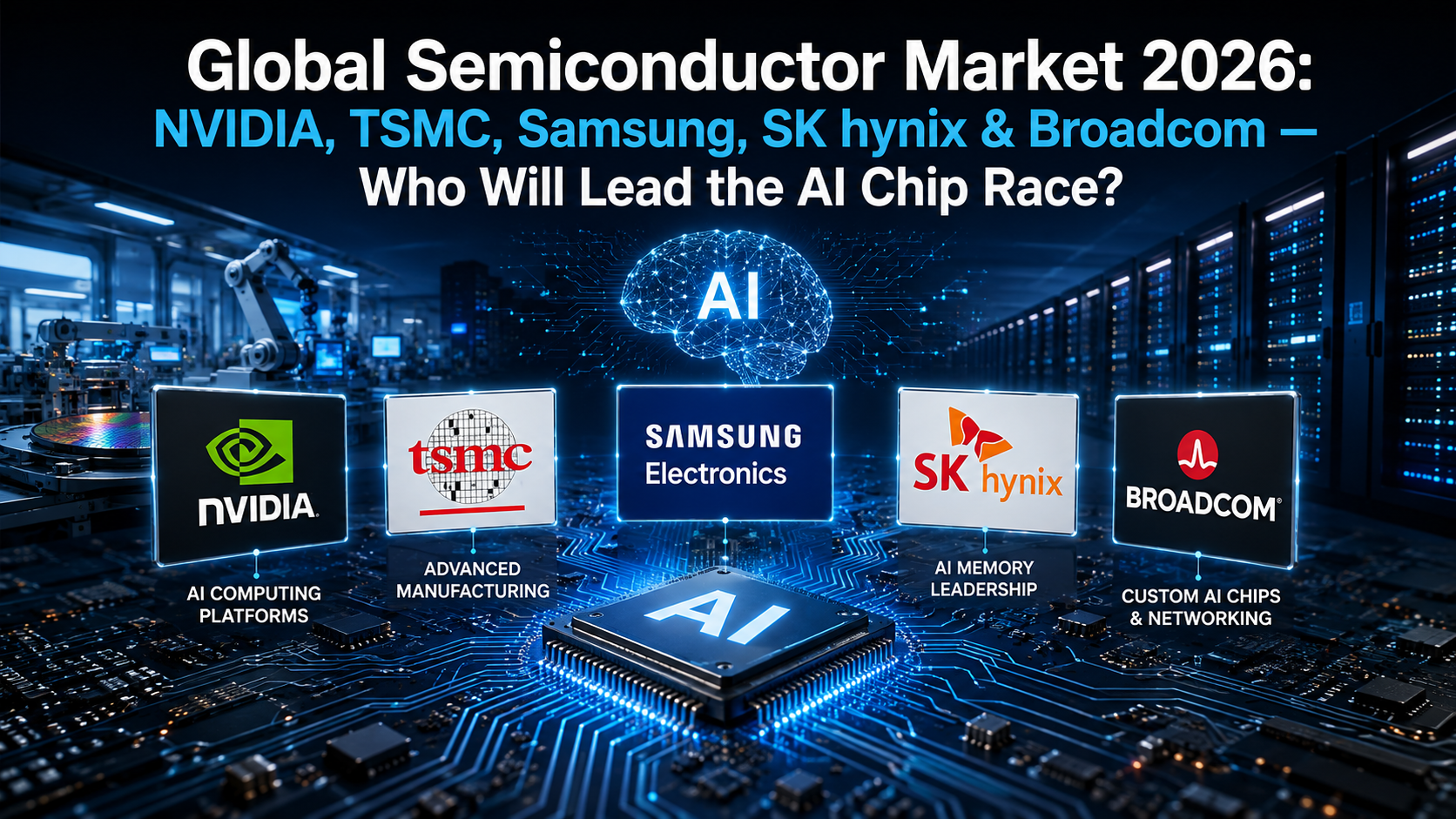
In 2026, five companies stand out for the strategic positions they hold across the AI semiconductor ecosystem: NVIDIA, TSMC, Samsung Electronics, SK hynix, and Broadcom.
These companies do not compete in exactly the same market. Instead, each controls—or is attempting to control—a critical part of the AI computing infrastructure.
NVIDIA is pushing the boundaries of AI accelerators and complete computing platforms. TSMC remains central to manufacturing many of the world’s most advanced chips. Samsung is combining memory, foundry, logic, and advanced packaging capabilities. SK hynix has built a powerful position in high-bandwidth memory. Broadcom is rapidly expanding in custom AI accelerators and AI networking.
So which company is best positioned to lead the next phase of the AI chip race?
The answer depends on which part of the semiconductor value chain becomes the most valuable.
1. NVIDIA — Building the AI Computing Platform
NVIDIA has become one of the most influential companies in the AI semiconductor industry because its strategy extends far beyond selling individual GPUs.
The company is increasingly building complete AI computing platforms that combine processors, networking, software, and rack-scale infrastructure.
Its next-generation Rubin platform illustrates this approach.
According to NVIDIA’s official Rubin technical overview, the platform is built around six major chips designed to work together as one AI computing system.
- Vera CPU — manages data and control flow for the AI system and works closely with Rubin GPUs.
- Rubin GPU — performs the core AI computation for large-scale training and inference.
- NVLink 6 Switch — links multiple Rubin GPUs with high-bandwidth, low-latency rack-scale connectivity.
- ConnectX-9 SuperNIC — provides high-speed networking between AI servers and racks.
- BlueField-4 DPU — offloads networking, storage, security, and infrastructure tasks from the main processors.
- Spectrum-6 Ethernet Switch — connects large numbers of AI servers across high-speed Ethernet networks.
The objective is clear: NVIDIA wants to optimize the entire AI computing system rather than improve the GPU alone.
Major Strengths
NVIDIA’s greatest advantage is its combination of hardware and software.
Its ecosystem connects AI accelerators with networking technology and a large software platform used by developers and enterprises around the world.
This creates a competitive advantage that is difficult to reproduce simply by designing a faster chip.
Who Is NVIDIA Best Positioned to Serve?
- Hyperscale AI data centers
- Generative AI training
- Large-scale AI inference
- Enterprise AI infrastructure
- AI factories and supercomputers
Key Opportunity
The continued growth of AI training and inference could keep demand for NVIDIA’s platforms extremely strong.
Rubin also demonstrates how the company is trying to reduce the cost of running increasingly complex AI models, making efficiency as important as raw computing performance.
Key Risk
NVIDIA’s success is attracting intense competition.
Cloud companies are developing more custom AI chips, while semiconductor companies are increasingly targeting specialized AI workloads.
The biggest question is therefore not whether NVIDIA will remain important, but whether general-purpose GPU platforms will continue to capture as much value as custom accelerators become more capable.
2. TSMC — The Manufacturing Backbone of Advanced Chips
If NVIDIA represents the computing engine of the AI boom, TSMC represents much of the manufacturing foundation behind advanced semiconductor products.
TSMC’s importance comes from its position as a leading pure-play semiconductor foundry.
Many semiconductor designers rely on advanced manufacturing processes that would be extraordinarily expensive and technically difficult to build independently.
According to TSMC’s 2025 Annual Report, its 2-nanometer N2 technology entered high-volume manufacturing in the fourth quarter of 2025, with a rapid production ramp expected in 2026.
TSMC also says N2P and A16 are scheduled for volume production in the second half of 2026.
Major Strengths
TSMC’s competitive strength is manufacturing technology combined with massive production experience.
Advanced semiconductor manufacturing requires far more than shrinking transistor dimensions. Yield, reliability, power efficiency, packaging, and the ability to manufacture enormous quantities consistently are equally important.
TSMC has built an ecosystem around those capabilities.
Who Is TSMC Best Positioned to Serve?
- Advanced AI accelerators
- High-performance computing chips
- Smartphone processors
- Custom silicon
- Next-generation data-center processors
Key Opportunity
As AI chips become larger, more complex, and more power-hungry, demand for advanced process technologies is likely to remain strategically important.
This means TSMC can benefit from the AI race even when its customers compete against each other.
Key Risk
Semiconductor manufacturing has become a geopolitical priority.
Governments around the world are investing heavily in domestic semiconductor production, while competitors are attempting to close the technology gap.
TSMC must therefore expand globally while preserving the manufacturing efficiency and technological leadership that made its business model so powerful.
3. Samsung Electronics — The Integrated Semiconductor Challenger
Samsung occupies a unique position in the semiconductor industry.
Unlike companies focused primarily on one segment, Samsung operates across memory, foundry manufacturing, logic technology, and advanced packaging.
That integrated structure could become increasingly important as AI chips evolve from individual components into highly integrated systems.
One of Samsung’s most important battlegrounds is high-bandwidth memory.
In February 2026, Samsung began mass production and commercial shipment of HBM4, according to Samsung HBM4 details.
Samsung’s HBM4 uses advanced 1c DRAM and a 4-nanometer logic base die and delivers up to 3.3 TB/s of bandwidth.
In May 2026, the company also began shipping HBM4E samples to major customers, as detailed in Samsung’s official HBM4E announcement.
Major Strengths
- DRAM
- HBM
- Semiconductor foundry
- Logic design
- Advanced packaging
Who Is Samsung Best Positioned to Serve?
- AI accelerators
- Data centers
- Smartphones
- Memory-intensive computing
- Custom semiconductor solutions
Key Opportunity
HBM represents one of Samsung’s biggest opportunities.
As AI accelerators become more powerful, memory bandwidth becomes increasingly important. Faster processors provide limited benefits if data cannot reach them quickly enough.
Samsung is therefore attempting to establish a stronger position not simply as a memory supplier, but as an integrated AI semiconductor solutions provider.
Key Risk
Samsung competes simultaneously against highly specialized companies.
It faces TSMC in advanced foundry manufacturing and SK hynix in HBM, while also competing across broader memory markets.
Its challenge is turning its enormous technological breadth into consistent leadership in the industry’s most profitable segments.
4. SK hynix — The AI Memory Specialist
The AI boom has transformed high-bandwidth memory from a relatively specialized semiconductor product into one of the industry’s most strategically important technologies.
SK hynix has been one of the biggest beneficiaries of that transformation.
HBM stacks multiple DRAM dies vertically to provide extremely high data bandwidth. This makes it particularly important for AI accelerators that must move enormous amounts of data between memory and processors.
SK hynix completed development of HBM4 and prepared its mass-production system in 2025.
In June 2026, SK hynix shipped 12-layer HBM4E samples to major customers. The product reaches speeds of up to 16 Gbps per pin, according to SK hynix’s official HBM4E announcement.
Major Strengths
SK hynix’s greatest strength is specialization.
The company has built deep experience in advanced HBM development and manufacturing, including technologies designed to manage heat, power consumption, and increasingly complex chip stacking.
Those capabilities are becoming more valuable as AI accelerators consume more data and electricity.
Who Is SK hynix Best Positioned to Serve?
- AI accelerator manufacturers
- Hyperscale data centers
- AI servers
- High-performance computing systems
- Next-generation AI infrastructure
Key Opportunity
Memory may become an increasingly important performance bottleneck.
An extremely powerful GPU cannot reach its potential if memory cannot deliver data quickly enough.
That means HBM suppliers could capture a growing share of the economic value created by AI infrastructure.
Key Risk
Competition is intensifying.
Samsung is pushing aggressively into HBM4 and HBM4E, while memory technology changes quickly.
SK hynix therefore needs to maintain technological leadership while expanding production capacity without creating excessive supply.
5. Broadcom — The Custom AI Chip and Networking Challenger
Broadcom may receive less consumer attention than NVIDIA, but it has become one of the most important companies to watch in the AI semiconductor race.
Its strength lies in two areas that could become increasingly valuable: custom AI accelerators and high-performance networking.
Large cloud companies operate AI infrastructure at enormous scale. At that level, even small improvements in performance per watt or computing cost can translate into significant savings.
This creates a strong incentive for hyperscalers to develop specialized accelerators optimized for their own workloads.
Broadcom is positioned to benefit from this trend.
According to Broadcom’s official fiscal Q2 2026 results, AI semiconductor revenue reached $10.8 billion, up 143% year over year, driven by demand for custom AI accelerators and AI networking. Broadcom also said it expected AI semiconductor revenue of approximately $16 billion in the following quarter.
Major Strengths
Broadcom combines custom semiconductor expertise with networking technology.
That is strategically important because an AI data center is not simply a collection of processors.
Thousands of accelerators must communicate with each other rapidly and efficiently. Networking therefore becomes part of the computing architecture itself.
Who Is Broadcom Best Positioned to Serve?
- Hyperscale cloud providers
- Custom AI accelerator programs
- AI data-center networking
- Large distributed computing systems
Key Opportunity
The biggest opportunity is the growth of custom AI silicon.
If major technology companies increasingly design accelerators specifically for their own AI workloads, the semiconductor market could become less dependent on one universal computing architecture.
Broadcom could be one of the largest beneficiaries of that shift.
Key Risk
Custom chips require enormous customers and long development cycles.
The market may also remain concentrated among a relatively small number of hyperscale companies.
Broadcom’s AI growth could therefore become heavily influenced by the investment decisions of a limited group of very large customers.
Big 5 Comparison
| Company | AI Strength | Main Opportunity |
|---|---|---|
| NVIDIA | GPUs, networking, software, rack-scale systems | Continued AI training and inference growth |
| TSMC | 2nm and advanced foundry technologies | Growing demand for leading-edge chips |
| Samsung | HBM, memory, foundry, packaging | Integrated AI semiconductor solutions |
| SK hynix | HBM3E, HBM4 and next-generation HBM | Rising memory bandwidth requirements |
| Broadcom | Custom accelerators and AI networking | Hyperscaler adoption of custom chips |
Strategic Position & Key Challenges
NVIDIA
Strategic Position: AI computing platform leader
Key Challenge: Growing competition from custom AI accelerators developed by major cloud companies.
TSMC
Strategic Position: Advanced semiconductor manufacturing leader
Key Challenge: Geographic concentration, geopolitical risks, and the enormous cost of expanding advanced manufacturing capacity.
Samsung Electronics
Strategic Position: Integrated semiconductor supplier across memory, foundry, and advanced packaging
Key Challenge: Strong competition in both advanced foundry manufacturing and high-bandwidth memory.
SK hynix
Strategic Position: Leading supplier of high-bandwidth memory for AI systems
Key Challenge: Maintaining technological leadership as competition in HBM intensifies.
Broadcom
Strategic Position: Key provider of custom AI chips and high-speed networking technologies
Key Challenge: Growth depends heavily on large hyperscale customers and continued investment in custom AI infrastructure.
How to Understand the AI Semiconductor Race
Instead of asking which company is simply the largest, investors and technology watchers should ask a different question:
Which semiconductor bottleneck (the most limiting or constrained part of the system) will become the most valuable?
If AI accelerator performance remains the dominant factor, NVIDIA could retain enormous strategic power.
If advanced manufacturing capacity becomes the limiting factor, TSMC’s importance could increase further.
If memory bandwidth becomes the critical constraint, SK hynix and Samsung could capture more value.
And if hyperscalers increasingly replace general-purpose accelerators with custom silicon, Broadcom could become an even more important competitor.
The semiconductor race is therefore not one competition.
It is several interconnected races happening simultaneously.
Practical Tips for Following the Semiconductor Market
When evaluating these companies, avoid focusing only on quarterly revenue or stock-price movements.
Watch the technology roadmaps.
For NVIDIA, follow new AI platforms and adoption by hyperscalers.
For TSMC, watch advanced-node production, yields, capacity expansion, and advanced packaging.
For Samsung and SK hynix, monitor HBM qualification, production capacity, bandwidth, power efficiency, and major customer adoption.
For Broadcom, watch growth in custom AI accelerators and AI networking revenue.
Most importantly, follow how these technologies interact.
The winner of the AI semiconductor era may not be the company producing the fastest individual chip. It may be the company that controls the most difficult bottleneck in the overall AI computing system.
FAQ
Which company currently has the strongest position in AI accelerators?
NVIDIA remains the central company to watch because of its combination of GPUs, networking, software, and complete AI computing platforms. However, custom accelerators are becoming an increasingly important competitive force.
Why is TSMC so important if it does not design NVIDIA-style GPUs?
TSMC manufactures advanced chips for semiconductor designers. As leading-edge manufacturing becomes more difficult and expensive, the ability to produce advanced chips reliably at scale becomes a major strategic advantage.
Why is HBM important for artificial intelligence?
AI processors need enormous amounts of data at very high speeds. HBM provides much higher bandwidth than conventional memory architectures, helping reduce the data-transfer bottleneck between processors and memory.
Are Samsung and SK hynix direct competitors?
Yes, particularly in memory and HBM. However, Samsung also operates a large semiconductor foundry business, giving it a broader business structure than SK hynix.
Why is Broadcom important in AI?
Broadcom is benefiting from growing demand for custom AI accelerators and AI networking. Its position could become increasingly important if hyperscale cloud companies continue developing specialized chips for their own AI infrastructure.
Who will ultimately win the AI chip race?
There may not be a single winner.
AI infrastructure depends on accelerators, memory, foundries, networking, packaging, and software. NVIDIA, TSMC, Samsung, SK hynix, and Broadcom each occupy different strategic positions within that ecosystem.
Conclusion
The global semiconductor race in 2026 is no longer simply about producing smaller or faster chips.
It is about controlling the infrastructure required to build artificial intelligence at massive scale.
NVIDIA is building complete AI computing platforms. TSMC is manufacturing many of the world’s most advanced semiconductor designs. Samsung is combining memory, foundry, logic, and packaging capabilities. SK hynix is pushing the limits of high-bandwidth memory. Broadcom is expanding rapidly in custom AI accelerators and networking.
That makes the competition far more complex than a traditional ranking of semiconductor companies.
The next phase of the industry will be determined by computing performance, memory bandwidth, manufacturing capacity, networking speed, energy efficiency, and the ability to integrate all of these technologies.
The company that solves the industry’s most difficult bottleneck may ultimately capture the greatest value.
And in the AI era, that bottleneck can change surprisingly quickly.
Continue with AI Semiconductors Part 2 to explore the technologies behind the AI chip ecosystem in more detail.