
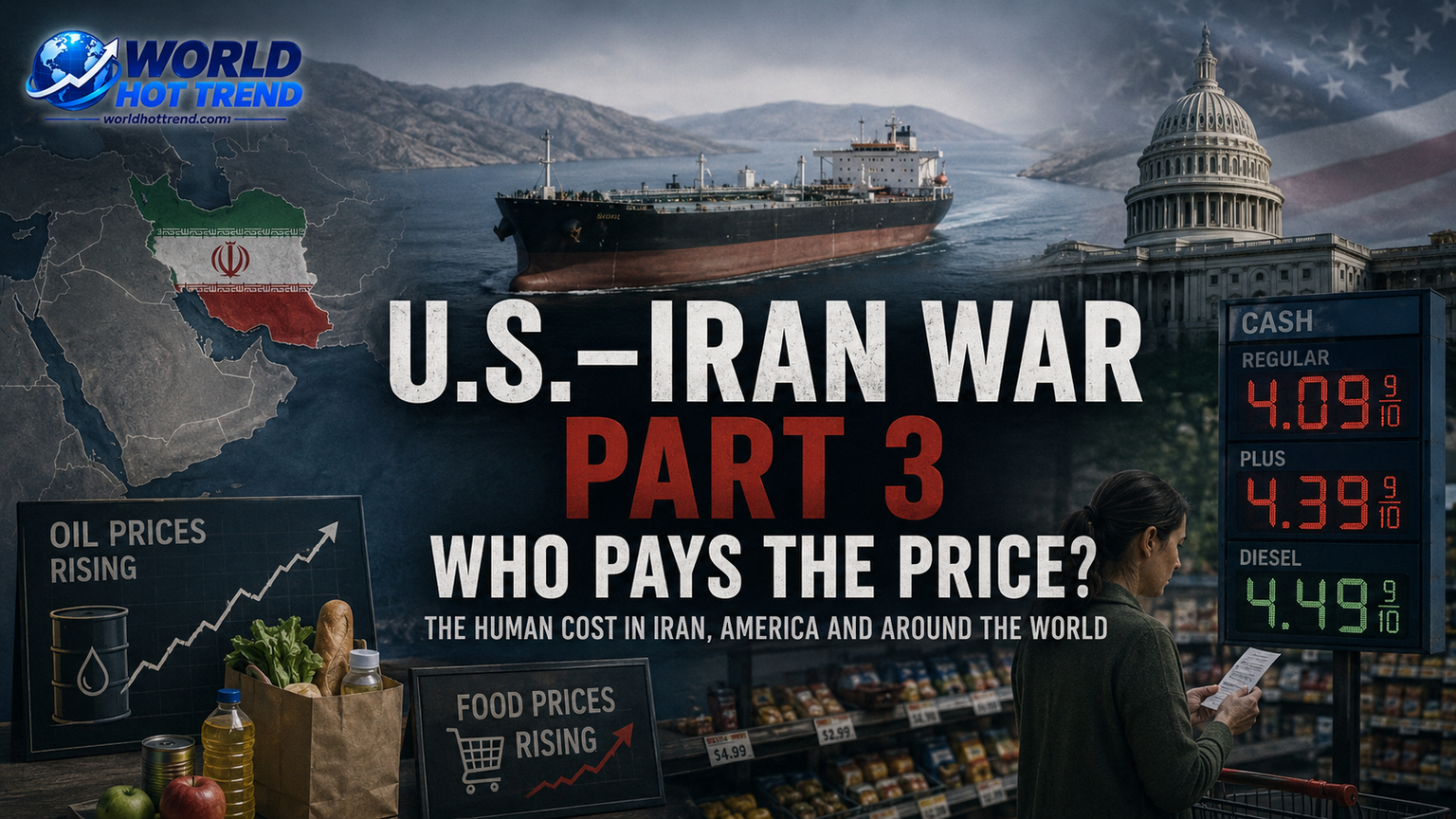
The U.S.–Iran war is no longer only a story about missiles, military targets or oil prices. Months of fighting have turned it into a wider test of how war spreads through civilian lives, national budgets, regional security and the global economy.
The conflict began on February 28, 2026, when the United States and Israel launched attacks on Iran. Since then, the immediate human cost has been concentrated in Iran, while the economic and political consequences have reached the United States, Gulf states and countries far beyond the Middle East.
The central question is no longer simply who is winning. It is who is paying the price — and whether the Strait of Hormuz can become a path out of the conflict before escalation spreads further.
Iranian Civilians Are Paying the Most Immediate Price
According to the UN humanitarian update, more than 2,100 civilians had been killed and over 27,900 injured in Iran by March 30. Around 3.8 million people had been affected, while more than 115,000 civilian units, including homes, businesses, schools and health facilities, had been damaged by April 1.
Those numbers represent lives interrupted far beyond the battlefield. Damage to hospitals, roads, electricity, water systems and telecommunications affects patients, families, workers and children even when they are nowhere near a military target.
The School Strike That Put Children at the Center of the War
One of the most disturbing incidents occurred at the Shajareh Tayyebeh primary school in Minab. The AP strike reconstruction using open-source material, videos, interviews and independent research. AP reported that at least 157 people were killed, including 123 children. Iranian official counts were higher.
AP reported that U.S. military records and a U.S. official indicated the strike was likely American, while the Pentagon had not yet released a final public accounting. The incident shows how quickly a military decision can become a civilian catastrophe when schools, homes and other civilian sites are close to potential targets.
The War Is Also an Economic Crisis for Iranian Families
Iran entered the war with years of sanctions, currency weakness and structural economic problems already weighing on households. The conflict has added another layer of pressure. Reuters reported on August 17 that Iran’s annual inflation rate reached 66% in July, while food inflation hit 128% year over year.
Iranian oil exports were also hit hard. Reuters reported on August 21 that Iranian crude shipments had fallen to about 534,000 barrels per day in August, compared with an average of about 1.4 million barrels per day in 2025.
Lower export revenue, high inflation and sanctions pressure reinforce one another. For ordinary families, the war is therefore experienced not only through military danger but through food prices, medicine, employment and the declining purchasing power of savings.
The United States Is Paying a Growing Military and Political Cost
By late July, Reuters U.S. war-cost report. The financial cost is only one part of the burden. The Associated Press reported in August that Pentagon data showed hundreds of U.S. service members had been wounded since the conflict began.
Public support has also weakened. A Reuters/Ipsos poll published on August 24 found that only 31% of Americans supported U.S. military action against Iran, down from 37% in March. The same survey found that 83% expected the war to continue for an extended period.
That matters because a prolonged war can turn foreign policy into a domestic economic and political problem. Higher military spending, military casualties and rising fuel costs all become more difficult to ignore as a conflict continues.
Could the Conflict Become a Wider Middle East War?
The geography of the Gulf makes escalation especially dangerous. Saudi Arabia and the United Arab Emirates sit across the Gulf from Iran. Qatar and Bahrain host major U.S. military facilities. Israel is directly involved, while Iran-aligned armed groups operate in Iraq and the Houthis in Yemen can threaten Red Sea shipping.
Reuters has reported that Iran retains options to increase pressure on Gulf energy flows and critical infrastructure if the confrontation worsens.
Why Gulf States Have Strong Reasons to Avoid Escalation
Iran and the Arab Gulf states are not natural allies. They have competed for influence for decades, and the memory of the 1980–1988 Iran-Iraq War remains important. Yet rivalry does not mean Gulf governments want another regional war.
Saudi Arabia, the UAE, Qatar and neighboring states have enormous amounts of oil, gas, export infrastructure, power facilities and desalination systems close to a potential battlefield. Damage to those assets could threaten government revenue, electricity, water supplies and global energy markets.
This creates a powerful restraint: weakening a rival may look attractive in theory, but not if the price is damage to your own ports, refineries, power plants or water systems.
The Most Dangerous Risk Is Escalation Nobody Fully Controls
A major regional war does not require every government to want one. A strike on a U.S. facility could trigger an American response. Iran could retaliate. A Gulf energy facility could then be hit. Israel could launch another strike. Iran-aligned groups could enter the cycle.
Each side may describe its own action as limited or defensive, but repeated retaliation can create an escalation ladder that becomes increasingly difficult to stop. This is why the most useful question is not simply who wants a wider war, but how long the participants can keep escalation under control.
The Strait of Hormuz Is Where the War Meets the Global Economy
Before the war, roughly one-fifth of global oil and liquefied natural gas traffic passed through the Strait of Hormuz. When shipping through the strait becomes dangerous, the effects spread through oil prices, LNG markets, insurance, transportation and inflation.
Reuters reported that fewer than 20 commodity vessels crossed the strait over a recent August weekend and that traffic was roughly 90% below pre-conflict levels.
This disruption affects countries with no direct role in the conflict. South Korea, for example, depends heavily on Middle Eastern energy. Reuters reported that South Korea buys around 70% of its oil and 20% of its LNG from the Middle East, according to Korea International Trade Association data.
Could Hormuz Become the First Practical Exit From the War?
By late August, the Strait of Hormuz had become more than a pressure point. It had also become a possible bargaining chip.
Iran and Oman resumed discussions over a temporary navigational corridor through the strait, including mine-clearing measures intended to make commercial passage safer. Reuters reported that this limited maritime arrangement could proceed even while larger disputes between Washington and Tehran remain unresolved.
The sequence could therefore become:
Limited reopening of Hormuz → safer commercial shipping → lower energy pressure → reduced military tension → broader negotiations.
This would not end the war by itself. Sanctions, Iran’s nuclear program, military security and political distrust would remain. But it could create a narrow area where both sides have a practical reason to cooperate.
Why Iran Is Unlikely to Give Up the Hormuz Card Easily
The United States has overwhelming conventional military and economic advantages over Iran. Geography gives Tehran a different kind of leverage. Iran controls a long stretch of coastline beside one of the world’s most important energy routes.
Iran’s decision to blacklist 45 tankers for allegedly violating transit rules showed that Tehran still intends to use access to the strait as a bargaining tool. Reuters reported that Iran warned vessels they could face fines, detention or other penalties.
For Iran, giving up influence over Hormuz without receiving something in return would mean surrendering one of its strongest negotiating cards. For the United States and its allies, restoring predictable commercial shipping is a major economic and strategic goal. That tension is why the strait matters so much to any potential settlement.
September Update: Six Months In, Neither Side Has Won
By early September, the war had entered a new and more revealing phase. A preliminary ceasefire reached in June had unraveled, diplomatic efforts remained stalled, and military exchanges resumed after a quieter period in August. On September 6, Reuters described the conflict as a stalemate: the United States had not forced Iran into a political settlement through military power, while Iran had not succeeded in using the Strait of Hormuz to create the global economic shock it had hoped would force Washington to retreat.
The military confrontation is still active. Reuters reported on September 6 that U.S. forces struck three Iranian tankers after Iran launched ballistic missiles at two U.S. Navy ships. Iranian officials warned that further attacks would bring a faster and more painful response.
But the balance of economic pressure is shifting. A separate Reuters analysis published on September 6 found that the U.S. naval blockade and tighter sanctions were increasingly restricting Iranian oil exports, access to foreign currency and imports. Iran has shown that it can disrupt Hormuz, but it has not been able to close the strait completely or produce the scale of global economic shock Tehran expected.
This is the paradox at the center of the war. Washington has been unable to turn military superiority into a decisive political victory. Tehran has been unable to turn its geographic leverage over Hormuz into a decisive economic victory. Neither side has won, while civilians, military families and consumers continue to absorb the cost.
That makes the Strait of Hormuz even more important as a possible negotiating exit. Reuters reported that mediators and Iran were discussing a formula under which Tehran could step back from demands for a general shipping toll while retaining the right to charge for legitimate navigation, security or environmental services. Such an arrangement could give both sides something they could present domestically as a gain without requiring either to declare defeat.
The question now is not whether Iran is under pressure — it clearly is. The question is whether that pressure produces compromise before renewed military retaliation creates another major escalation. Six months into the conflict, that may be the clearest meaning of “Nobody Wins.”
What Consumers, Governments and Investors Should Watch
- Actual ship movements through Hormuz: real tanker and LNG traffic matters more than political statements.
- Attacks, mines and insurance costs: shipping companies will not return normally unless maritime risks fall.
- Oil and refined fuel prices: crude, gasoline, diesel and jet fuel remain the fastest channels through which the war reaches consumers.
- U.S.–Iran diplomatic contacts: a limited maritime agreement would matter most if it leads to broader negotiations.
- Regional military incidents: major U.S. casualties, attacks on Gulf energy infrastructure or renewed direct Israel–Iran strikes would sharply increase escalation risk.
Who Is Bearing the Cost?
| Group | Key Pressure | Real-World Impact |
|---|---|---|
| Iranian civilians | Deaths, injuries and infrastructure damage | Loss of life, disrupted healthcare, damaged homes and schools |
| Iranian households | High inflation and weaker oil revenue | Higher food costs, weaker purchasing power and job insecurity |
| U.S. military families | Casualties and prolonged deployment | Medical care, rehabilitation and family hardship |
| U.S. taxpayers and consumers | War spending and higher fuel prices | Budget pressure and higher household costs |
| Gulf states | Risk to energy, ports, power and desalination | Threats to revenue, infrastructure and domestic stability |
| Asian economies | Hormuz disruption and energy dependence | Higher transport, fuel and industrial input costs |
| Global economy | Energy and shipping shocks | Inflation pressure, slower growth and market volatility |
FAQ
Is the Strait of Hormuz fully open now?
No. Commercial shipping remains severely disrupted. A proposed temporary corridor is a negotiating step, not a full return to normal traffic.
Would reopening Hormuz end the U.S.–Iran war?
No. Major disputes involving sanctions, security and Iran’s nuclear program would remain. But a functioning maritime agreement could become a practical first step toward broader de-escalation.
Could the war still spread across the Middle East?
Yes. Gulf governments have strong reasons to avoid a wider war, but repeated retaliation, major casualties or attacks on critical infrastructure could still pull more countries into the conflict.
Why does the war affect countries such as South Korea?
South Korea imports most of its energy and depends heavily on Middle Eastern oil. Disruption in Hormuz can raise crude, fuel, shipping and petrochemical costs, which then move through manufacturing and consumer prices.
Conclusion: The Cost of War and the Value of an Exit
The U.S.–Iran war shows how quickly a military conflict can move beyond the battlefield.
Iranian civilians have suffered the most immediate human cost. American troops and taxpayers are carrying a growing military burden. Gulf governments face the risk that escalation could strike the infrastructure on which their economies depend. Consumers across Asia and elsewhere can feel the consequences through energy and transportation costs.
At the same time, the Strait of Hormuz has become both a weapon and a possible exit. It gives Iran leverage, but it also gives every side a reason to search for a limited agreement that could reduce the pressure on shipping and energy markets.
Despite six months of war, neither side has achieved a decisive victory. In the meantime, Iran — and indeed the entire world — has paid an enormous price. In the end, the real question of this war is no longer “Who won?” It is: “Who paid the price?”
The final question is therefore not simply whether one side can win. It is whether the participants can find a way to stop the escalation before the human and economic costs become even larger.
Start from Part 1 → U.S.–Iran War Part 1