
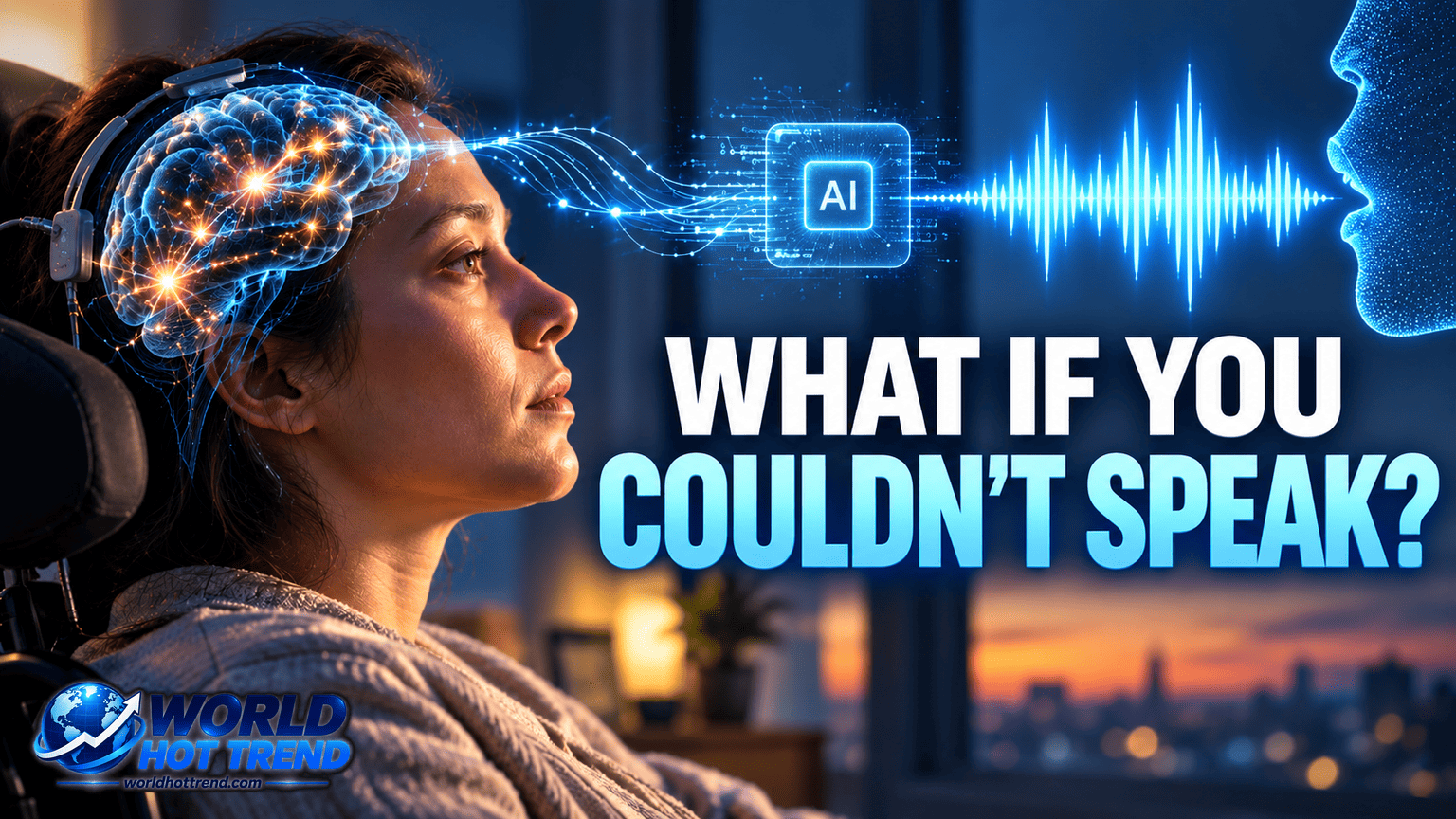
The human brain has long been a place no one else could enter. If a person could not speak, the thoughts inside often had no way out.
For people who lose speech to ALS or stroke, that barrier can be devastating. The thoughts remain. There are still things to say to family—pain, gratitude, love—but the body can no longer carry the words into the world.
AI and brain-computer interfaces are beginning to reopen that blocked pathway. A BCI (brain-computer interface) reads patterns of brain activity and converts them into outputs such as text, speech or computer commands. What began as an effort to restore communication is now moving deeper: researchers have started decoding not only attempted speech, but limited forms of speech produced silently inside the mind.
ALS Took Away a Father’s Voice
Casey Harrell has ALS and is a father. ALS (amyotrophic lateral sclerosis) is a progressive neurological disease that damages the nerve cells controlling voluntary muscles, eventually affecting movement, speech and breathing.
As Casey’s disease progressed, his speech became increasingly difficult to understand. Eventually, other people had to help interpret him. Casey described the loss of communication as feeling “like you are trapped.” The thoughts were still there; the route for expressing them was disappearing.
In July 2023, researchers implanted four microelectrode arrays, containing 256 cortical electrodes in total, in a brain region involved in coordinating speech. Even when Casey could not produce clear speech, attempting to speak still generated neural activity. The electrodes recorded those patterns, and AI translated them into words.
Brain signal → electrodes → AI decoding → text → voice
At the first training session, the system reached 99.6% word accuracy. With a vocabulary expanded to 125,000 words, accuracy initially reached 90.2% and later improved further with additional data.
Decoded words could also be spoken in a synthetic voice resembling Casey’s voice before ALS. When the words he was trying to say first appeared correctly on the screen, he cried with joy.
The technology did not give Casey new thoughts. It gave thoughts already inside him a path back into the world.
Ann Lost Her Voice at 30
Ann Johnson was a high school math teacher. In 2005, at age 30, a brainstem stroke left her severely paralyzed. At first, she could not even breathe independently.
She later described the experience simply: “Overnight, everything was taken from me.”
Her daughter was only 13 months old. After years of rehabilitation, Ann recovered some facial and neck movement, but not the muscle control required for speech. She communicated through an assistive device at roughly 14 words per minute.
There was another painful consequence. Ann’s daughter grew up without really knowing her mother’s original voice. The voice she knew was largely the computer-generated voice of an assistive device.
A Voice Returns After 18 Years
UCSF researchers placed a thin array of 253 electrodes over speech-related areas of Ann’s brain. This approach uses ECoG (electrocorticography), which records electrical activity directly from the surface of the brain.
When Ann attempted to speak, her brain still generated signals associated with movements of the lips, tongue, jaw and larynx. AI learned those patterns and transformed them into text, speech and a digital avatar. Text decoding reached a median rate of 78 words per minute, although errors remained.
Researchers also used a recording from Ann’s wedding speech to create a synthetic voice resembling the one she had before the stroke. Hearing it was, in her words, “like hearing an old friend.”
AI and neuroscience were not simply restoring sound. They were restoring part of the way a person exists in a family as herself.
AI Is Moving Toward the Words Inside the Mind
Casey and Ann’s systems primarily decoded signals produced when they intentionally attempted to speak. Stanford researchers have now moved one step further inward.
Inner speech is the silent language we produce in our minds without speaking aloud. In a study involving four people with severe speech impairment from ALS or stroke, researchers compared attempted speech with words spoken only internally.
The study found that inner speech could be decoded in all four participants. Attempted speech produced stronger signals, and accuracy varied substantially, so this is far from unrestricted mind reading. But language that was never spoken aloud was leaving neural patterns that a computer could distinguish.
If AI Can Read It, It Must Also Know When Not to Read
The Stanford research also raised a boundary that medicine cannot ignore. Some inner speech that participants had not intentionally meant to communicate could appear in neural signals.
Reading the words a patient wants to tell a family member is fundamentally different from exposing words the person intended to keep private.
Researchers therefore tested safeguards, including a “brain password” keyword to unlock inner-speech decoding.
As the technology improves, the challenge is not only how much of the brain we can decode. We also need technology that protects thoughts that should remain unread.
Researchers Are Also Trying to Decode the Brain Without Surgery
The most accurate speech BCIs currently carry a major burden: surgery. Systems that place electrodes in or directly on the brain are called invasive BCIs. Noninvasive approaches measure brain activity from outside the skull.
In the 2026 Brain2Qwerty study, researchers recorded brain activity from 35 healthy adults using EEG and MEG. EEG (electroencephalography) measures electrical activity from the scalp, while MEG (magnetoencephalography) measures tiny magnetic fields generated by brain activity.
Participants memorized sentences and typed them without visual feedback while their brain activity was recorded. With MEG, the average character error rate was about 29%, falling to 18% in the best-performing participants. EEG was much less accurate, with an average error rate of about 65%.
This was not AI reading whatever someone happened to be thinking. It decoded brain activity generated during a structured typing and language task. Noninvasive methods avoid brain surgery, but signal quality and accuracy remain major obstacles.
Sometimes the Body Does Not Respond, but the Brain Does
Brain decoding research also points toward a very different group of patients: people with severe brain injuries who show no observable response to commands.
In a large 2024 international study, 60 of 241 patients showed command-following brain activity on task-based EEG or fMRI. fMRI (functional magnetic resonance imaging) tracks changes in blood flow associated with brain activity.
That finding must not be simplified into “one in four unresponsive patients is conscious.” The patient population and testing methods varied, EEG and fMRI did not always agree, and the tests themselves can miss responses.
In fact, among 112 patients who could respond to commands behaviorally, only 43—38%—showed command-following responses on EEG or fMRI. A negative scan therefore cannot prove the absence of consciousness.
The careful conclusion is narrower but still remarkable: some people with severe brain injury who cannot respond through their bodies show brain activity consistent with following commands. Science cannot yet freely extract their memories, emotions or unspoken final messages.
AI Still Cannot Read the Whole Human Mind
Today’s AI cannot pull hidden memories out of a person’s brain at will. It cannot freely turn emotions and desires into sentences. It cannot remotely read the thoughts of strangers walking down the street. Nor can it freely read the memories and feelings of patients in coma or other severe disorders of consciousness.
The frontier today is more specific: decoding parts of neural activity related to language and intended action under controlled conditions.
But something important has changed. Unspoken language leaves measurable traces in the brain, and AI has begun to decode some of them. In some patients whose bodies cannot respond, researchers can also detect brain activity consistent with intentional command following.
Science is beginning to find pathways through barriers that once seemed absolute.
FAQ
Can a BCI read everything a person is thinking?
No. Current BCIs decode particular patterns of brain activity under specific conditions, especially signals related to attempted speech or intended movement. They cannot freely read every memory, emotion or thought in a person’s mind.
Can AI decode brain activity without implanted electrodes?
Yes, researchers are developing noninvasive approaches using technologies such as EEG and MEG. They avoid brain surgery, but today their signals are generally weaker and their accuracy is more limited than the leading implanted systems.
Can someone who cannot speak at all communicate through AI?
For some people with ALS, paralysis or stroke, experimental BCIs have already demonstrated that attempted speech can be converted into text or synthetic voice. These systems remain investigational and are not yet a routine treatment available to every patient.
Does a brain response in an unresponsive patient prove consciousness?
No. Command-following brain activity is important evidence of cognitive processing, but the tests have limitations and do not reveal a person’s entire subjective experience. A negative result also cannot prove that consciousness is absent.
What We Should Hope This Technology Becomes
There is still a long way to go.
Invasive BCIs require surgery. Noninvasive systems still face major limits in signal quality and accuracy. Detecting a particular brain response must never be exaggerated into a claim that we can completely read a person’s thoughts or feelings.
And as these systems become more powerful, mental privacy and human choice will become even more important.
Even so, I hope this technology does not stop here.
If an accident or disease someday takes away my ability to speak, while the words I want to say are still clear inside my mind, I hope AI can find those signals and become my voice.
And if someone I love reaches the final moments of life unable to speak, I hope medical AI will someday become advanced enough to help—if a real, intentional message is still there to be communicated.
It might be only one sentence.
It might be “I love you.” It might be “Thank you.” It might be an apology that was never spoken.
If AI could one day carry that final message back to a family, a few words might mean more to the people left behind than almost any other technological achievement.
I do not hope for a future in which AI can read every human thought.
I hope for AI that does not expose thoughts we want to keep private, but can give a voice to the thoughts of people who desperately want to speak and cannot.
I hope medical AI can advance that far.
The real measure of this technology will not be how deeply it can look inside the human brain, but what it can give back to a human being.
That is where the true value of AI that can read the brain will ultimately be decided.